
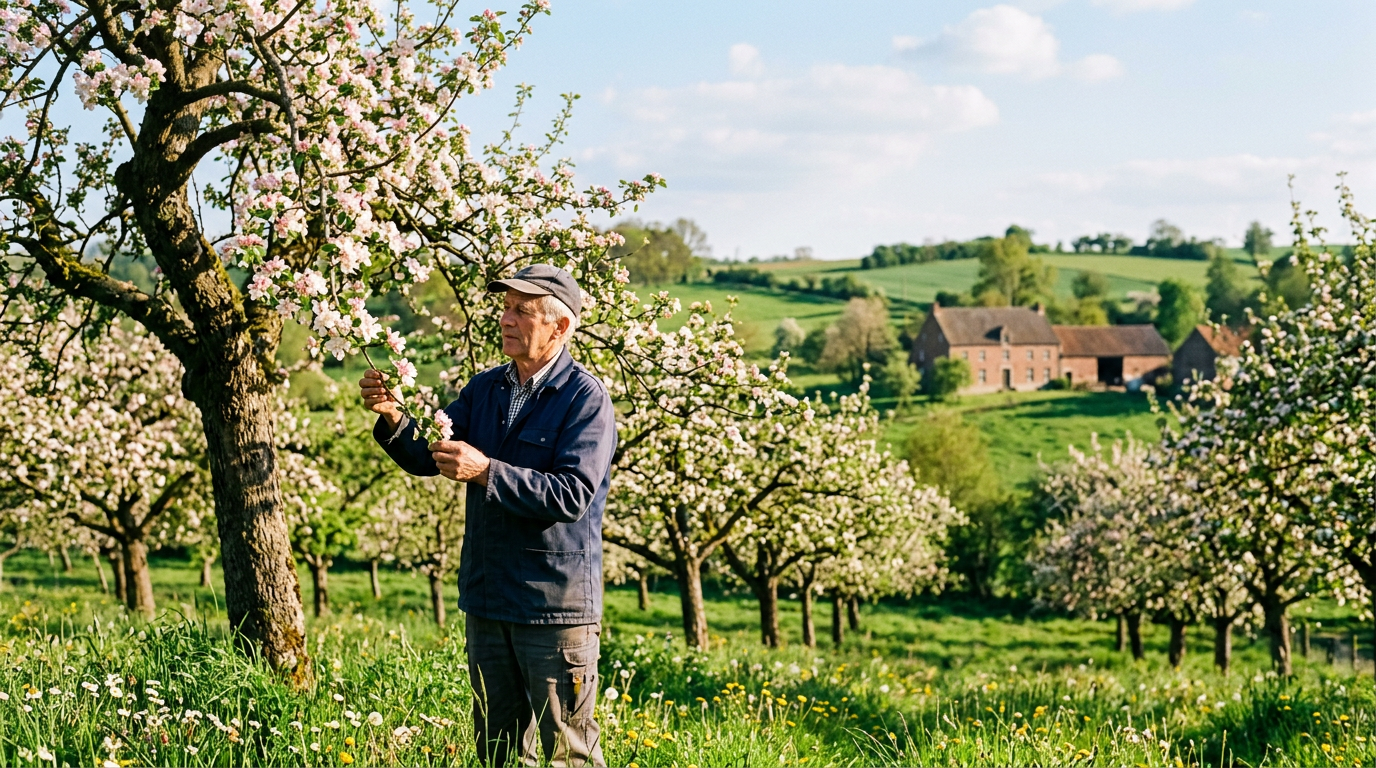

The project, officially launched on 17 July 2026 in Oudenaarde, aims to identify, preserve and replant old varieties of apples, pears and cherries from the Flemish Ardennes. Residents are invited to report old trees in their gardens, while experts will identify the varieties and collect cuttings to secure their future. Some of the grafts will be planted against the abbey wall of Ename, where they will form a “living genetic bank”.
Cristin Tomeci (Staff: Belgium / Heritage & Environment)
The Flemish Ardennes, the hilly region of Flanders, was once famous for its rich fruit growing. From the 19th century until around 1950, traditional tall orchards with old varieties of apples, pears and cherries were a common feature of the landscape. Today, these monumental trees are disappearing rapidly, and with them an important part of the region’s identity is being lost. To counter this decline, the Province of East Flanders, together with several partners, launched the project “Fruitig erfgoed in de Vlaamse Ardennen” (“Fruit Heritage in the Flemish Ardennes”).
A loss for the region’s identity
“It is a major loss for the regional identity of the Flemish Ardennes Landscape Park,” said Daan Declercq of the Heritage Service of the Province of East Flanders. The old varieties are not only reminders of the past, but also valuable genetic resources that have adapted over generations to the local soil and climate.
How is the project carried out?
The project runs for two years and consists of several stages:
- Inventory: Over two winters, experts will search for old fruit trees by studying historical maps and carrying out fieldwork.
- Citizen involvement: Residents throughout the Flemish Ardennes are encouraged to report old trees or traditional orchards they know. “In many gardens, orchards and heritage landscapes, old fruit trees still exist whose variety is no longer known. These trees may be valuable forgotten varieties at risk of disappearing,” explained David Coppens, provincial executive responsible for Heritage.
- Identification of varieties: Specialists will analyse the fruit to determine the exact variety. Residents are asked to collect 5–7 healthy fruits, photograph them from several angles next to a ruler, and send the images and information to annelies.schepens@rlvad.be.
- Collection of cuttings: If a tree proves to be a special or rare variety, a specialist will come in December or January to collect twigs for grafting.
The living genetic bank of Ename
Some of the collected cuttings will be grafted and planted against the abbey wall of Ename, part of the provincial Heritage Site Ename in Oudenaarde. Here, the trees will be cultivated as “leifruit” – fruit trees trained in decorative forms against a wall. The wall will function as a living genetic bank designed to protect and preserve rediscovered varieties.
The remaining cuttings will be planted in towns and municipalities throughout the Flemish Ardennes as traditional tall fruit trees. They will contribute to restoring old orchards or replacing diseased or dying trees.
Fruit tourism and themed routes
The project is not limited to heritage conservation. The leifruit wall at Ename will also become a starting point for tourist excursions. Each variety will have an information panel with details about its municipality of origin, the variety itself and its importance to the region. QR codes will allow visitors to discover hiking and cycling routes passing orchards and characteristic landscapes.
A chance for the region
“The Flemish Ardennes are less well known for fruit growing than, for example, Haspengouw. Thanks to the project, this special part of the past will regain attention and boost blossom and fruit tourism in the region,” the official statement said. Project partners include the Province of East Flanders, Toerisme Vlaanderen, Landscape Park Flemish Ardennes, Regional Landscape Flemish Ardennes tot Dender and Pomko.
Conclusion
“Fruitig erfgoed in de Vlaamse Ardennen” is more than a heritage conservation project. It is an investment in the future of a region, an effort to save tree varieties that could disappear forever and an opportunity to bring tourism to an area with great potential. The involvement of residents is essential: every old tree reported can become part of a story worth preserving and passing on.




Leave a Reply