
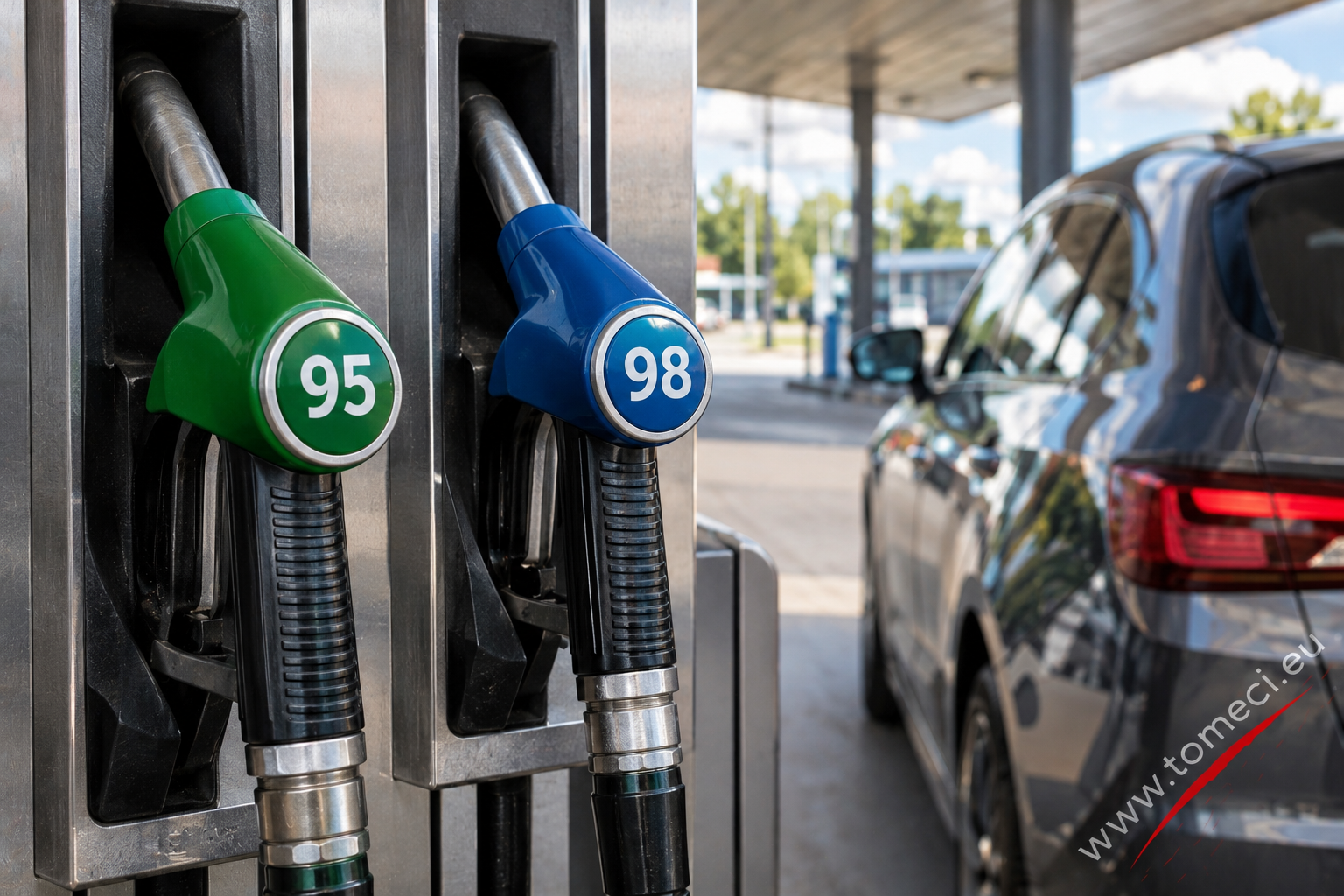

The difference is not limited to the pump price. The octane number, ethanol content and manufacturer’s recommendations can influence the behavior and operation of the engine.
(Editorial team: The Weekend Magazine)
It’s one of the drivers’ frequently asked questions: is it worth paying more for the Euro 98 gasoline or Euro 95 is enough? The answer depends on the engine, its technology and, above all, the manufacturer’s specifications.
To understand the difference, we need to separate two information that appears on the gas station pumps: the RON octane number and the ethanol percentage, indicated by the E5 or E10 markings.
What does RON 95 and RON 98 mean?
Ron is short for Research Octane Number. The figure indicates the resistance of gasoline to uncontrolled auto-ignition under the operating conditions of the engine, a phenomenon known as detonation or “engine knock”.
The higher the octane number, the better the fuel withstands pressures and temperatures that can cause uncontrolled combustion.
A frequent confusion arises here: the RON 98 does not mean that the gasoline automatically has more energy or that it burns more intensely in any situation. The octane number measures the detonation resistance, not the energy value of the fuel.
Why do some engines need Euro 98?
High compression ratio engines, turbochargers or other performance-oriented construction solutions may require fuel with a higher octane number.
If the manufacturer requests RON 98, the use of gasoline RON 95 may favor detonation. Modern motors often have sensors that detect this phenomenon and allow the computer to alter the ignition advance to protect the engine. However, this intervention can reduce power and efficiency.
On the other hand, if the engine is designed for the RON 95, the RON 98 fuel does not automatically guarantee more horsepower, lower consumption or longer service life. The benefit depends on the design of the engine and the ability of the electronic system to capitalize on the additional octane number.
E5 and E10: Another important difference
In Belgium and the rest of Europe, gasoline is also identified by the E5 and E10 markings:
These labels indicate the maximum ethanol content, while RON 95 or RON 98 indicates the octane rating: they are two separate characteristics. In Belgium, combinations include RON 95 E10, RON 95 E5, RON 98 E5 and RON 98 E10.
- E5 It can contain a maximum of 5% ethanol by volume.
- E10 It can contain a maximum of 10% ethanol by volume.
Ethanol has an energy value per liter lower than conventional gasoline. For this reason, E10 can lead to slightly higher consumption than a comparable fuel with a lower ethanol content.
Ethanol also has hygroscopic properties, that is, it can absorb water. This aspect, along with the compatibility of the materials in the fuel system, is especially important for some old cars, carburetor motorcycles and vehicles kept for long periods without use.
However, it should not be assumed that any E5 gasoline contains no ethanol at all. The E5 marking allows a content of up to 5%, does not guarantee its absence.
Does Euro 98 automatically mean better fuel?
Not necessarily. Some premium variants marketed by companies like Shell or BP may include additional packages of additives to clean and protect the fuel system. However, these characteristics depend on the product and the formula of each distributor, not just the octane number.
Therefore, two RON 98 petrol from different companies should not be automatically considered identical, but it cannot be said that any RON 98 is superior to any RON 95 gas in all respects.
What should you choose at the pump?
The safest rule is to follow the directions in the car manual or on the inside of the tank cover.
If the engine is designed for the RON 95 and supports E10, the Euro 95 E10 fuel is normally sufficient. If the manufacturer recommends or imposes RON 98, this requirement must be respected.
For older cars, it is important to check compatibility with E10. In Belgium, authorities recommend the use of gasoline with a higher octane and low ethanol content for certain older engines that are not compatible with E10.
Conclusion: The Euro 98 is not automatically the better choice for any car, and the Euro 95 is not automatically a smart economy for any engine. The right fuel is the one that meets the technical requirements of the car and the compatibility of its fuel system.
The Weekend Magazine – A Tomeci Press Publication




Leave a Reply