
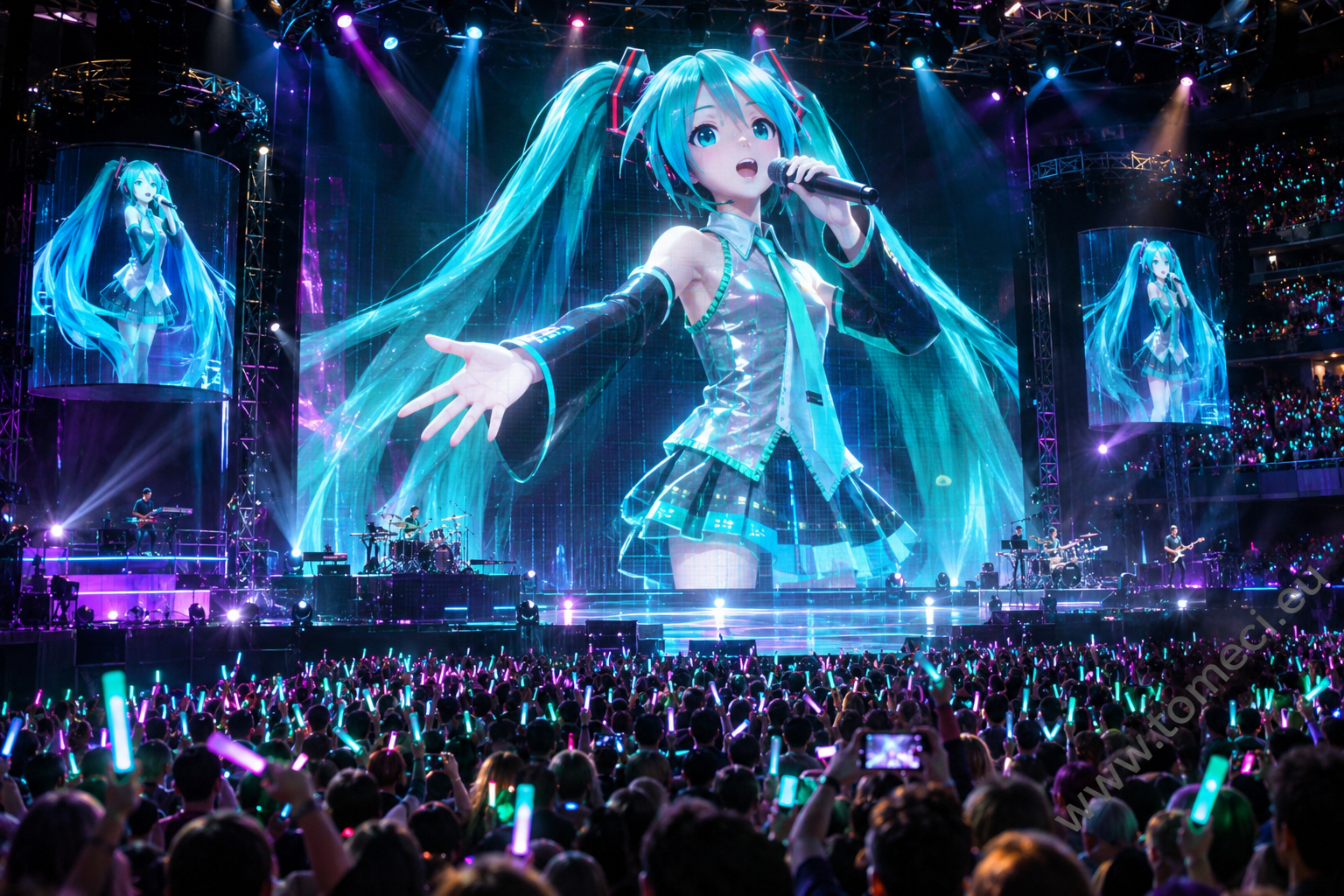

He is not human, does not breathe, does not age and composes alone. However, it has concerts, costumes, choreographies, millions of admirers and a repertoire created by a huge community of musicians. And on Saturday evening, November 14, he took the ING Arena stage in Brussels.
(Staff: The Weekend Magazine)
Imagine an arena full of thousands of people. Colorful lights, real musicians on stage, spectators who sing, dance and pick up bright sticks in the air. The audience is waiting for the star of the evening to appear. When she enters the spotlight, the hall bursts into applause.
The star has turquoise hair, two long tails, an electronic voice and an anime character look. She is not an actress, she is not a singer in the flesh, nor a humanoid robot. It’s a digital projection.
Her name is Hatsune Miku. .
On November 14, 2026, this virtual singer arrived at the ING Arena in Brussels, as part of the 2026 Miku Expo European tour. The concert once again demonstrated that, in the world of contemporary music, the physical presence of the artist does not There is also a mandatory condition to create an authentic show experience.
It all started in Japan in 2007
Hatsune Miku was not originally invented to become a pop star. Originally, it was a software product for music creators.
On August 31, 2007, the Japanese company Crypton Future Media, based in Sapporo, launched a program based on Vocaloid 2 technology, developed by Yamaha.
The idea was revolutionary for that period: the user entered the lyrics and the melody, and the computer generated a sung voice. It was no longer necessary to have a vocalist in a studio to turn a composition into a song.
But the developers did something extra. They created a character to represent this voice: a virtual teenager with long, turquoise hair, two characteristic tails and an easily recognizable visual identity.
Her name, Hatsune Miku, can be roughly translated as “the first sound of the future”.
The character is, in the official profile, 16 years old, 158 centimeters tall and an artistic identity inspired by Japanese pop culture.
Her voice was not completely invented by the computer. The vocal base was made from recordings provided by Japanese actress and vocal artist Saki Fujita, which were then transformed and controlled by software.
So, behind a voice that seems artificial there is also the contribution of a real human voice.
The Extraordinary Secret: The audience writes his music
This is where the really fascinating part of the story begins.
In the traditional music industry, the artist usually has composers, lyricists, producers, instrumentalists, and a record label that coordinates releases.
In the case of Hatsune Miku, the mechanism is different.
The software was made available to the creators, and they started composing songs using her voice. They published the songs on the Internet, made videos, drew illustrations and created choreographies.
A fan could compose a song. Another could create the video. Another could achieve the animation of the character. Someone else could build a remixed version or invent a new story for the song.
In this way, Hatsune Miku became the center of an international community of creators.
According to the official Crypton Future Media presentation, his voice was used in over 100,000 songs published around the world. The number does not represent a catalog of songs composed by the company, but a music production to which independent creators from many countries have contributed.
The total number of creations and variants distributed on different platforms may be higher, but the official figure published by the company is more than 100,000 songs.
Think of this idea: a star who doesn’t compose, write lyrics and sing spontaneously, but has a huge repertoire created by people who don’t even work together in the same country.
An artist who belongs to the community
Hatsune Miku has long passed the status of a simple computer program.
She became a cultural character, and her community developed a whole world around her. There are video games, figurine collections, costumes, illustrations, videos, composition contests and international events.
One of the reasons for success is that admirers are not just music consumers. They can become active participants in building the artistic universe.
The audience usually receives the final product from the artist. In Miku’s case, the public can even contribute to the realization of the product.
This collaborative culture has also generated careers for some of the creators who started composing using her voice. Some producers have become important names in Japanese and international music.
It’s an interesting change: the virtual character is not only a destination for the talent of the fans, but also a platform through which they can discover their own abilities.
How can he perform a concert if there is no physical?
Hatsune Miku’s shows are much more complex than simply projecting a video on a screen.
The three-dimensional image of the character is integrated into the show through a stage projection system. Depending on the technology used, the effect can create the impression that the artist is actually on stage, in front of the spectators.
That is why Miku is frequently described as a hologram, although technically speaking, his performances do not necessarily use holography in the strict scientific sense. It is about three-dimensional projection and display techniques that create the illusion of the presence of a virtual character.
There are also real musicians on stage, who interpret the instruments in sync with the synthesized voice and animation of the character.
Movements, choreography, lights and moments of interaction with the audience are ready for each show.
And the reaction of the spectators is as real as possible: applause, enthusiasm, songs hummed together and thousands of lights raised in the air.
There is no need for the artist to be biologically present for the emotion of the public to exist.
From Japan to the Great Scenes of the World
The phenomenon has grown so much that Hatsune Miku has come to support international tours and appear on important stages in America, Asia and Europe.
The Miku Expo tour started in 2014 and became one of the main events through which its artistic universe is presented to the international public.
In 2026, the European tour included several major cities including London, Brussels, Amsterdam, Berlin, Paris, Madrid and Lisbon.
In Brussels, the show took place at ING Arena, on November 14, starting at 8:00 p.m. The organizers presented the event as part of a European series combining Japanese electronic music, animation and creative culture.
Approximately 5,000 viewers were mentioned in the information about the event, but this figure is not confirmed in an official participation balance sheet published by the organizers.
A question about the future of the music industry
The story of Hatsune Miku raises a much more important question than whether a virtual character can perform a concert.
Who is the artist?
Is the company that created the software? Is the actress whose voice became the raw material for the character? are the composers who write the songs? Are the animators and producers building the shows? Or is the whole community?
Perhaps the answer is that Hatsune Miku is not an artist in the traditional sense, but a collective artistic project, in which technology provides the instrument, and people permanently give it a musical identity.
In an era where artificial intelligence can generate voices, images and videos, the Miku experience is particularly interesting. It shows that technology does not necessarily have to replace the human creator. It can also become a tool through which thousands of people unite their talent.
Hatsune Miku has no childhood, no memories and cannot tell about the emotions of a tour. But each song written for her carries the imagination, sensitivity and creativity of a real person.
Perhaps this is the secret of his success: There is not a single person behind the artist, but a whole community that makes her exist.
And on Saturday evening, in Brussels, thousands of people came to applaud not only a hologram, but also the result of a new form of collective creation.
The Weekend Magazine – A Tomeci Press Publication




Leave a Reply