
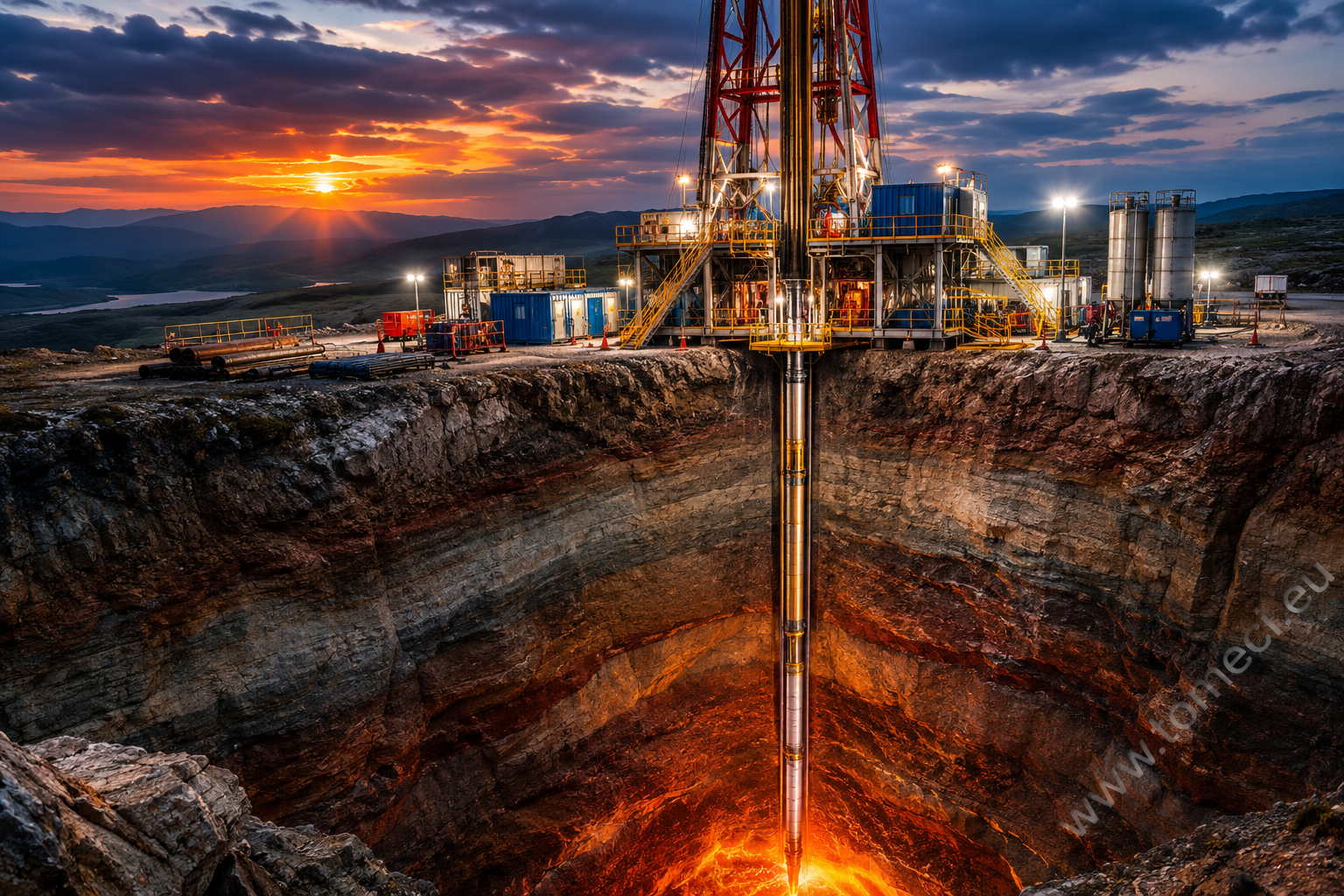

Humans have managed to drill more than 12 kilometers into the depths of the planet, but the mantle and core remain inaccessible to direct exploration. Why is it so hard to get further?
(Staff: The Weekend Magazine)
The idea of drilling a tunnel beyond the Earth’s crust seems straight out of a science fiction movie. But the question is as serious as possible: if we had machinery powerful enough, could we cross the Earth’s crust? And what would happen if we ended up in the mantle of the planet?
The answer is that we currently do not have the necessary technology. Obstacles are not only represented by temperature, but also by pressure, rock behavior, equipment strength and huge costs.
How thick is the Earth’s crust?
The earth has three major structural components: the Earth’s crust, the mantle and the nucleus.
The bark is the relatively thin outer layer of the planet. Below the oceans can be about 5–10 kilometers, while the continental crust is, on average, about 30–40 kilometers. Under the great mountain ranges can be considerably thicker.
Under the Earth’s crust is the mantle, which stretches to about 2,900 kilometers deep. Below is the core, consisting mainly of iron and nickel.
An important detail: the mantle is not a huge ocean of lava. Most of it consists of solid rocks, which, at very high temperatures and pressures, can deform and move extremely slowly, over geological periods.
World Record: Kola Drilling
The most impressive experiment of this kind was carried out in the Soviet Union. In 1970, researchers began drilling a scientific well in the Kola Peninsula in northwestern Russia.
The project, known as the Kola Superdeep Borehole, aimed to reach a depth of 15 kilometers and provide direct information about the structure of the Earth’s crust.
In 1989, the well reached a depth of 12,262 meters, the record for the deepest vertical drilling achieved by humans.
But the researchers encountered much more difficult conditions than they had anticipated. At the base of the drilling, the temperature reached about 212°C, and the rocks began to behave differently from what is observed on the surface. Under high pressure and temperature, the rocks began to behave in a ductile manner and could gradually deform or close the drill hole.

The project failed to touch the mantle. The works were abandoned in 1992, in the context of technical and financial difficulties.
What would happen if we continued to drill?
As we descend into the Earth’s crust, there are more major problems:
- Temperature: It grows with depth, but not at an identical rate in all regions of the planet. In some areas, the values become incompatible with the operation of conventional equipment.
- Pressure: The rocks exert enormous pressure on the walls of the borehole, which can begin to deform and close.
- Equipment: Drills, pipes, sensors and electronic systems must simultaneously withstand extreme temperatures and pressures.
- Material evacuation: Rock fragments must be transported to the surface through a drilling fluid circulation system, an increasingly difficult operation at great depths.
In addition, the drilling fluid, essential for cooling the drill and transporting the rock fragments, can become unstable in extreme conditions. A loss of pressure control can cause an uncontrolled eruption of fluids and gases, known in the drilling industry as Blowout. .
Would we meet lava if we crossed the Earth’s crust?
Not necessarily. This is one of the most widespread misconceptions about the interior of the Earth.
At the border between the Earth’s crust and the mantle, called the discontinuity Mohorovičić or Moho, there is no sea of lava. There is a change in the type of rocks and their physical properties.
The mantle is predominantly solid. Magma occurs only in certain conditions and regions, when part of the rock melts. Volcanoes represent natural ways through which the molten material can reach the surface, but it does not prove that the entire interior of the planet is liquid.
Why doesn’t the Earth cool down? Is there a nuclear reactor inside?

Another interesting question raised in the original discussion concerns the very high temperature of the core. If the Earth is constantly losing heat, why is its interior still so hot after about 4.5 billion years?
The explanation is not the existence of an artificial nuclear reactor or a controlled nuclear fission process.
Internal heat comes mainly from two sources: the energy left over from the formation of the planet and the energy produced by the natural disintegration of some radioactive elements, especially uranium, thorium and potassium.
In addition, the gradual solidification of the inner nucleus releases thermal energy and contributes to the dynamics of the liquid outer core, which participates in the generation of the terrestrial magnetic field.
The earth is cooling, indeed, but very slowly. There is no need for a mechanism to keep its temperature constant: the natural processes inside continue to produce and redistribute energy.
Future: Can we drill with lasers?
Alternative technologies have been proposed, including the use of very high energy bundles for melting or vaporizing rocks. The idea is interesting, but its transformation into an industrial system capable of achieving an ultra-deep drilling remains a technological challenge.
Even if we could destroy the rock by such a method, we should further solve the evacuation of the material, the stability of the walls, the pressure control and the strength of the equipment.
So, the problem is not just how to pierce the rock, but how to keep an open and functional tunnel at such depths.
A planet we still haven’t been able to explore in depth
The deepest vertical drilling by humans represents only a small part of the thickness of the continental crust and about 0.2% of the distance to the center of the Earth.
We sent space probes billions of miles away, explored the surface of the Moon and photographed distant planets. However, we have not yet been able to cross the crust of our own planet.
Perhaps one of the greatest frontiers of human exploration is not in space, but just under our feet.
The Weekend Magazine – A Tomeci Press Publication
Scientific sources: US Geological Survey for the internal structure of the Earth and heat sources; the research published in Communications Earth & Environment in 2026 for updated data on Kola drilling; European Geosciences Union for the technical difficulties of ultra-deep drilling




Leave a Reply