
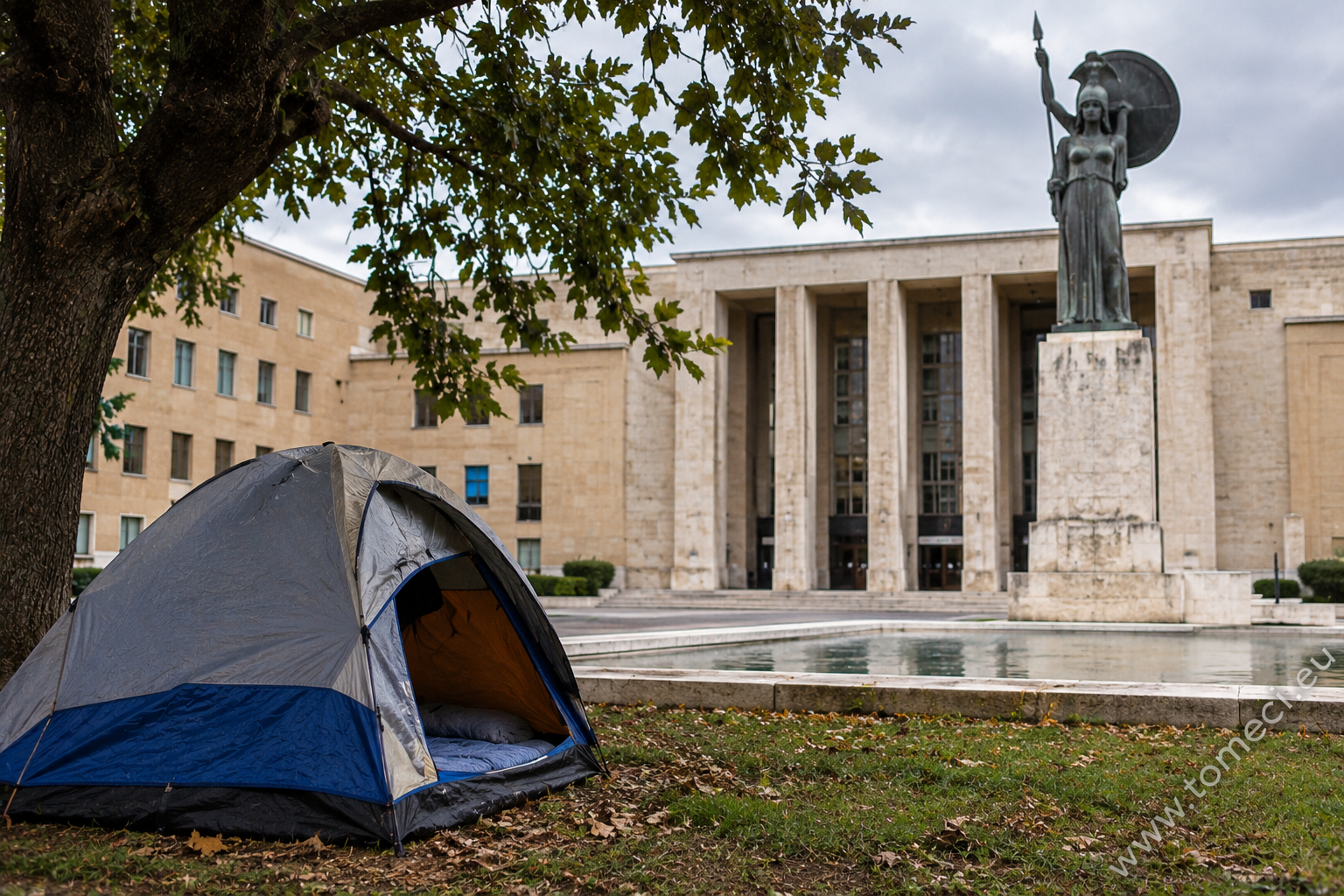
The Italian-Dutch student was studying physics at Sapienza University and living in a tent while trying to find accommodation. He had gone on hunger strike to draw attention to his situation. The cause of death is still under investigation.

A tragic case has sparked strong reactions in Rome. Alessandro Ingusci, aged 58 and a first-year student at the Faculty of Physics at Sapienza University, was found dead on Monday, 23 November 2026, in the tent where he was living on the university grounds.
The man held both Italian and Dutch citizenship and had lived in the Netherlands for several years. He had returned to Italy to fulfil his wish to study physics, but had found himself in an extremely vulnerable situation without stable accommodation.
He lived in a tent beside the statue of Minerva
According to Italian media reports, Ingusci had been living in a tent on the university campus since October, near the statue of Minerva.
His financial difficulties and lack of accommodation prevented him from continuing his studies under normal conditions. After returning to Italy, he had at one point slept on benches and on the streets while trying to find a temporary solution.
His medical situation was also complicated. He had heart problems and had previously suffered a heart attack, following which three stents were fitted.
Hunger strike to obtain a place in student accommodation
The student organisation Cambiare Rotta said that Alessandro Ingusci had gone on hunger strike to protest the difficulties in obtaining a place in university accommodation.
According to the Italian publication *L’Indipendente*, he began the protest on 12 November and documented it on social media. After six days, he temporarily suspended it after being promised assistance with an accommodation application through the regional DiSCo Lazio programme.
Problems subsequently arose with the documents required for his application, including paperwork relating to his income and his situation in the Netherlands. Ingusci said that the process had not been completed properly and announced that he would resume the hunger strike on 23 November.
On the same day, he was found dead in his tent.
The university and student organisations present differing accounts
Sapienza University’s management said that the rectorate had been in repeated contact with the student and that medical services and local authorities had been involved. Rector Antonella Polimeni stated that the institution had offered him concrete accommodation and support options.
However, representatives of DiSCo Lazio said that Ingusci had not taken part in the usual procedure for allocating places in student residences. The university acknowledged that his application had not been completed.
According to *L’Indipendente*, the municipality’s social services had met him twice. He had reportedly declined certain temporary accommodation options because he was looking for a place where he could both live and study.
These explanations show that there had been contact and attempts to provide support, but they also raise questions about the effectiveness of administrative procedures when someone is in such a difficult situation.
The cause of death must be established through an investigation
The Rome Public Prosecutor’s Office ordered an autopsy to clarify the circumstances of the death. Initial checks found no obvious signs of violence.
So far, there is no official conclusion proving that the hunger strike caused the student’s death. His heart condition and the other medical circumstances must be examined by specialists.
Alessandro Ingusci’s death has brought renewed attention to the student housing crisis in Italy, the administrative difficulties faced by people with income or documents from abroad, and the ability of institutions to intervene before a social crisis becomes a tragedy.
A man returned to his country to pursue his dream of studying, but ended up living in a tent on university grounds. His death demands clear answers, both about the medical circumstances and about the support the institutions did—or did not—manage to provide.




Leave a Reply