
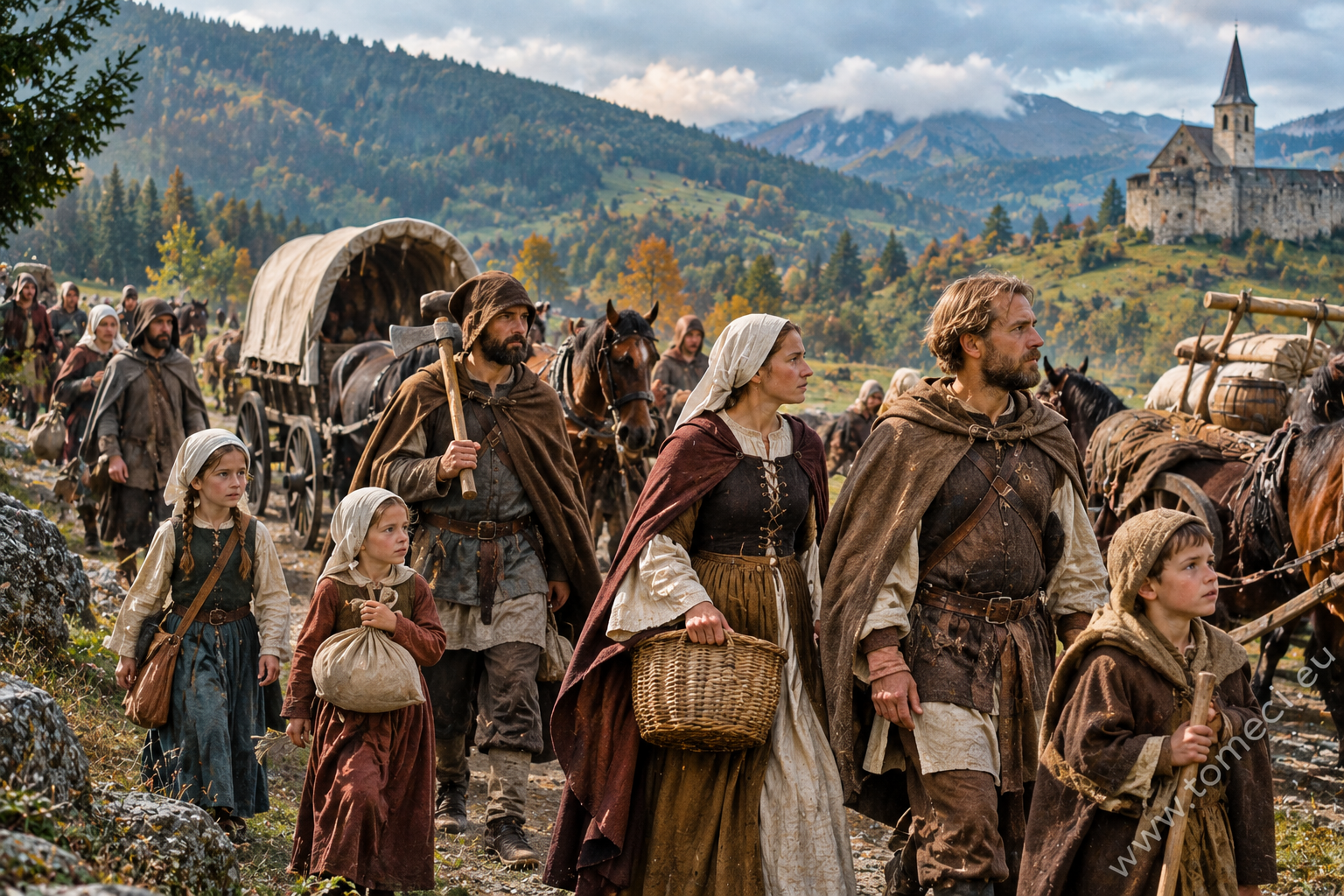
Present in Transylvania for almost eight centuries and originating from various parts of Europe, this community made a decisive contribution to the region’s history, architecture and economic development.

The Transylvanian Saxons are among the most important historical communities of the region. They lived here for almost 800 years, founded settlements, developed crafts and trade, and left behind an impressive architectural heritage. But there is an interesting historical question: why are they called “Saxons” if their ancestors did not come mainly from Saxony, in present-day Germany?
King Géza II’s invitation
The settlement of German-speaking colonists in Transylvania began in the 12th century. Around 1150, King Géza II of Hungary (1141–1162) encouraged groups of settlers from Central and Western Europe to arrive.
They received land and privileges. Their settlement had two important objectives: developing the territory’s economy and strengthening the defence of the southeastern border of the Kingdom of Hungary.
The newcomers settled mainly in southern Transylvania, in the Sibiu area, and later expanded their communities to other parts of the region.
Where did they actually come from?
The name “Saxons” may give the impression that all these settlers came from Saxony. The historical reality is more complex.
Research points to diverse origins. Most settlers came from the Rhine and Moselle regions, while others came from areas such as Flanders, Lorraine, Luxembourg and other German-speaking territories.
This migration was not a single event organized at one specific moment. It took place in several waves, and the community gradually took shape in Transylvania.
The name “Saxons”, therefore, is not proof that these people came exclusively from Saxony.
Where does the name come from?
The Latin term “Saxones” appears in documents of the Hungarian royal chancery in the Middle Ages. It was used as a collective designation for the German-speaking settlers in Transylvania.
In the medieval context, the term also had a legal and administrative meaning, as it was associated with the status and privileges granted to certain categories of settlers. Over time, the designation became the established name of the community.
An essential document in their history is the Andreanum Diploma, issued in 1224 by King Andrew II. It confirmed and regulated the rights and privileges of the Saxon communities in the Sibiu area.
A legacy that remains in Transylvania
Over the centuries, the Saxons developed prosperous towns and villages, built fortified churches and contributed to the economic and cultural life of Transylvania.
Sighișoara, Sibiu, Biertan, Viscri and many other localities preserve traces of this history. The fortified churches and the distinctive architecture of Saxon villages are now part of Europe’s cultural heritage.
The community experienced major political and historical changes. Mass emigration in the 20th century considerably reduced the number of Saxons still living in Transylvania.
Their story nevertheless remains an important part of Romania’s history: that of a community with diverse European roots, formed in Transylvania and connected to this territory for almost eight centuries.



Leave a Reply