
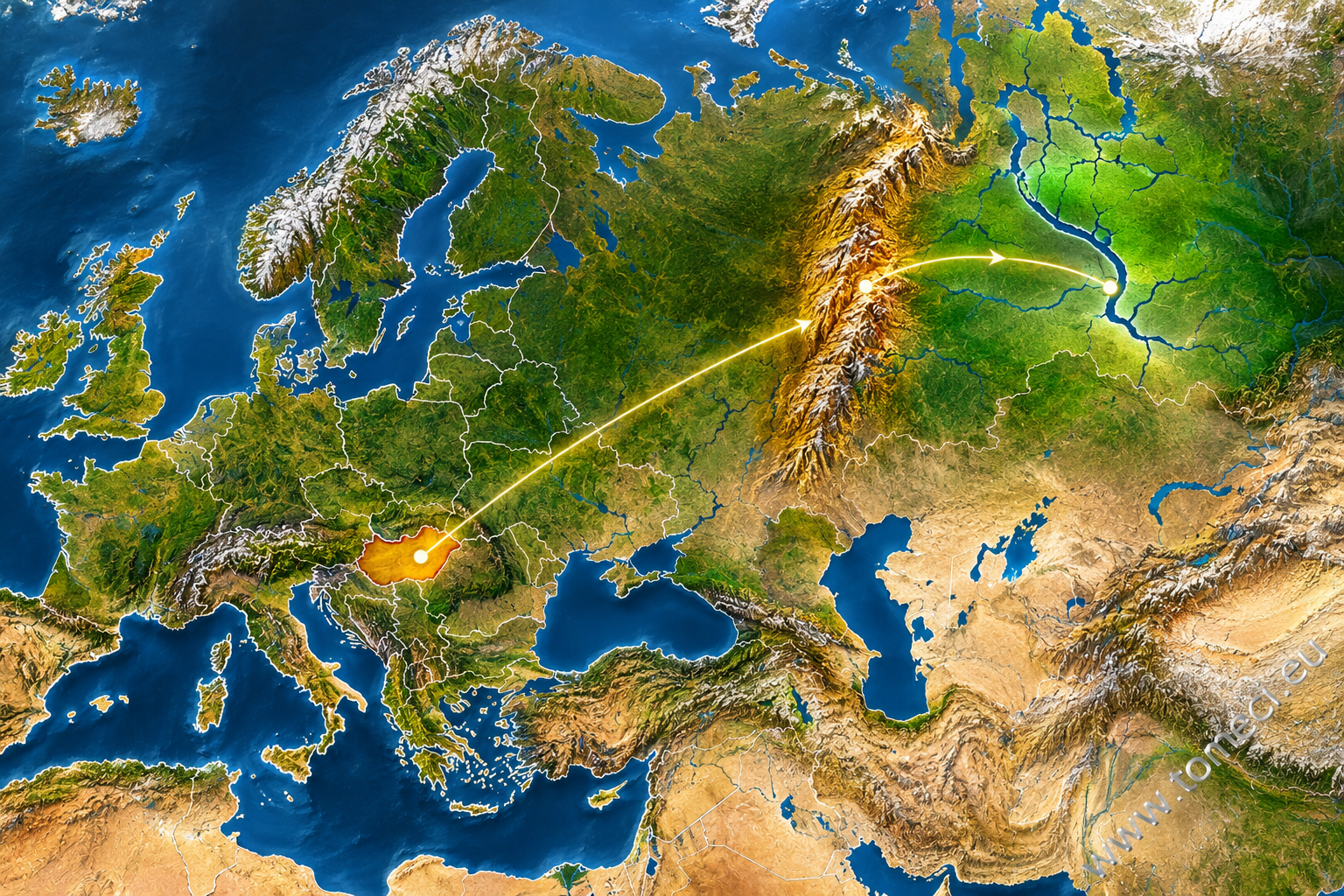
Why is the language spoken in Hungary so different from the languages of its neighbours, and what historical ties connect it with populations near the Ural Mountains and the River Ob?

In the heart of Europe, among countries where Slavic, Germanic and Romance languages predominate, Hungary preserves a remarkable linguistic feature. Hungarian belongs to none of these families; it is part of the Uralic language family. Its closest linguistic relatives are two languages spoken thousands of kilometres away in Western Siberia: Khanty and Mansi.
It is one of the most fascinating stories in European linguistic diversity. How did a language with such distant roots come to be spoken in the Carpathian Basin today?
A linguistic island in the heart of Europe
A glance at the map of Central Europe shows that Hungary is surrounded by countries whose main languages are Indo-European. Slovak, Ukrainian, Romanian, Serbian, Croatian, Slovenian and German belong to different branches of the great Indo-European family.
Hungarian is different. It belongs to the Uralic language family, which extends across a vast area from northern and eastern Europe to northern Asia.
This family includes Finnish, Estonian, the Sámi languages and several languages spoken in Russia, among others. Geographically, however, Hungarian is one of the most distant from the other Uralic language communities.
Today, approximately 13 million people speak Hungarian. Most live in Hungary, but there are also significant Hungarian-speaking communities in Romania, Slovakia, Serbia, Ukraine and other European countries.
Khanty and Mansi: the linguistic relatives in Siberia
In the traditional classification, Hungarian belongs to the Ugric branch of the Uralic family, alongside Khanty and Mansi.
These two languages are spoken in Western Siberia, in the region of the River Ob and its tributaries. The Khanty and Mansi communities live mainly in areas of the present-day Khanty-Mansi Autonomous Okrug in the Russian Federation.
The geographical distance between Hungary and these regions is considerable. Nevertheless, the linguistic links are significant enough for Hungarian, Khanty and Mansi to be studied together.
The exact relationship between these three languages is, however, still debated in modern linguistics. The traditional classification regards them as members of the same Ugric branch, but some researchers point out that certain similarities may also result from prolonged historical contact, rather than solely from a directly shared linguistic origin.
In other words, the relationship is real, but its history is more complex than a simple family tree might suggest.
Finnish and Estonian: other languages related to Hungarian
Many people know of the connection between Hungarian, Finnish and Estonian. All three belong to the Uralic family, but they are not closely related in the everyday sense of the term.
Finnish and Estonian belong to the Finnic (Baltic Finnic) branch, while Hungarian is assigned to the Ugric branch in the traditional classification.
Grammatical similarities and certain elements of vocabulary reflect a distant linguistic history. However, a Hungarian speaker cannot automatically understand Finnish or Estonian, just as a Romanian speaker cannot understand a related Romance language without learning it.
Over the centuries, each of these languages has developed its own vocabulary and structure, shaped by contact with other populations.
The Hungarians’ journey to the Carpathian Basin
The linguistic relationship leads us to another question: where did the ancestors of the Hungarian population come from?
Historical and linguistic research places the distant origins of the early Hungarian-speaking populations in northern Eurasia, near the Ural region and Western Siberia. Later, these groups gradually moved west and south, coming into contact with numerous peoples of the Eurasian steppes.
These contacts left important traces in the language. Over time, Hungarian adopted many words from Turkic, Iranian, Slavic and other languages with which its speakers came into contact.
Before settling in the Carpathian Basin, the Hungarian groups passed through various regions of the East European steppe. One area associated with this period is Etelköz, located broadly between the Dnieper, Dniester and Prut rivers, although its precise location and chronology remain subjects of research.
Around 895–896, the Hungarians began entering the Carpathian Basin in a historical process that unfolded in several stages. It was not a single, straightforward journey, but a process involving migration, military confrontations, alliances and the gradual establishment of communities.
By the beginning of the 10th century, their presence had become decisive for the history of the region. In the centuries that followed, the political structures that formed the basis of the Kingdom of Hungary took shape.
A word that travels through history: “horse”
One interesting detail presented in the video is the similarity between the Hungarian word ló, meaning “horse”, and certain forms found in the Mansi and Khanty languages.
In some varieties of Mansi, the form luw is found; in Khanty, forms such as law or loγ are documented. These correspondences are also recorded in the Uralonet etymological database, compiled by researchers specialising in Uralic languages.
An important qualification is needed, however: the exact origin of this group of words is not considered definitively established. Researchers have proposed different explanations, including the possibility that the words were borrowed from older languages with which the populations concerned came into contact.
The similarity is therefore real and interesting, but it should not be presented as simple proof of a certain common origin.
The importance of the horse in the history of the peoples of the Eurasian steppes, by contrast, is well known. Animal husbandry, mobility and contact between communities played an important role in the formation of societies that contributed to migrations towards Central Europe.
A language that tells the story of an older Europe
Hungarian shows that Europe’s history cannot be understood solely through today’s borders. Languages preserve traces of migrations, encounters and separations that took place long before modern states emerged.
Today, a resident of Budapest may speak a language with linguistic connections to populations in Western Siberia, while their neighbours speak languages belonging to entirely different families.
It is a remarkable example of how the history of peoples continues to live on in their vocabulary, grammar and cultural identity.
And perhaps the most interesting lesson is this: today’s geography does not always tell the whole story of a language. To discover its origins, we sometimes have to look far beyond the borders of the country where it is spoken today.




Leave a Reply