
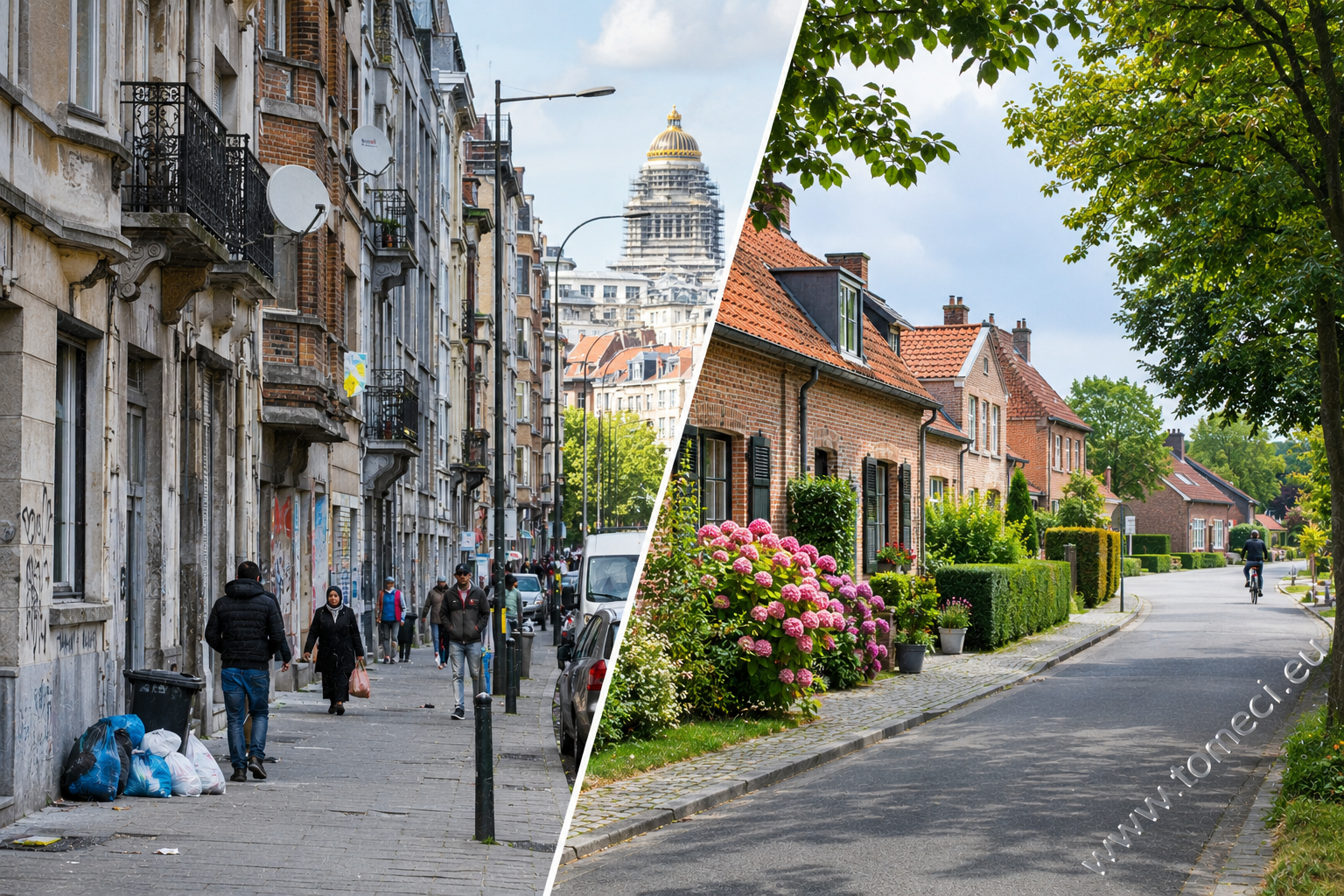
New Statbel data for 2024 reveal a marked contrast between the Brussels-Capital Region and Flanders. While the risk of poverty remains below 4% in some Flemish municipalities, it affects almost one in three residents of Saint-Josse-ten-Noode.

Statistics published by the Belgian statistical office, Statbel, for 2024 highlight a sharp social contrast between Belgian municipalities. All five municipalities with the highest risk of poverty are located in the Brussels-Capital Region. At the other end of the scale, the five municipalities with the lowest risk are all in the Flemish Region.
The figures show that economic differences between Belgian municipalities remain considerable, and that the capital continues to concentrate some of the country’s most challenging social conditions.
Saint-Josse-ten-Noode tops the poverty-risk ranking
The most vulnerable municipality is Saint-Josse-ten-Noode, where 32.8% of the population falls below the poverty-risk threshold. In practical terms, this affects almost one in three residents.
The next highest figures are:
- Molenbeek-Saint-Jean: 30.6%
- Anderlecht: 28%
- Koekelberg: 25.6%
- Schaerbeek: 25.3%
The fact that all five municipalities are in Brussels shows how strongly economic vulnerability is concentrated in certain parts of the capital.
These percentages do not mean that every person in these municipalities lives in severe poverty. They indicate the share of the population whose income is below the national threshold used to calculate the risk of poverty.
Flanders at the other end of the ranking
The picture is very different among the best-performing municipalities. The lowest poverty-risk rates were recorded in five Flemish municipalities:
- Zemst: 2.8%
- Holsbeek: 3.4%
- Rotselaar: 3.4%
- Begijnendijk: 3.4%
- Glabbeek: 3.5%
The gap between Zemst and Saint-Josse-ten-Noode is 30 percentage points. This is a substantial contrast between two municipalities in the same country, reflecting very different economic and social realities.
Income figures confirm the differences between municipalities
Median-income statistics add another dimension to the picture.
The municipality of Attert, in the Province of Luxembourg, remains at the top of the national ranking, with a median income of €45,790 in 2024.
Among the ten municipalities with the highest median incomes, six are in the Province of Luxembourg and four are in Flemish Brabant:
- Kraainem: €37,730
- Tervuren: €37,082
- Oud-Heverlee: €36,964
- Wezembeek-Oppem: €36,649
At the other end of the scale is Saint-Josse-ten-Noode again, with a median income of just €21,891. It is followed by Molenbeek-Saint-Jean at €22,220, Anderlecht at €22,931 and Koekelberg at €23,815.
Saint-Josse-ten-Noode therefore appears both among the municipalities with the lowest median incomes and among those with the highest risk of poverty.
The two indicators should be distinguished: median income describes the income level within a population, while the risk of poverty measures the share of people whose income falls below a specified national threshold.
A problem that goes beyond the figures
Behind these percentages are complex social realities: insufficient income, difficulties accessing housing, economic instability and significant differences between communities.
The statistics presented do not, on their own, explain the causes of these disparities. Nor do they show that every neighbourhood within a municipality faces the same circumstances. They do, however, send a clear message to public authorities: efforts to tackle poverty must take account of the specific characteristics of each community.
Brussels is Belgium’s capital and an important European economic and institutional centre. Yet proximity to international institutions, economic activity and professional opportunities does not automatically guarantee the well-being of all its residents.
The difference between Saint-Josse-ten-Noode and Zemst is more than a statistical comparison. It illustrates the inequalities that persist in Belgium and calls for a serious discussion about income, housing, social inclusion and genuine opportunities for every citizen.


Leave a Reply