
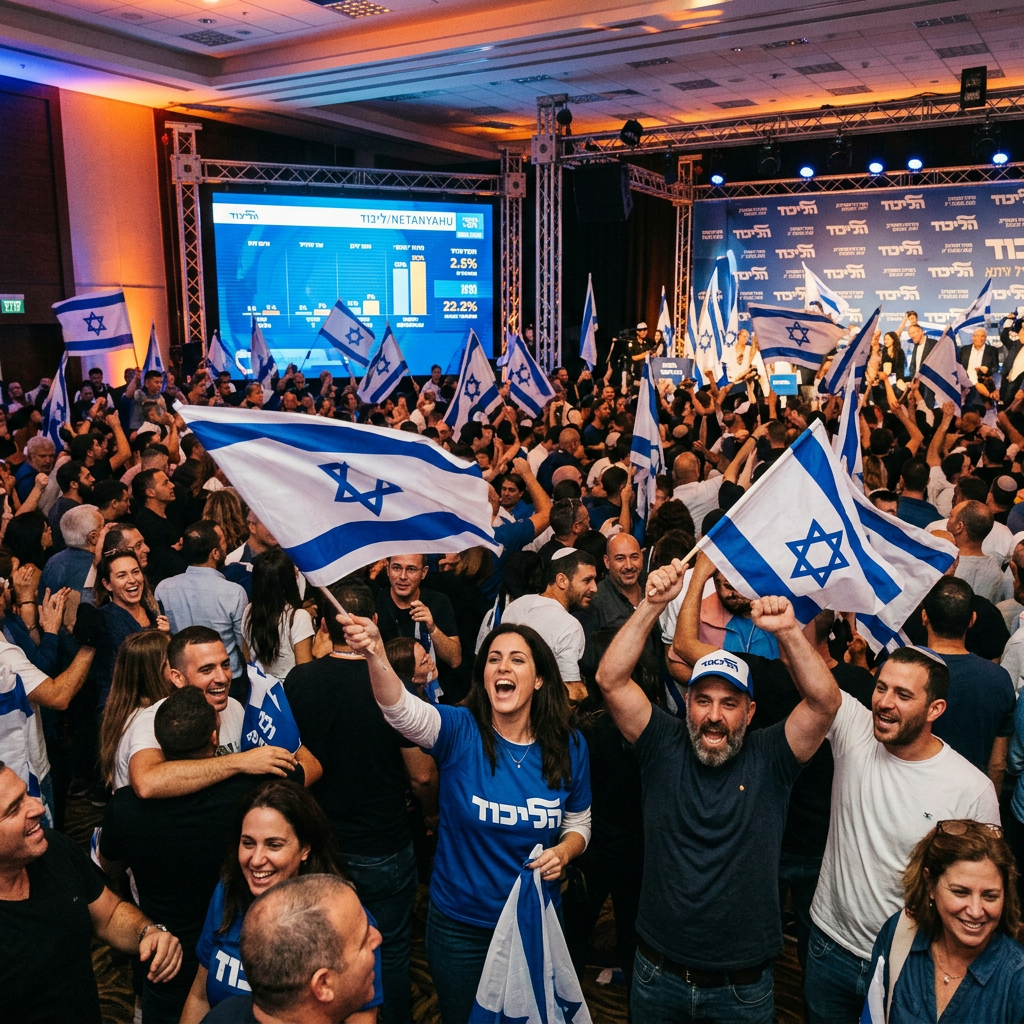

Tuesday evening’s exit polls pointed to a stinging defeat for Benjamin Netanyahu. Yet as the votes were counted, the prime minister’s camp staged a remarkable comeback. With more than 57% of the votes counted, Netanyahu’s right-wing bloc was leading with 55 seats, compared with 49 for the opposition. Neither side, however, had the majority needed to govern, leaving the country facing a prolonged political deadlock.
(Staff: Israel / Politics & Geopolitics)
The Israeli elections held on Tuesday, 27 October, were widely seen as a referendum on Benjamin Netanyahu. After almost a year of war in Gaza and mass protests against his government, exit polls released when voting ended suggested a clear victory for the opposition led by former chief of staff Gadi Eisenkot. The actual count, however, told a very different story.
A remarkable overnight comeback
In the first hours after polls closed, three major Israeli television networks published exit polls giving the anti-Netanyahu bloc a two-seat lead (52 to 50), or even suggesting a tie. As the ballots were counted, however, the trend reversed.
According to figures released by the Central Elections Committee, after 41.9% of the votes had been counted, the pro-Netanyahu bloc had secured 57 seats, while the opposition had 47. After 50.1% of ballots were counted, the lead narrowed slightly, but the prime minister’s camp remained ahead, with 56 seats to the opposition’s 49. At 57.3% counted, the figures stood at 55 seats for Netanyahu’s bloc and 49 for the opposition, while Arab parties held 16 seats.
The comeback was enough for US President Donald Trump to claim some of the credit. On Truth Social, Trump shared a message saying that after he supported “Bibi” Netanyahu, the situation had taken a dramatic turn: instead of a crushing defeat, the result now appeared to be a close contest after a comeback, or even a victory for Netanyahu.
A political deadlock looks almost certain
Despite the dramatic recovery, neither bloc reached the 61 seats required for a majority in the Knesset, Israel’s 120-seat parliament. Netanyahu’s bloc was six seats short. The gap could only be bridged with support from Arab parties, an option the incumbent prime minister has categorically ruled out.
Addressing supporters, Netanyahu said the right had a “large majority” among the “Zionist public” and called for a “strong right-wing government” without Arab parties. Likud’s leader stressed that his party remained Israel’s largest, with 27 seats, and urged rivals in the nationalist camp to unite against what he described as the “danger” of a coalition relying on Arab support.
Gadi Eisenkot, for his part, also claimed victory, arguing that the partial results showed a “total lack of confidence in Netanyahu and the government of 7 October”. Mathematically, however, the opposition faced the same obstacle: without the Arab parties, it could not form a majority.
Record turnout and the Arab vote
A key feature of the election was turnout of 77.7%, the highest since 1999. The record mobilisation was driven in large part by Israel’s Arab community, whose participation reached historic levels. The two Arab parties, the Joint List and Ra’am, secured 16 seats combined, a result Israeli analysts described as a major achievement.
Yet both Jewish political camps largely ignored this record Arab participation in their public statements, illustrating the political complexity of Israel. Netanyahu and Eisenkot both spoke of a “Zionist majority” or a coalition “without the anti-Zionist parties”, implicitly marginalising representatives of around 20% of the country’s population.
What happens next?
The formation of the next government will depend on the negotiations ahead and on smaller parties hovering below the 3.25% electoral threshold. Building a coalition appears extremely difficult under the current arithmetic. If neither bloc can attract enough partners to reach 61 seats, Israel may face a prolonged political stalemate, making another early election increasingly likely.
Conclusion
Netanyahu’s narrow lead is not a decisive victory; it is evidence of a deeply divided society. The prime minister managed to mobilise his right-wing base and reverse a result that had appeared lost, but he did not secure a clear majority of Israelis behind a renewed mandate. In a country facing unprecedented security challenges and a crisis of confidence in its institutions, the election has brought no stability, only further uncertainty. For ordinary citizens, whatever their political camp, the real battle may only just be beginning.


Leave a Reply