
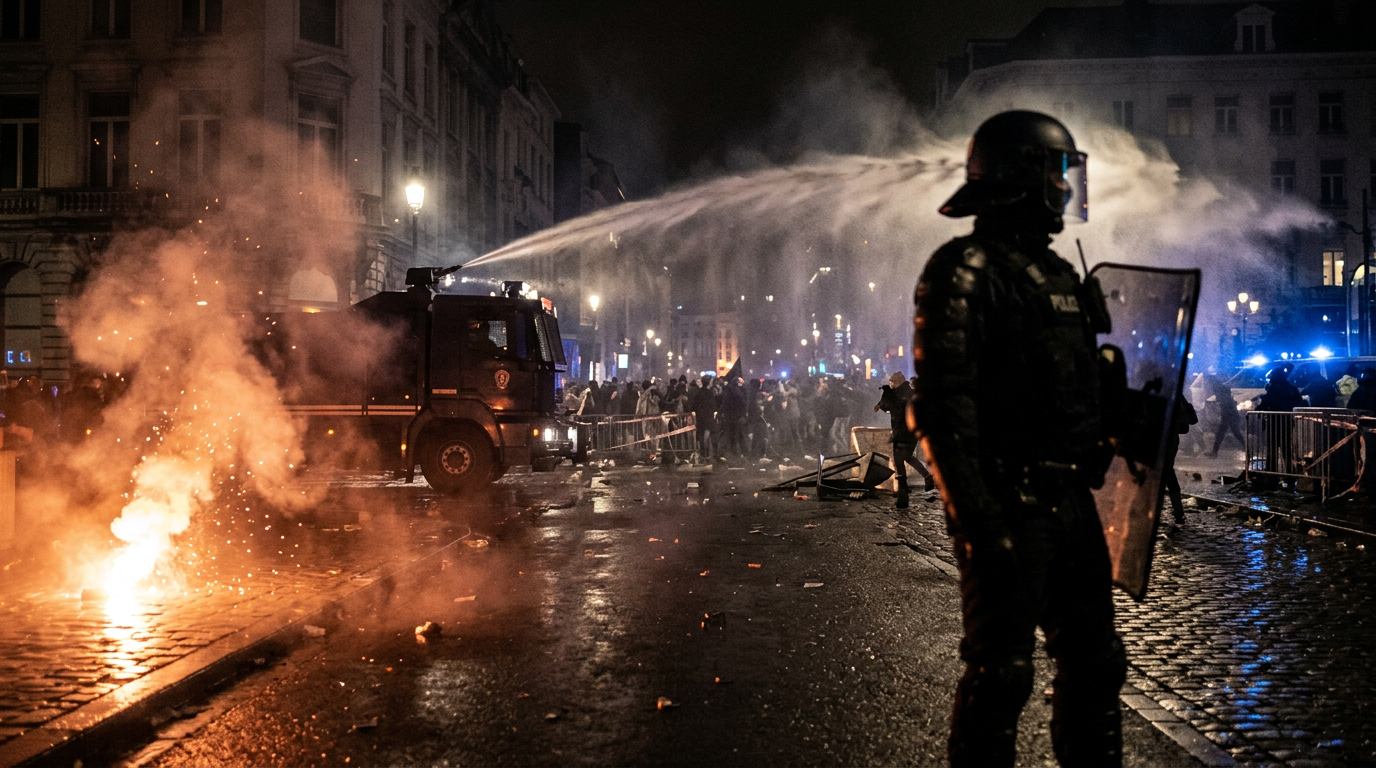

Brussels’ socialist mayor Philippe Close is facing an unprecedented revolt in his own party. After three nights of violent protests, in which the young people set fire to scooters and threw stones, the images of policemen hitting demonstrators who have already fallen to the ground triggered accusations of brutality, systemic racism and abuse in detention. While some PS members demand the sanctioning of agents, the mayor is silent and borrows solutions from the nationalist right.
(Staff: Belgium / Society & Justice)
Brussels has been shaken in recent weeks by three waves of violent protests. What started as a manifestation of young people in disadvantaged neighborhoods quickly turned into chaos: electric scooters set on fire, destroyed bus stops, burning cars and barricades. Law enforcement responded with a massive device, using water cannons, tear gas and harsh arrests.
But beyond the images of the young people throwing stones, another series of images began to circulate on social networks. And these triggered a political scandal that threatens to break the unity of the ruling party in Brussels.
Allegations of brutality and “racial profiling”
Posts of left-wing social media channels, such as Brussels Dévie, but also witness accounts, brought to the fore a much uglier facet of the police intervention. Witnesses described scenes where agents with their faces covered and no visible identification badges hit people not involved in the protests with their batons.
More seriously, the arrested young people declared that they were kept in conditions they called “inhumane”: without water, without access to the toilet and without the right to take their medicines. There have also been allegations of “racial profiling” (racial profiling), which means that the agents would have chosen who is raided or detained on ethnic criteria, not based on behavior. The excessive use of water cannons and tear gas in crowded spaces has also been criticized.
Revolt within the Socialist Party (PS)
These revelations put the Socialist Party (PS) in an extremely uncomfortable situation. Both in Brussels and in Liège, the mayors who coordinate the local police are PS members. And the party’s Brussels MPs, Yannick Piquet and Martin Casier, came out publicly to condemn the actions of the agents.
“There have certainly been violence from the demonstrators. But we have also seen police violence. I am talking about images of agents mercilessly hitting men who are already on the ground. This is unacceptable,” Martin Casier told La Libre.
Yannick Piquet was just as blunt: “Protests are not a civil war. There are problems in the police, some agents go way too far with the use of force. They must be punished.” In an extensive Instagram post, the Brussels branch of PS wrote in black and white: “Protest is not a crime, demonstrators are not criminals. We condemn the destruction, but they must not hide institutional violence, systemic racism and injustice.” The party demanded that the police act with their face uncovered and show self-control.
The silence of the mayor and the solution “from Antwerp”
While his party was publicly criticizing his own police, Brussels mayor Philippe Close refused to comment on the brutality allegations, responding briefly “with no comment” to media requests. Close chose instead to focus on the destruction of the youth and the “kettling” tactic (kettling), which he defended, although it was banned by a court last year. He also insisted on the role of the parents, accusing them of not knowing where their children are walking.
However, in a reversal of an ironic situation, the socialist mayor announced that he was analyzing the introduction of some residence bans (Plaatsverbod) for young people causing incidents, to prevent New Year’s night chaos. This measure, by which a young man is forced to stay at home, is famous in the city of Antwerp, the fiefdom of the right-wing prime minister Bart de Wever (N-VA) — a politician whom the Belgian left frequently criticizes for his harsh policies. “I can require some people not to participate in the New Year’s celebration because they have caused damage. The mayor of Antwerp is doing this,” Close said. Just a day after his statements, a judge in Kortrijk applied such a ban to a young man involved in riots.
Conclusion
Brussels is at a crossroads. The case reveals a deep tension between the right to protest, public safety and the limits of police intervention. The Socialist Party, in power in the Brussels-Capital Region, is caught between the need to maintain order (even appealing to the methods of the right) and to listen to its electoral base that condemns the brutality of law enforcement. Mayor Close’s silence over police violence, while borrowing disciplinary measures from his political opponents, demonstrates how complicated it is to govern a polarized city. It remains to be seen whether the internal pressure in the party will lead to the sanctioning of agents who have exceeded the limits or if everything will boil down to a simple debate on social networks.



Leave a Reply