
Family, memories and a Muscel tradition rediscovered after more than 50 years
Editorial by Cristin Tomeci
The Weekend Magazine – A Tomeci Press Publication
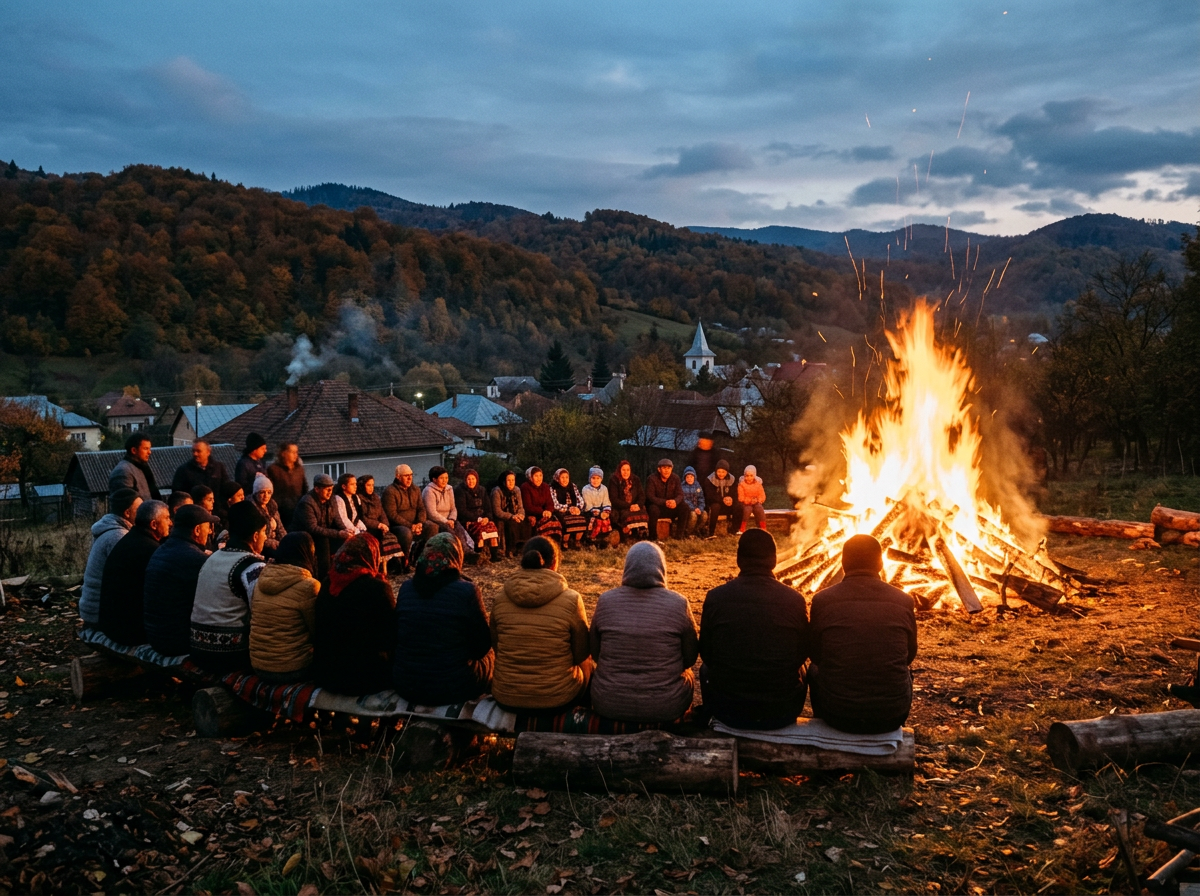
I returned to Câmpulung Muscel to see my family again, not to participate in a celebration. My hometown was no stranger to me: I had visited it over the years. But, for more than 50 years, I had not participated in the Sumedru bonfire.
I found out by chance, during my stay, that this traditional holiday was going to take place. I decided to go and was happy to discover that the tradition has been preserved and continues to gather so many people. It was a pleasant surprise, which added an unexpected experience to the visit and gave me the opportunity to see a tradition from my youth.
It was organized around the Orthodox church in Mărcuș, a beautiful area on the outskirts of Câmpulung, but also on other high hills around. We went there. Beyond the strictly religious significance, locals, families, friends and visitors gathered. The atmosphere was warm and natural, and the celebration proved that an old custom can continue to have an important place in the life of a community.
Looking at the fire, I wondered where this tradition comes from and how it managed to cross so many generations.
An old tradition, between fire, seasons and folk beliefs
the Sumedru bonfire, also called Sâmedru or Simedru, is a traditional custom spread especially in Muntenia, with a strong presence in Argeș and Muscel. It is linked to the feast of Saint Demetrius, on October 26, and to the symbolic moment when the traditional communities marked the end of autumn and the approach of winter.
In the village world of old, the change of seasons was not just a matter of calendar. It meant the end of a period of agricultural work, the preparation of households for the cold and the completion of a pastoral cycle. For people who lived in close connection with nature, these moments had a practical and symbolic importance.
Fire occupied a special place in community rituals. Flames, songs, and encounters were associated with protection, purification, and banishment of evil. In some interpretations of the folk tradition, the fire marked the separation from the old cycle of the year and the preparation for the cold period. Beliefs are also preserved according to which young people jumped over the fire for health and luck (I remembered that I jumped like that when I was a child), and the ashes and embers were related to the fertility of the land and the abundance of the household.
We cannot establish with certainty a single origin for all these practices, nor should we confuse folklore interpretations with historical evidence. However, it is clear that the Sumedru bonfire has gathered, over time, elements of pastoral life, agrarian calendar and folk beliefs, preserved and adapted by local communities.
Muscel, shepherds and fires linking the mountains
To understand the importance of this tradition in Muscel, we must return to the world of shepherds, trade roads and communities that lived between the mountain and the plain.
The Câmpulungului area, a city that was the first capital of Wallachia, was linked to centuries of shepherding, the circulation of people and goods and the passes that connected Wallachia and Transylvania. People’s lives depended on the seasons, the movement of the herds, and the information that could go from one valley to another.
In the local memory, the story of the burning fires on the heights has been preserved, so that their light can be seen from the mountain to the mountain, towards the Bran Pass area. According to this tradition, the fires could have served as warning signals in times of danger, including in the case of Ottoman incursions from the Danube.
It is a powerful image: people who, in a time without phones, radios or modern means of communication, relied on what they could see from a distance. However, the direct connection between the Sumedru bonfire and an organized medieval military alarm system must be viewed with caution, in the absence of historical evidence to confirm it. We can keep the story as part of local memory and tradition, without presenting it as a certain fact.
The fact that such stories have remained alive says something about the way communities convey their memory: through repeated gestures, celebrations and stories that connect generations.
Câmpulung Muscel and a letter that entered the history of the Romanian language
The history of the city is also documented through a landmark of national importance.
In 1521, the merchant Neacșu Lupu from Câmpulung sent a letter to Johannes Benkner, the mayor of Brașov. The document, drafted with the Cyrillic alphabet, warned him about the movements of the Ottoman troops south of the Danube and about the dangers that could threaten Wallachia and Transylvania.
Known as Neacșu’s Letter from Câmpulung, it is the oldest surviving document known to have been written in Romanian. Discovered in the archives of Brașov in 1894, the letter remains an essential landmark for the history of the Romanian language and culture.
We cannot say that the document proves the existence of a system of signaling fires related to the Sumedru bonfire. It does show, however, that as early as the 16th century, Câmpulung was connected to a network of commercial relations and intelligence, in a region where news about dangers and political changes could have important consequences.
This connection between documented history and the memory transmitted by people makes Muscel traditions all the more interesting. They belong to a territory with a rich history, with old roads, exchanges between communities and an identity formed over the centuries.
A changed city that has not lost all its roots
The Câmpulung I found is different from the one I remember. I noticed the evolution of the city, from the cars and the appearance of the streets to the cleanliness and the organization of the event. I’m not saying that everything is perfect or that there are no more things to improve, but that I have seen positive changes that pleasantly surprised me.
When you move far away from the place where you were born, its image can remain frozen in time. You remember the streets, the people and the atmosphere of that time, without always knowing how much things have changed in the meantime.
Beyond the appearance of the city, the greatest joy was the reunion with family and friends that we see far too rarely. Such a celebration offers an opportunity to talk, to reminisce and discover what has happened in the lives of those you carry in your soul, even if the distance separates you.

A city does not only mean buildings, streets and monuments. It also means the people who inhabit it, the connections between them and the habits that give them reasons to meet. When a tradition succeeds in bringing them together, it becomes more than an old ritual: it contributes to keeping a living community.
The fire that brings us together
I am not a religious man and do not look at the Sumedru bonfire from the perspective of an obligation of faith. For me, its value lies in history, in folk tradition and in the power to gather people who, during the rest of the year, may not have many opportunities to meet.
I rediscovered a tradition that has endured, a community that still knows how to gather and a city that has evolved without giving up all the landmarks of the past.
Perhaps this is one of the important lessons of the holiday: modernization should not mean oblivion. We can have new cars, cleaner streets and a different lifestyle than the generations before us, while preserving the habits that connect us to the place we come from.
the Sumedru bonfire is not just a burning flame on an October evening. It is a story about seasons, shepherds and communities, about Muscel’s past and about people who continue to meet around an inherited symbol.
For me, this holiday has become an opportunity to rediscover the connection with my hometown and see that, despite the inevitable changes, some traditions continue to find their place in the present.
Sometimes the most beautiful surprises are to discover that the places and traditions that are part of your history continue to live, evolve and bring people together.


Leave a Reply