
Editorial by Cristin Tomeci | The Weekend Magazine

About the woman’s right to be accompanied at birth, the experience of a father in Belgium and a Romania that is still struggling with the fear of responsibility, the stacks of documents and digitization done more on paper than in reality.
Contents
- An experience that forever changed my perspective on birth
- From Romania’s maternity hospitals four decades ago to the experience in Belgium
- Why do we have to turn birth into a natural moment, not a privilege
- Do we need medical safeguards or yet another paper dossier?
- The bureaucracy that suffocates an entire country
- Digitalization is not moving papers to a screen
- Conclusion: more trust in people, less bureaucracy
1. An experience that forever changed my perspective on birth
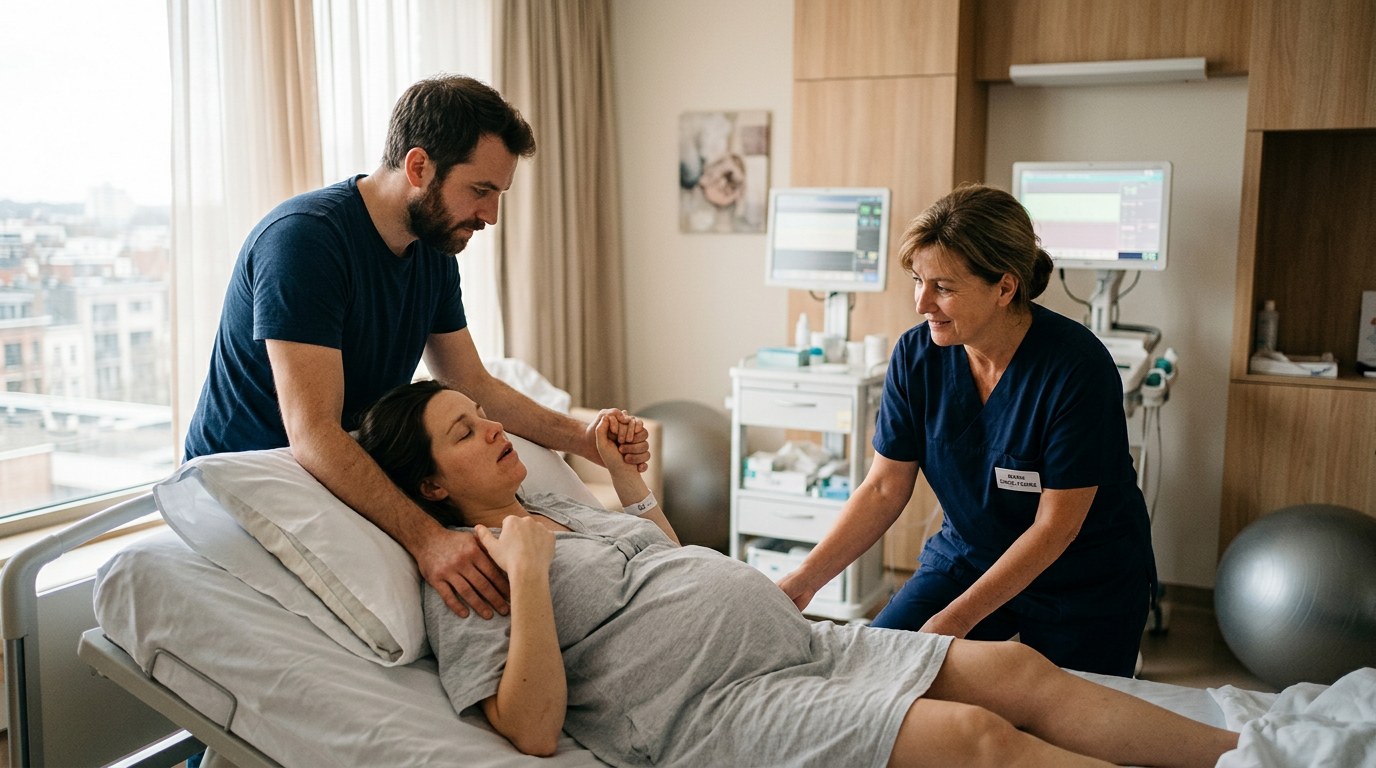
I was in Romania, visiting, when I was watching by chance, at Digi24, an account of the possibility that women could be accompanied by a person chosen by them during labor and birth. The subject seemed, at first glance, a natural one, related to the evolution of medical services and the respect of the emotional needs of the woman who is going to give birth to a child.
What surprised me, however, was not only the fact that this possibility is still treated as a novelty, but also some of the conditions discussed: documents attesting to the psychological state of the accompanying person, additional procedures and costs for disposable materials.
Then I remembered my own experience. I am the father of several children and have gone through very different periods of the medical system. I have known the realities of maternity hospitals in Romania almost four decades ago and later had the chance to live, in Belgium, an experience that forever changed the way I look at the birth of a child.
That’s why I feel the need to talk about this topic not only as a journalist, but also as a father.
Because birth is not exclusively a medical act. It is also a fundamental moment in the life of a family, a human experience that deserves to be treated with respect, responsibility and understanding.
2. From Romania’s maternity hospitals four decades ago to the experience in Belgium
When my first children were born in Romania, the reality was completely different. We are talking about a period of about 38–40 years ago, when the father’s presence in the delivery room was not part of the usual practice of the maternity hospitals we knew.
In those days, fathers were not considered natural participants in childbirth. Often, they were not even allowed to see their baby immediately after birth. In some cases, they met the child only when the mother and baby were ready to go home.
I remember the big hospitals in Ploiești, a city where I lived for a long time, during my studies and after that. That’s how things worked then, and families adapted to the existing rules, without having too many possibilities to discuss them.
After the 90s, when I arrived in Belgium, I discovered another perspective.
It was winter, and my baby girl was going to be born in December. My wife was in an individual maternity room, and I could be with her.
I still remember an episode that, watched today, has something comical. I was putting my thick coat on, as if ready to leave the room. The nurses asked me where I was going. I answered them that nowhere, I left my coat in place and returned to the chair. After a while, I was taking it again, I was getting ready to leave, and they asked me again where I was going. And so, to the general amusement.
The truth was that I didn’t know what to do with my emotions. I was there, next to the woman I shared my life with, waiting for a moment that I thought would impress me, but for which I was not fully prepared.
When the little girl was born, I stayed beside my wife’s head. The medical staff placed my daughter in my arms before handing her to her mother. I was also given special scissors to cut the umbilical cord.
I cannot describe in a few words what I felt at that moment.
The little girl opened her eyes and looked at me. She was so small, so fragile and at the same time so present in our world. That image stayed with me forever.
It wasn’t just the joy of seeing my baby. There was also the feeling that I was witnessing something extraordinary, at the beginning of a life, a transformation that went beyond any administrative or medical explanation.
I understood then that the presence of the father should not be considered a favor granted by the hospital, but can represent a deep experience, with value for the whole family.
Of course, every birth is different. Not all fathers want to participate and not all medical situations allow the same type of access. But a parent who loves his child and wants to be with his mother should be given the opportunity, under appropriate medical and safety conditions, to live this moment.
3. Why we must turn birth into a natural moment, not a privilege
The discussion about the presence of a person chosen by the woman during labor and birth should not be turned into an unnecessary controversy.
First of all, it is about the woman who gives birth. It is she who goes through labor, through pain, through fear, through effort, and through all the physical and emotional changes associated with birth. Whenever the medical situation allows, she should be able to decide who supports her and whom she trusts.
For some women, the right person is the husband. For others, it may be their partner, mother, sister or another person close to them. It is important that the choice belongs to the woman, within the limits of clear and medically justified rules.
I do not claim that anyone should enter a delivery room at any time, regardless of the circumstances. A hospital has real obligations regarding hygiene, privacy of other patients, infection prevention and staff safety.
But between justified medical rules and disproportionate administrative obstacles there is an essential difference.
If a person must be trained on hygiene rules, follow the instructions of the staff and leave the room when the medical situation requires it, these requirements are easy to understand.
But if we turn access into a complicated process, with hard-to-obtain documents and procedures without a clear justification, we risk losing sight of the main goal: supporting the woman and the safe conduct of birth.
4. Do we need medical safeguards or yet another paper dossier?
One of the ideas related in the show I watched was the need for proof or evaluation from a psychologist or psychiatrist for the person who wants to be present at birth.
If this is indeed an official requirement for certain maternity hospitals or a concrete proposal, it must be explained publicly: who requests it, on what grounds, in what situations it applies and what real problem it seeks to solve.
It would not be right to generalize based on a brief televised account. But that is precisely why clarity is necessary.
Safety must not be negotiated. If there are concrete indications that a person can endanger the mother, child or medical staff, the hospital must have procedures to intervene. Likewise, access must be managed so as not to compromise the care of other patients.
However, requesting a routine psychological or psychiatric assessment for each accompanying person should have a sound medical and legal justification. Such a requirement should not be introduced only out of the abstract fear that something bad might happen.
We cannot assume that every person poses a danger until they produce a document proving otherwise.
In a functional society, rules are built from concrete risks and are applied proportionately. Not every possible situation justifies a new form, a new certificate or a new path between institutions.
And if the problem is the training of the accompanying person, the solution can be much simpler: a clear set of rules, a short training on hygiene and conduct in maternity and the obligation to follow the instructions of the medical team.
Less formalities do not mean less safety. It means more thoughtful formalities.
5. Who pays for gloves and masks? A question about system priorities
Another issue discussed was the possibility for the accompanying person to pay for the disposable materials he uses in the hospital.
Let’s be very clear: gloves, masks and other materials needed to prevent infections cost money. Hospitals have limited budgets, and consumables do not miraculously appear in warehouses.
But that is precisely why we need to discuss how medical services are organized and financed.
If the presence of an accompanying person is allowed and considered useful for the patient, the foreseeable costs of the necessary protective equipment should be assessed transparently and, where possible, included in the operating budgets.
We are not talking about equipping an operating room with equipment worth millions of euros, but about consumables necessary to comply with some sanitary rules. The total cost can be calculated, budgeted and publicly explained.
I am not saying that any material must be provided for free, regardless of context and resources. I say that a medical policy must start from the patient’s needs and a realistic cost assessment, not from the reflex of automatically transferring any expense to the citizen.
Before asking a family for money to allow the presence of a close person, the institution should explain what materials are needed, how much it costs, who sets the tariff and why they cannot be covered by the usual financing mechanisms.
And if a payment is requested, it must be legal, transparent and justified, not an improvised tax at the level of each institution.
Respect for the patient is not only measured in high-performance equipment and renovated buildings. It can also be seen in the way the rules are explained to him and in the way his family is treated.
6. The bureaucracy that suffocates an entire country
The problem of the accompanied birth brought back to my mind a reality that I have encountered in other fields in Romania: the dependence on documents, legalized copies, certificates, forms and confirmations that the citizen must sometimes obtain from several institutions.
I have encountered situations where administrative procedures seem to become an end in themselves. People are sent from one counter to another, they are asked for documents that other institutions already have, and the lost time is considered almost inevitable.
In the medical field, this mentality is all the more difficult to accept. The patient needs care, explanations and a system that works. You should not be required to become an expert in administrative procedures to benefit from a service.
I know the situation is not simple. I have a doctor in my family who works in a large hospital and teaches at a medical university in Romania. I know, through this approach, some of the difficulties of the medical staff and the pressure under which they have to work.
That is precisely why I do not consider it correct to put all the problems on the shoulders of doctors and nurses. Many of them face rules that they have not conceived, with insufficient resources and overlapping responsibilities.
The problem must be analyzed at the level of the system organization: who establishes the procedures, who checks their usefulness, who eliminates the redundant obligations and who responds when a rule complicates access to services without reason?
Not every document is useless. In medicine, records, informed consent and documentation of the medical act are essential. But each procedure should have a clear purpose, and the administrative burden must be maintained at a reasonable level.
Romania does not need less responsibility. It needs responsibility exercised intelligently.
7. Digitalization is not moving papers to a screen
In recent years, digitalization has become one of the recurring promises of the Romanian administration. We are told about platforms, computer systems, digital identity and publicly accessible services from a distance.
However, citizens’ experiences show that the existence of an online portal does not automatically guarantee a simple and efficient administration.
If a digital service requests the same documents that were required at the counter, if the user needs to print a form to sign it and then upload it again, if the institutions cannot check each other’s data legally, then we have not eliminated bureaucracy; we have merely moved it online.
True digitization means institutions can communicate with one another, citizens are not repeatedly asked to provide the same information, and procedures are designed around people’s real needs.
Of course, computer systems must respect data security, privacy protection and legal requirements. Not every information can be transmitted automatically between institutions. But these limits must be resolved through well-designed technical and legal solutions, not used as a permanent justification for blockages.
I personally encountered authentication difficulties and digital procedures that seemed disproportionately complicated to me. I do not claim that each individual experience describes the entire Romanian administration. But such problems deserve to be investigated and corrected, especially when they are repeated.
A modern European country must allow citizens to solve as many administrative problems as possible online, without unnecessary trips, without redundant paperwork and without being forced to learn the internal language of each institution.
And this change is not made only by purchasing computers or by contracting expensive platforms. It requires simplifying procedures, establishing common standards and taking responsibility for results.
Conclusion: more trust in people, less bureaucracy
I return to the question from which this editorial started: Why should the presence of a loved one next to a woman in labor be treated as a complicated administrative problem?
Birth is a time when medicine must exercise its competence, and institutions must ensure the safety of all involved. But it is precisely at such a moment that we should also understand the value of human support.
My experience in Belgium has shown me how strong the impact of attendance at the birth of my own child can be. The image of my little girl, whom I held in my arms immediately after she was born, remained one of the fundamental memories of my life.
I wish every family that wants this experience could benefit from it, when medical conditions allow, without unnecessary administrative obstacles and without undue costs.
Romania must seriously discuss the clear rules for the presence of the accompanying person, about respecting the choice of women, about the protection of patients and about the responsibility of hospitals. If there are psychological requirements, fees or other restrictions, they must be explained and justified transparently.
But this discussion should not stop at the maternity ward. It concerns the way the Romanian state treats its citizens.
After so many years of belonging to the European Union, Romania needs public administrations that simplify rather than complicate; healthcare services that support patients rather than turn them into permanent applicants for approvals; and digitization that solves problems instead of reproducing them electronically.
It is not enough to declare that the country is being modernized. Modernization must be felt in everyday life, in the maternity ward, at the doctor, at the counter and in every public service.
And the first step could be a very simple one: to start from trusting people, to ask for documents only when they are necessary and to never confuse the existence of a procedure with solving a problem.
Because a child comes into the world through a miracle of life, not by filling out a form. And his parents deserve to be treated as people, not as administrative files.




Leave a Reply