
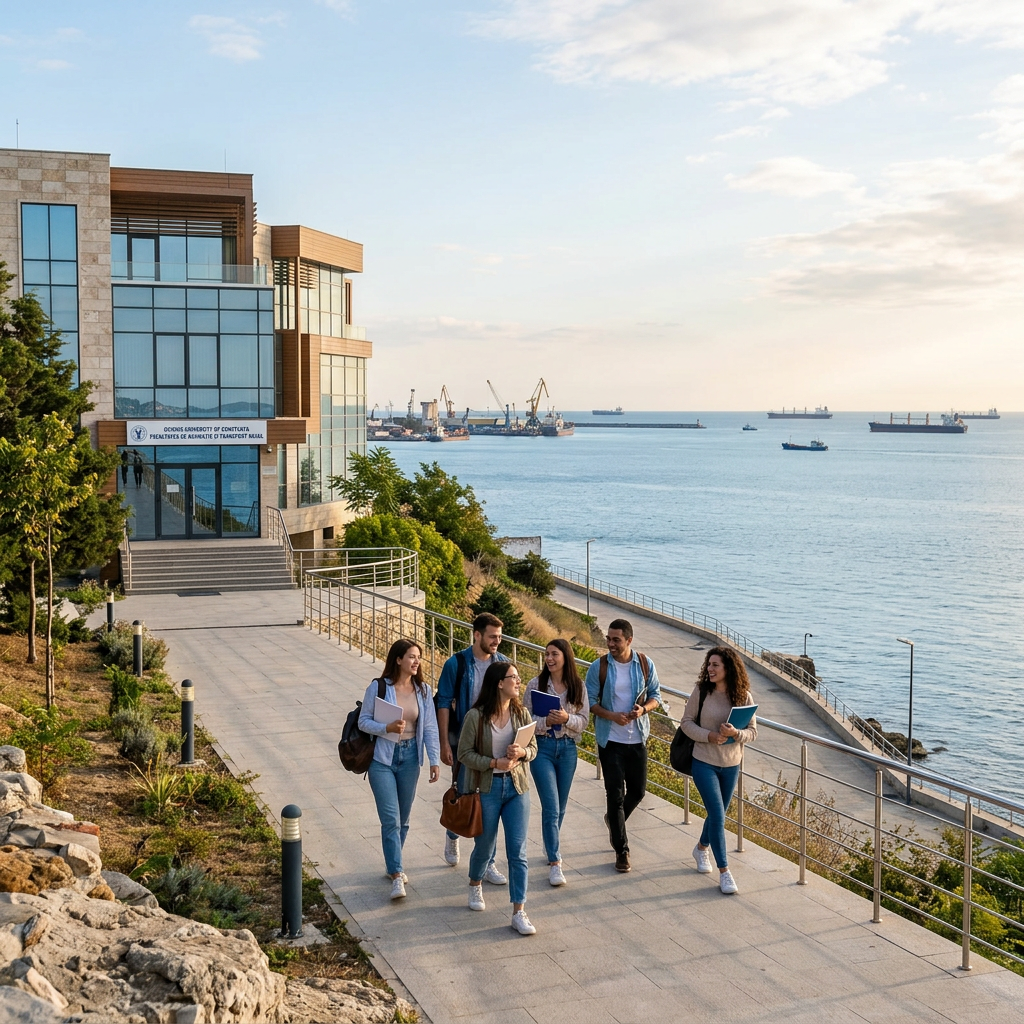

For two decades, the idea of an elite academic institution on the Black Sea seemed like a diplomatic luxury. Russia’s war against Ukraine has turned it into a strategic necessity. In Constanța, a project backed by regional academic and diplomatic circles has received an initial formal response from the Romanian authorities.
This article is based on information provided by Prof. Dr. Cristina Vanberghen.
Europe is investing heavily in Black Sea infrastructure. Pipelines, ports, undersea cables, defence cooperation and logistics corridors are all covered by strategies and budgets running into billions of euros. The European Union funds dozens of projects across the region, while Romania and Bulgaria receive substantial support for security and connectivity. Yet something essential is missing from this effort: the people who can make that infrastructure work.
This is the central argument of an academic and diplomatic initiative that, according to its founders, has finally reached maturity. The idea of establishing a College of Europe campus in Constanța—following the established models in Bruges, Natolin and Tirana—has moved beyond theoretical debate to a first concrete institutional step.
An idea that waited two decades
The argument is not new. Two decades ago, during preparations for Romania’s accession to the EU, some Romanian diplomats were already speaking about the need to build academic and administrative bridges around the Black Sea. At the time, the idea seemed ambitious but premature. In Brussels, the region was seen more as a periphery—a transit zone associated with irregular migration, smuggling and frozen conflicts—than as a strategic frontier.
Russia’s full-scale war against Ukraine radically changed that perception. Almost overnight, the Black Sea became one of the West’s main strategic frontiers. Such a frontier needs not only ships and radar systems, but also diplomats, analysts and decision-makers able to understand the region’s historical, cultural and geopolitical depth.
The gap treaties cannot fill
Why a College of Europe? The project’s proponents argue that, after two decades of dialogue through the Black Sea Economic Cooperation Organization (BSEC) and other regional forums, the region still lacks a leading institution to prepare future generations of specialists. BSEC established a working group on education, issued ministerial declarations and organised training programmes for diplomats. These efforts kept dialogue alive, but did not turn it into lasting institutional capacity.
A College of Europe campus in Constanța could do what treaties and summits cannot: build trust among people living around the same sea through shared education, applied research and the exchange of experience. It would not simply copy Bruges or Natolin, but adapt the model to the Black Sea basin’s specific geopolitical realities.
A first step: an in-principle response and a working group
According to publicly available information, the initiative has recently made an important advance. Romanian public-administration authorities have sent a formal response expressing agreement in principle, and a working group has been established, bringing together academics and diplomats from the Black Sea region and the European Union. This is an early but significant stage: the move from an idea backed by a few initiators to an organised framework capable of holding official discussions.
The initiative also aligns with Romania’s broader efforts to strengthen its role as a regional hub. In June 2026, Romania and Bulgaria completed a joint concept for a European Black Sea Maritime Security Centre, with sites in Constanța and Varna. The European Commission has also adopted a Black Sea strategy and is funding numerous projects in the region. A College of Europe campus would complement this ecosystem by providing the missing human-capital dimension.
Why education matters in a frontier region
In a region where propaganda, disinformation and hybrid pressure are everyday realities, education becomes a form of security. An independent academic institution with European standards and a clear mission to prepare the region’s future leaders could serve as a long-term source of resilience. It is no coincidence that the project’s proponents describe human capital as the region’s most undervalued strategic resource.
Many questions remain, of course. What exactly would the campus look like? How would it be funded? What relationship would it have with the College of Europe in Bruges and with academic institutions across the region? And, perhaps most importantly, how would academic independence be protected in such a geopolitically tense environment? The answers will determine whether the project remains an attractive idea or becomes a real institution.
Conclusion
For two decades, a College of Europe on the Black Sea was a long-term bet. The war has turned that bet into a necessity. Europe spends billions on regional infrastructure, but without people equipped to manage, understand and protect it, that infrastructure is an empty shell. A campus in Constanța could be the institutional response to this gap. For now, the fact that Romanian authorities have begun discussing the proposal is the clearest sign yet that it has moved beyond declarations of intent.
(Editorial team: Romania & EU / Education & Geopolitics)


Leave a Reply