
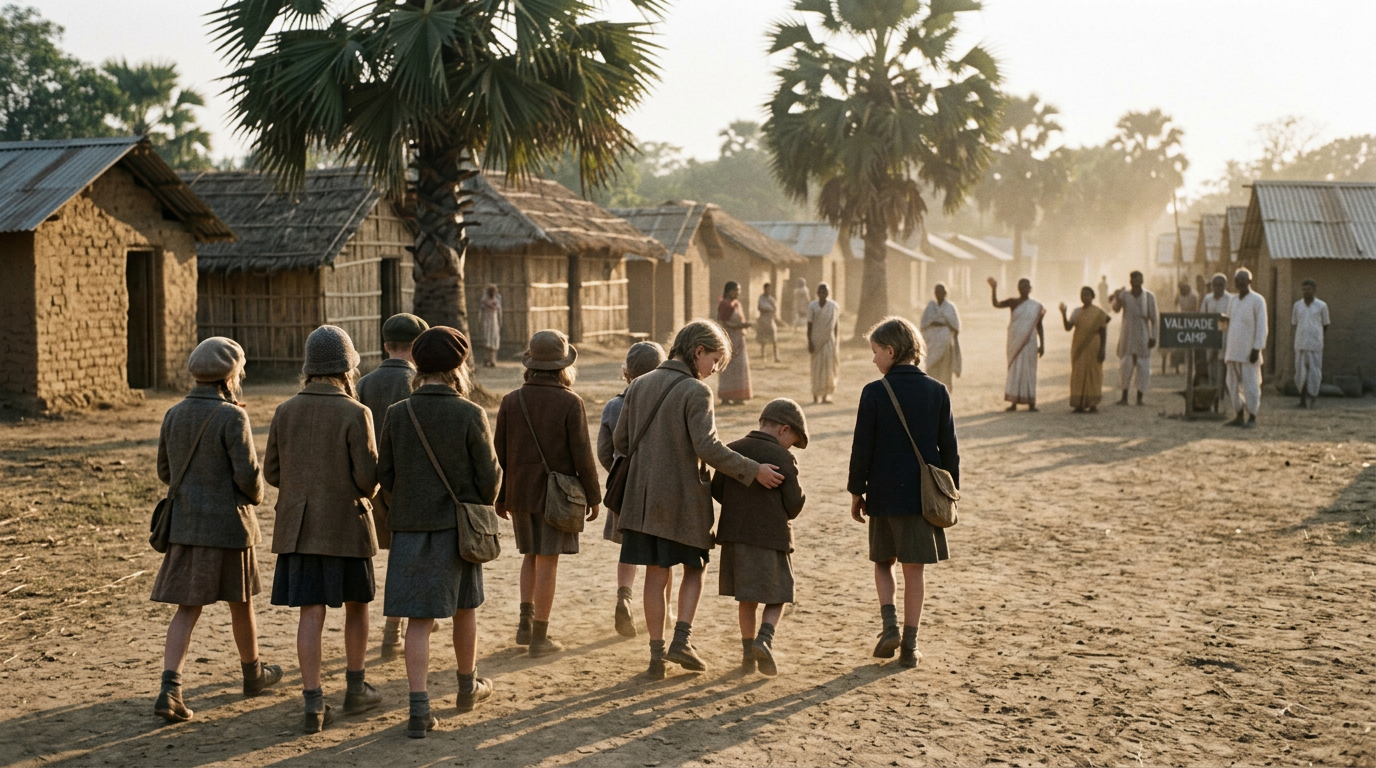

In 1942, hundreds of Polish children who had survived the Soviet gulags were turned away from port after port. A Maharaja in India opened the gates of his kingdom, built a home for them, and told them something simple: “You are not orphans. I am your Bapu.”
(Staff: India & Poland / History & Memory)
There are moments in history when humanity faces its hardest test, and the answer comes neither from the great powers nor from international organisations or peace conferences. It comes from one person who decides that political rules must not outweigh a clear conscience.
In the summer of 1942, while the Second World War was devastating Europe and Asia, around 740 Polish children were aboard a ship off the coast of Iran. They were not tourists. They had survived Soviet deportations to Siberia. Many were children of Poland’s intellectual elite whose families had been arrested, starved and torn apart. Some had watched relatives die along the way; others had not known for years whether anyone in their family was still alive.
After an exhausting journey through Turkmenistan and Iran, they had reached one grim conclusion: the world did not want them.
Port after port, refusal after refusal
The great powers of the free world did not rush to take them in. Britain, which administered India, was preoccupied with the war. The United States maintained strict immigration quotas, and the British dominions imposed their own barriers. The children were too young to fight, too ill to work and too poor to pay their way. In the cold logic of bureaucracy, they were not a priority.
British authorities were prepared to help only a few hundred refugees, while more than a million Poles were in need. Every day spent at sea or in temporary camps meant less food, fewer medicines and greater despair. The children grew weaker; some became ill. With every refusal, their future seemed to shrink.
The man who asked, “How many?”
Far from the conference rooms where the fate of refugees was being decided, a 47-year-old man read about their plight in the princely state of Nawanagar in north-western India. His name was Jam Sahib Digvijaysinhji Ranjitsinhji Jadeja. He was neither an elected politician nor an emperor, and he did not command an army. He was the Maharaja of a princely state, an aristocrat educated in London with a distinguished military and diplomatic career.
When he heard about the stranded children, he did not call for a debate or invoke treaties. He asked one question: “How many are there?”
The answer was 740.
For him, that was enough.
Balachadi: a home built from the ground up
The Maharaja did not merely offer temporary shelter. He decided to create a place that could feel like home. He chose land near his summer residence in Balachadi, about 17 miles from the capital, Jamnagar. He provided land, money and workers, and ordered the area to be planted with trees, bananas, papayas and flowers. Residential buildings, a dining hall, a kitchen, storage facilities and a school were built.
The children arrived in July 1942, weak and ill, suffering from vitamin deficiencies and skin diseases. Many had no shoes and wore rags. Some were only two years old. Yet, for the first time in years, they found a bed, a warm meal and an adult who smiled at them.
The Balachadi camp operated like a small, self-contained community. It had a school with primary classes, a kindergarten and a secondary school, as well as a library, extracurricular activities, theatre performances, sports competitions and excursions. In 1943, a Scout troop of around 200 children was established. Polish holidays were observed, and the children learned about a homeland some of them had never seen.
“You are not orphans”
For many of the children, the most powerful memory was not a building or a lesson, but a sentence. The Maharaja often came among them, talked with them and joined their celebrations. With a kindness they had not experienced for a long time, he would tell them: “Do not think of yourselves as orphans. I am your Bapu” — father in Hindi.
For children who had lost their parents in the gulags, on trains or along the roads of exile, those words carried a weight no official document could match. This was about more than food and shelter. It was about dignity and the right to be children again.
Gratitude that spans generations
After the war, the children left. Some returned to Poland; others emigrated to the United States, Canada, Australia or Britain. But their bond with India endured. Many kept photographs, letters and memories. Some learned Hindi. Others told their children and grandchildren about the prince who welcomed them when nobody else would.
Official recognition came late, but it came. In 2016, fifty years after the Maharaja’s death, Poland’s Sejm adopted a resolution honouring the “Good Maharaja” for helping Polish children during the war. The President of Poland posthumously awarded him the Commander’s Cross of the Order of Merit. Warsaw’s Ochota district now has a Good Maharaja Square and a monument dedicated to him. In Israel, a statue also commemorates his role in saving Polish and Jewish children.
In Balachadi, India, a memorial marks the place where a prince decided that humanity was not a matter of foreign policy.
Conclusion
The story of the 740 Polish children is more than a lesson in generosity. It is a lesson in what it means to have power and use it for others. The Maharaja of Nawanagar had no legal obligation to help them, no strategic interest to pursue and nothing to gain in return. Faced with real suffering, he simply found no justification good enough to say no.
In a world where refugees are still too often treated as a problem and compassion is weighed against budgets and election polls, his example remains strikingly relevant. The question is not merely what we can do, but whether we have the courage to do something.



Leave a Reply