
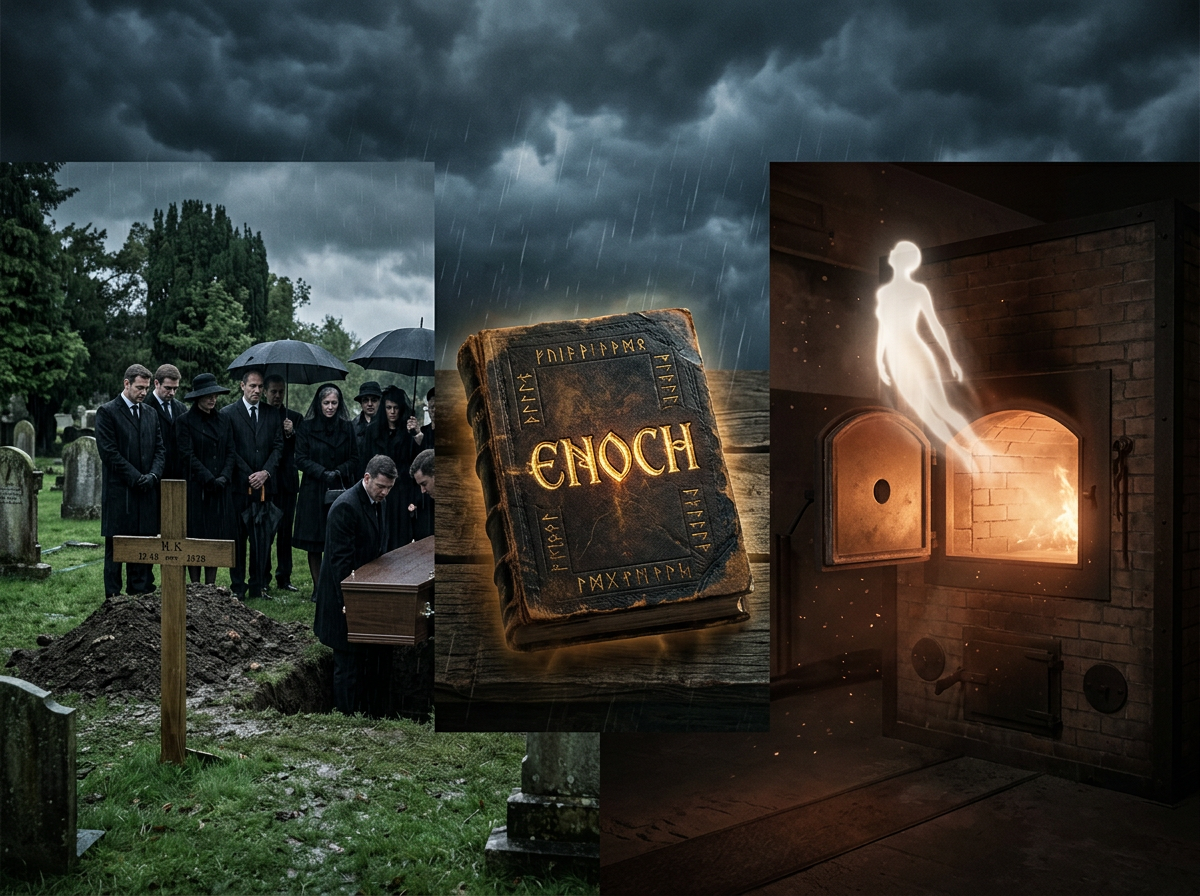

A Romanian channel devoted to apocryphal texts claims that a passage in the Book of Enoch explains what happens to the soul immediately after death and why cremation supposedly changes that process. The text, absent from the biblical canon of most Christian churches, is presented as a key to hidden truths. Here is what is known about the book, how religious traditions approach the subject, and what remains disputed.
(Staff: Religion & History)
A recent video from the channel “Cartea Ascunsă” (“The Hidden Book”) has attracted attention among Romanian internet users by promising to reveal a “disturbing” passage from the Book of Enoch, an ancient Jewish work not included in the biblical canon of most Christian denominations. According to the video’s description, it examines what happens to the soul immediately after death and claims that cremation radically changes that process, contrasting the fate of people who are buried with those who are cremated. It also suggests that the Church avoided discussing the book for centuries.
What is the Book of Enoch?
The Book of Enoch is a collection of Jewish apocalyptic writings attributed to the patriarch Enoch. In Genesis, Enoch is described as having “walked with God” before he disappeared from the earthly account. The texts were composed over a period spanning roughly the third century BCE to the first century CE and include sections known as the Book of the Watchers, the Book of Parables, the Astronomical Book, the Dream Visions and the Epistle of Enoch. The book is canonical in the Ethiopian Orthodox Tewahedo Church, but not in most Jewish and Christian traditions. Its exclusion cannot be reduced to a single reason such as language: questions of tradition, reception and religious authority also shaped the different canons.
What does it say about life after death?
The book contains visions of the realm of the dead, fallen angels, final judgment and the vindication of the righteous. Some passages describe the spirits of the dead awaiting judgment and distinguish between the destinies of the righteous and the wicked. However, there is no explicit passage stating that cremation changes the fate of the soul. That claim appears to be a later theological interpretation or speculation, not a direct statement in the text.
Burial versus cremation: what do Christian traditions say?
Burial became the dominant Christian practice, reflecting the burial of Jesus and the symbolism of bodily resurrection. In some early Christian settings, cremation was associated with non-Christian customs and viewed with suspicion. Attitudes have since differed among churches and over time. The Roman Catholic Church permits cremation, provided it is not chosen to deny Christian teachings about resurrection; Orthodox churches generally maintain a more restrictive attitude, while many Protestant communities accept it. Practices and rules can vary by denomination and local church.
Why was the Book of Enoch excluded from most biblical canons?
There was no single, universal decision by all churches. The book was not received as canonical by most Jewish and Christian communities, owing to a complex history of religious transmission, interpretation and canon formation. Its language history and distinctive accounts of angels, judgment and the origins of evil form part of the discussion, but it is misleading to suggest that one simple doctrinal or linguistic reason explains every tradition’s decision.
What remains controversial?
The video implies that the Church concealed a hidden truth about cremation and the soul. That claim is overstated. The Book of Enoch does not set out a clear doctrine linking cremation to a person’s fate after death, and the book’s non-canonical status in most churches is not proof that it was deliberately hidden. The video was made with the help of AI tools, which is another reason to check its claims against independent historical and theological sources.
Conclusion
The Book of Enoch is a significant work for understanding Jewish apocalyptic thought in the Second Temple period. But claims that it links cremation to the fate of the soul are speculative rather than established teachings of the text. Anyone interested in the subject should consult reliable editions and a range of historical and theological studies instead of relying on a single online video.



Leave a Reply