
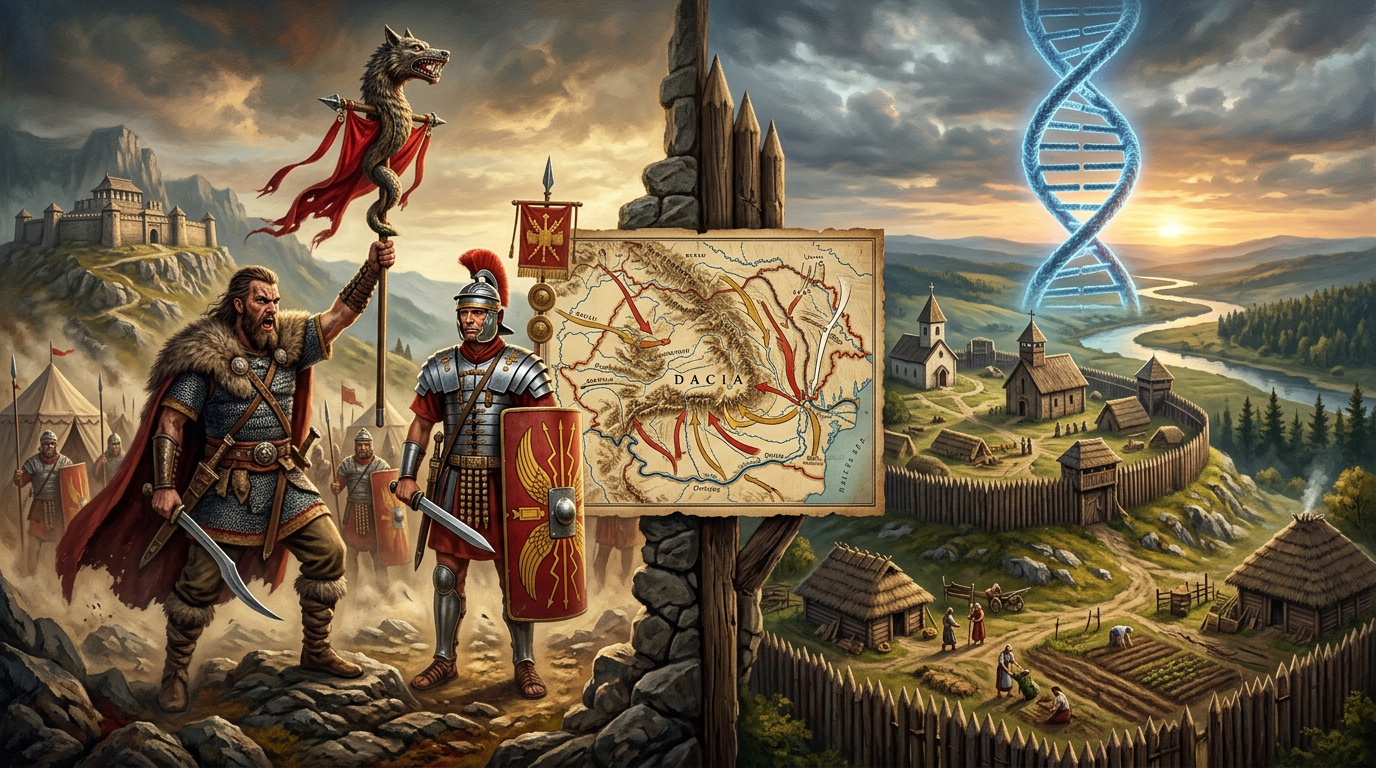

We speak a Romance language, look back to Dacia and live in a region shaped by Slavic peoples. The history of Romanian identity brings together the Roman conquest, Romanization, migrations and findings from modern population genetics. The reality is more nuanced than the myths.
(Staff: Romania / History & Identity)
Few questions prompt as much debate as this one: Who are the Romanians, really? Their language is Romance, their historical memory includes the Dacians, and their neighbours have included Slavic peoples. The region also experienced Ottoman rule and strong Hungarian, German and Greek cultural influences. Romanian identity is not a straight line but a mosaic of historical layers.
The Dacian layer: the ancient inhabitants
Before the Roman conquest, much of what is now Romania was home to the Dacians, an Indo-European people whose rulers included Burebista and Decebal. They had their own cultural and religious traditions. In 106 CE, Emperor Trajan conquered the Dacian kingdom, beginning a period that profoundly changed the region.
Roman rule: a lasting linguistic legacy
Roman rule in Dacia lasted roughly from 106 to 271/275 CE. During this period, Latin spread through administration, trade and daily life, while local communities interacted and mixed with settlers from across the empire. The withdrawal of Roman administration under Aurelian did not erase the region’s Latin linguistic legacy. The Romanian language is a central part of that inheritance.
Migrations and cultural contact
After the Roman withdrawal, the region experienced successive migrations and changing political influences. Slavic settlement and contact left a substantial mark on Romanian vocabulary and place names. Ottoman power influenced the principalities for centuries, while Greek communities and Phanariot rulers played roles in administration and culture. Hungarians and Germans also helped shape Transylvania. These contacts contributed to the region’s history, though their impact varied by period and place.
What can population genetics tell us?
Population genetics does not support simple labels such as ‘pure Dacian’, ‘pure Roman’ or ‘pure Slavic’. The ancestry of present-day Romanians reflects a complex history of population continuity, movement and intermarriage across southeastern and central Europe. Research may identify varying affinities with ancient Balkan, Roman-era and Slavic-associated populations, but genetic ancestry cannot be reduced to a single ancient people or mapped neatly onto modern ethnic identities.
- ancient populations of the Balkans and neighbouring regions;
- people who lived in the area during and after Roman rule;
- Slavic migrations and settlement, especially in the early medieval period;
- later movements and contact involving many neighbouring populations.
In other words, today’s Romanians reflect a long history of population mixing. There is no scientifically meaningful idea of a genetically ‘pure Romanian race’; ethnic identity cannot be defined by genetic purity.
Why does this matter?
Identity is not determined by genetics alone. It also involves language, culture, memory and tradition. Romanian’s Romance structure connects it linguistically to Latin-speaking Europe, while words borrowed from Slavic, Turkish, Greek and other languages record centuries of contact. The Dacian past remains part of the country’s historical memory, alongside many other influences.
Conclusion
Who are the Romanians? They are a people whose history includes the ancient inhabitants of the region, Roman rule and language, Slavic settlement and many later cultural encounters. They speak a Romance language in southeastern Europe and have maintained a distinct identity through changing empires and borders. The most accurate picture is not a single origin story, but a historical mosaic.


Leave a Reply