
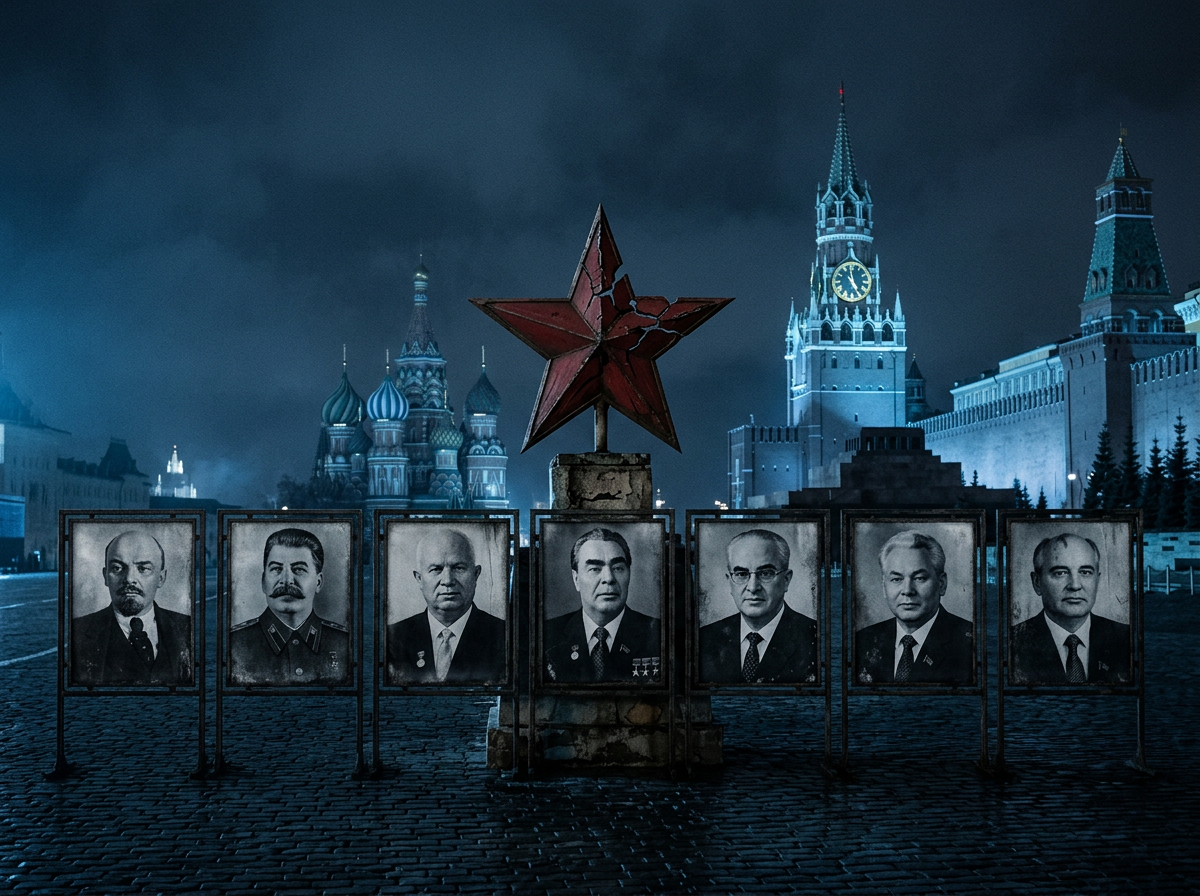

For almost seven decades, the Soviet Union was one of the world’s most powerful states. Its leaders entered history not only through their decisions, but also through the circumstances of their deaths. Medical explanations, official statements, eyewitness accounts and later speculation have shaped the stories surrounding their final days.
(Staff: Soviet Union / History & Politics)
Vladimir Lenin: a declining brain and a final stroke
Lenin died on 21 January 1924, aged 53, after a series of strokes that severely impaired his ability to speak and write. After his death, his brain was removed for scientific study at the Moscow Brain Institute, under neurologist Oskar Vogt. Researchers hoped to identify a physical explanation for his abilities, but the work never produced a definitive answer. Lenin was embalmed and placed in the mausoleum on Red Square.
Joseph Stalin: the long delay before medical help
Stalin died on 5 March 1953 after suffering a cerebral haemorrhage. Accounts say he was found lying on the floor at his Kuntsevo dacha, but guards were reluctant to enter his quarters or disturb him. Medical assistance was called only after a delay. Claims that he was poisoned remain disputed and have not been conclusively proven. His death triggered an intense struggle for power.
Lavrentiy Beria: executed after Stalin’s death
Beria, head of the Soviet security apparatus, was arrested in June 1953. He was accused of treason and other crimes and was executed by firing squad on 23 December 1953, following a power struggle within the leadership.
Nikita Khrushchev: removed from power, not executed
Khrushchev was ousted in October 1964 and spent his remaining years under close supervision in Moscow, working on his memoirs. He died of a heart attack on 11 September 1971, away from public political life.
Leonid Brezhnev: a failing health and a delayed announcement
Brezhnev, who led the Soviet Union for about 18 years, died on 10 November 1982. His health had deteriorated significantly in his final years. Reports describe him appearing frail at official events shortly before his death; the public announcement followed after a delay.
Yuri Andropov and Konstantin Chernenko: illness at the top
Andropov died on 9 February 1984 after about 15 months as leader. He suffered from serious kidney disease and required dialysis. Chernenko, who succeeded him, died on 10 March 1985 after roughly 13 months in office. Both were gravely ill during much of their leadership.
Mikhail Gorbachev: the last Soviet leader
Gorbachev, the final leader of the Soviet Union, died on 30 August 2022 at the age of 91 after a prolonged illness. His death was natural, unlike the violent ends suffered by some figures in Soviet politics. His legacy remains debated, especially in Russia.
Leon Trotsky: murdered in Mexico
Trotsky did not lead the Soviet Union, but he was a prominent revolutionary and Stalin’s political rival. Soviet agent Ramón Mercader attacked him in Coyoacán, Mexico, on 20 August 1940; Trotsky died the following day. His former home is now a museum.
Conclusion
The endings of Soviet leaders ranged from illness and old age to execution and assassination. Some details of their final hours remain debated, while other events are well documented. Distinguishing established facts from speculation is essential to understanding both the people involved and the secrecy of the political system they served.


Leave a Reply