
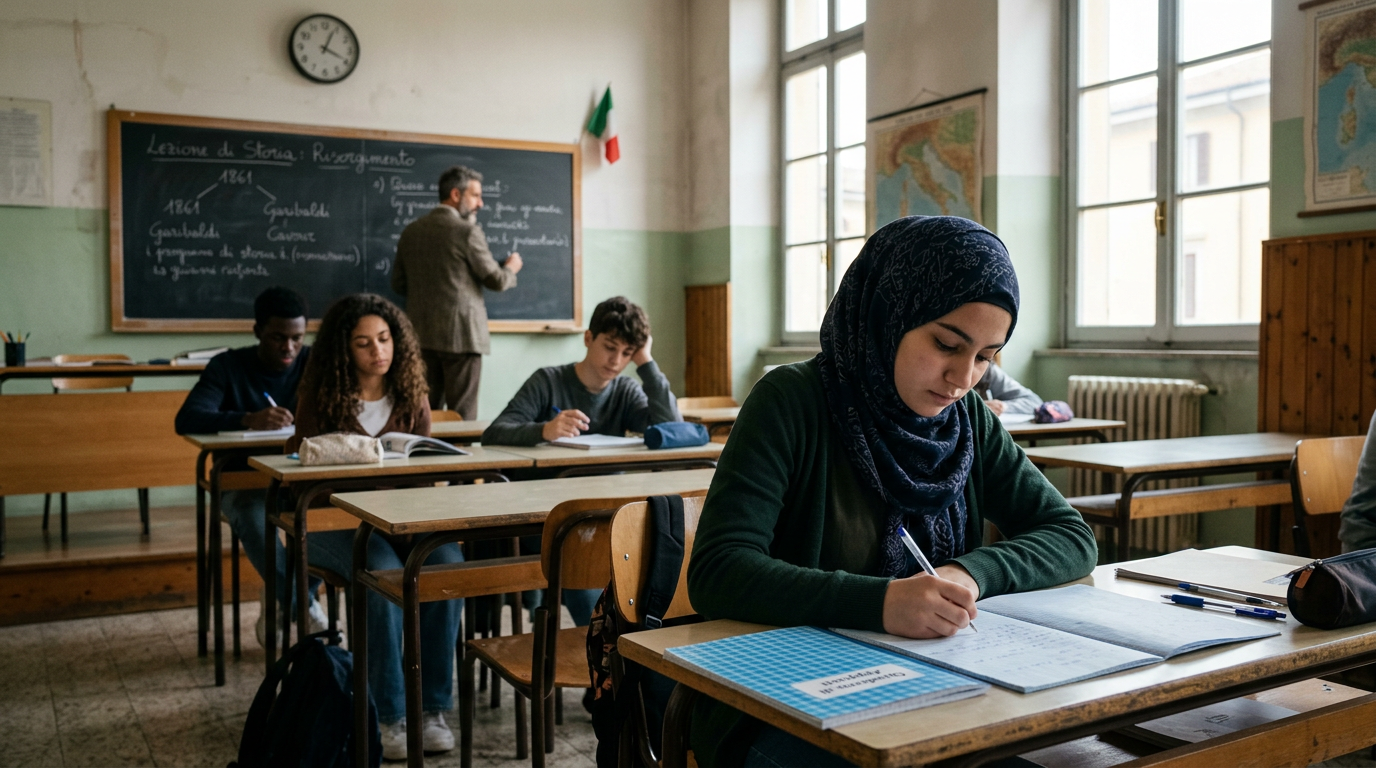

On Sunday, Giorgia Meloni said at the youth festival of her party, Brothers of Italy, that the government would soon adopt a law banning the burqa and niqab in schools, setting a maximum number of foreign students per class and requiring parents of children facing major integration difficulties to learn Italian. The measures have been criticised by the opposition and school principals, who describe them as electoral propaganda and difficult to implement in practice.
(Staff: Italy / Education & Politics)
Italy is preparing to introduce a series of measures directly affecting schools and the integration of foreign students. Prime Minister Giorgia Meloni announced on Sunday, 20 September 2026, during a meeting of the youth wing of her party, Brothers of Italy (Fratelli d’Italia), that the government is preparing a legislative package that will soon be presented to the Council of Ministers.
What does the package of measures provide?
The Italian prime minister’s announcement includes three main measures:
- Ban on the burqa and niqab in schools. “At school, people should appear with their faces uncovered, and in Italy no one, in the name of a real or supposed tradition, can decide that a young woman must hide,” Meloni said. She added: “Equality between men and women is not negotiable, neither in our streets nor in our schools.”
- Limiting the number of foreign students per class. “A measure will soon be presented to the Council of Ministers to establish by law a maximum number of foreign students per class,” Meloni said. She did not specify the ceiling, but argued that “if there is only one child in a class who does not understand Italian, that child will probably be able to integrate quickly. However, if the number of children who do not understand the language becomes large — or even a majority — we can no longer speak of integration, but of neglect.”
- Requiring parents to learn Italian. The measure would require parents of foreign students facing “major integration difficulties” in the school system to learn Italian.
Demographic and political context
Students who are not Italian citizens account for 11.6% of all pupils enrolled in Italian schools — almost 12 out of every 100 children — according to data from Fondazione ISMU, a research institution. Meloni also highlighted a sensitive issue: “It is unacceptable that, in an Italian classroom, the children who end up feeling marginalised are Italian children because they have become a minority. This cannot be allowed.”
The announcement comes as Italy prepares for general elections next year, while competition on the right has intensified with the entry of retired general Roberto Vannacci, who has called for even tougher measures against immigration. Migration remains one of the most divisive issues in Italian politics, and Italy is among the European countries most exposed to migrant arrivals across the Mediterranean.
Reactions from the opposition and school principals
The measures have prompted strong criticism. Vittoria Baldino, vice-president of the opposition Five Star Movement (M5S), described the proposal as “electoral propaganda”. “We can expect propaganda from this government on issues such as taxes or ‘woke’ topics, but is it acceptable to use schools and our children for propaganda?” she told La7. Baldino added that “the real problems of public education are completely different”, citing shortages of toilet paper in some schools, classrooms that become extremely hot in summer and defective heating systems in winter.
Antonello Giannelli, president of the National Association of School Principals (ANP), expressed doubts about the measure’s practical applicability. “From an educational point of view, the issue is legitimate and understandable, but it is difficult to find a practical solution. Schools are obliged to accept children from their local area, especially in kindergarten and primary school; if foreigners represent the majority in that area, what can we do? Refuse them? For this reason, a 30% ceiling could not be applied,” he told ANSA.
European context
Restrictions on covering the face in public spaces are not unprecedented in Europe. France and Belgium already have such bans, while Austria has introduced similar restrictions in schools. In Spain and Poland, by contrast, freedom of conscience and religion is protected by the constitution. Meloni specifically referred to the burqa — which covers the whole body and includes a mesh over the eyes — and the niqab, which covers the face while leaving only the eyes visible. The hijab, which covers the hair and neck but leaves the face uncovered, is not targeted by this proposal.
Conclusion
The package announced by Giorgia Meloni brings the debate over identity, integration and the role of schools in an increasingly diverse society back into focus. Supporters argue that the measures protect gender-equality values and prevent the formation of “ghetto schools”, while critics describe them as an electoral manoeuvre that does not address the underlying problems of the Italian education system. The final form of the law and its practical implementation remain to be seen.


Leave a Reply