
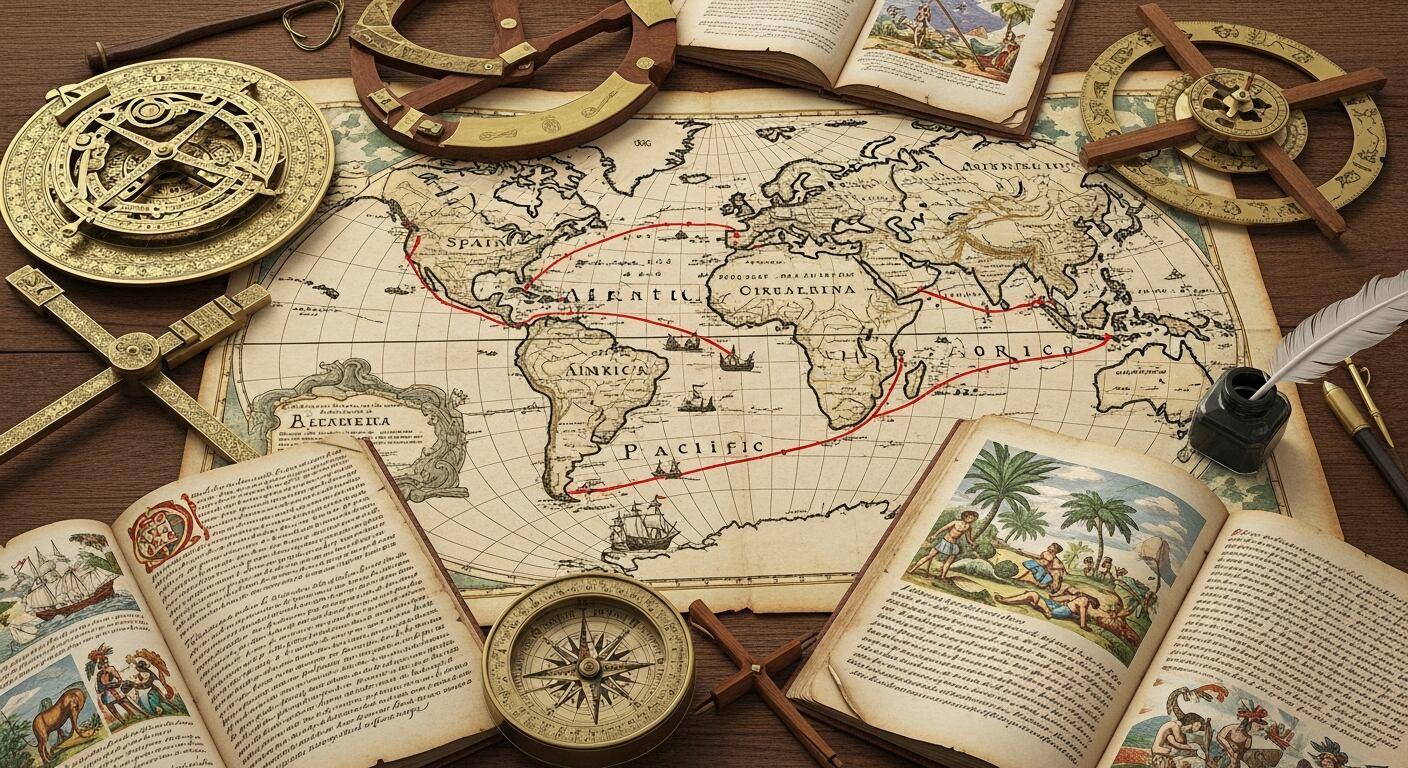

Long before European ships crossed the Atlantic, slavery was already an institution present in numerous civilizations of the world. Africa, the Middle East, Asia and the Mediterranean basin have experienced systems of capture, sale and exploitation of people. Transatlantic trade, however, changed the size, organization and consequences of this phenomenon. And the struggle for abolition opened another chapter in world history.
(Staff: International / History and Society)
There are chapters of history that are often presented through a single perspective. Slavery is one of them. In the current public debate, the subject is particularly associated with European colonialism, plantations in America, and the forced transportation of millions of Africans across the Atlantic Ocean.
This part of history is real, documented and extremely important. But it is not the beginning of slavery, nor its entire history.
Thousands of years before the emergence of the great European colonial empires, people were captured in wars, turned into the property of other people, sold, exploited, and transported over considerable distances. Practice existed in very different societies, from different continents, without being limited to a certain religion, race or civilization.
To fully understand the phenomenon, we must look at history without convenient selections and without turning historical responsibility into a collective accusation against a population.
1. Slavery in the Ancient World: Thousands of Years Before European Colonialism
Slavery is attested since the oldest documented civilizations. In Mesopotamia, legal and economic documents recorded the existence of people owned by others, their sale and various forms of compulsory labor.
In Ancient Egypt there were enslaved prisoners of war, dependent servants and people forced to work for the authorities. However, historians make an important distinction between actual slavery and forms of compulsory labor or servitude. Pharaonic Egypt cannot be simply described as a society built entirely on slavery.
In ancient Greece and Rome, slavery became an important component of the economy and social organization. People could be captured in wars, bought in specialized markets or reduced to slaves in debt and conflict.
Rome has developed an extensive servile labor exploitation system, using slaves in households, agriculture, mines, workshops and administration.
However, the phenomenon was not limited to the Mediterranean basin.
In China, various dynasties have experienced slavery and servitude systems, and in Korea, the institution named Nobi It became particularly important during the medieval dynasties and during the Joseon Dynasty. People in this category could be subject to hereditary obligations and very severe forms of dependence.
These realities demonstrate that slavery was not a European invention, nor an institution specific to a single continent.
2. Africa and Trans-Saharan Commercial Networks
Africa has a complex history of slavery, prior to both transatlantic trade and European trade expansion.
In various African societies there were practices of capturing prisoners, enslavement in the aftermath of wars, selling people and using servile labor.
With the development of the Trans-Saharan trade routes, these practices became part of economic networks that connected Sub-Saharan Africa to North Africa and the Middle East.
African merchants and intermediaries, local leaders and North African merchants participated, in various periods, in the capture, transport and commercialization of people.
It is important to point out that not all African societies participated in the same way and that Africans were not just victims or only traders. Some communities have been involved in capturing and selling other populations, while others have been victims of raids and wars.
The routes crossed the Sahara Desert, connecting areas of the Sahel and West Africa with the markets of the north of the continent. The transported people were used in households, agriculture, administration, army and other economic activities.
This trade was not a short episode. Trans-Saharan networks have been in operation for many centuries, and the trade in persons continued after the emergence of the transatlantic system.
The researchers point out that African slavery must be understood by its regional and historical diversity, not by a single generalizing formula.
3. North African corsairs and Europeans transformed into slaves
Another insufficiently known chapter in popular debate is that of capturing and enslaving Europeans by the corsairs in northern Africa.
Beginning in the Middle Ages and especially in the 16th-18th centuries, corsairs operating from ports such as Algiers, Tunis and Tripoli attacked coastal ships and coastal localities in Europe.
The captives were transported to North Africa and sold or used as slaves. Among the victims were sailors, fishermen, merchants and inhabitants of coastal communities. Captured women and children were also exposed to enslavement.
Historians have documented raids on some regions of Italy, Spain, France, Portugal, Greece, the Mediterranean islands and even some areas of the British Isles.
Research published by Mhamed Oaldi in the Oxford Research Encyclopedia of African History shows estimates of up to 1.25 million Christian captives in the Maghreb during 1530–1780.
These figures should be treated as historical estimates, not an exact census.
The phenomenon was not exclusively one-way: in the Mediterranean there were also captures and enslavements of the North Africans by the European powers and corsairs.
This history is essential for understanding the complexity of relations between Europe and North Africa. Slavery was not a simple relationship between a single group of victims and a single group of responsible.
4. Transatlantic trade: the transformation of slavery into an economic system of industrial proportions
Beginning in the 15th century, the European maritime expansion opened a new chapter in the history of the human trade.
Portugal was one of the pioneers of the transatlantic transport of enslaved Africans, followed by Spain, the Netherlands, England, France and other commercial powers.
The system developed in direct connection with the colonial expansion and the plantation economy of the Americas and the Caribbean.
Sugar, tobacco, coffee and later cotton have become extremely profitable products for European economies. Their production required a large workforce, and the traders and plantation owners built an exploitation system based on the transport and forced labor of millions of people.
At this stage, the slave trade has acquired an unprecedented economic and logistical dimension. Specialized ships, commercial companies, financial institutions, maritime insurance, ports and colonial infrastructures have been integrated into an international mechanism.
Britain became one of the main powers of this system, especially between 1640 and 1807.
According to estimates presented by the British National Archives, approximately 3.1 million Africans were transported by British merchants, of which approximately 2.7 million reached their destination.
But it is important not to confuse major British responsibility with the idea that Britain invented transatlantic trade or that it was the only power involved. Portugal has transported in total more enslaved Africans than the UK.
Also, the system was not possible without the participation of African drivers, traders and intermediaries who provided captives to coastal markets, in parallel with the captures and raids carried out by Europeans.
This reality does not diminish the responsibility of the European colonial powers. However, it explains more completely the economic and political mechanism of transatlantic trade.
5. Britain and the beginning of a major historical change
In the second half of the 18th century, an organized movement against the slave trade began to develop in Great Britain.
There were several causes: religious movements, debates about human rights, pressure from civil society, the testimonies of former slaves and the actions of those who opposed the colonial system.
Important personalities included William Wilberforce, Thomas Clarkson, Granville Sharp and Olaudah Equiano, a former slave turned author and militant for abolition.
An important role was also played by activists of African origin, such as Ottobah Cugoano and members of the Sons of Africa group.
In parallel, the revolts of the enslaved populations in the colonies demonstrated that freedom was not a simple political concession, but also the result of the resistance of those living in slavery.
The Haitian Revolution, which began in 1791, was one of the most important events of this period. The revolt of the enslaved population of Saint-Domingue led to Haiti’s independence in 1804.
In this context, the British Parliament adopted in 1807 the law that prohibited British slave trade.
It was a major historical decision, but it did not mean the immediate abolition of slavery in the British Empire. This was made legislatively through the Slavery Abolition Act of 1833, which entered into force in 1834 in most of the territories concerned. The system of so-called “apprentice” imposed on former slaves continued until 1838.
6. British fleet and the fight against international trafficking
One of the most important elements of the British contribution to abolition was naval intervention.
Following the ban on British trade, Royal Navy began tracking the ships involved in the illegal transportation of enslaved persons.
The West Africa Squadron, a specialized naval unit, has carried out operations in the Atlantic, especially off the West African coast.
Between 1808 and 1869, this squadron captured more than 1,600 ships involved in the illegal trade and contributed to the release of approximately 150,000 Africans.
Britain also used diplomatic instruments, international treaties and pressure on other states to limit the transport of enslaved people.
These operations played an important role in diminishing transatlantic trade, although they failed to eliminate it immediately.
Trafficking continued mainly to Brazil and Cuba, and other powers maintained slavery systems for decades after British law passed.
7. Was Britain the first to ban the slave trade?
A distinction must be made for an exact historical presentation.
Denmark-Norway passed in 1792 a law banning transatlantic slave trade under the Danish flag, with entry into force in 1803.
Britain passed its own law in 1807, becoming one of the first major commercial powers to ban transatlantic trade and subsequently assuming a major role in the international application of the ban.
But neither the Danish nor the British decision meant the immediate release of all the enslaved people.
Moreover, the prohibition of trade and the abolition of the institution of slavery are two different historical events.
In the British case, the abolition of slavery in most imperial territories came in 1834, and in other territories of the empire there were exceptions and delays.
Therefore, the British contribution must be recognized in its real dimension: legislation, political mobilization, diplomacy and naval intervention.
However, it would not be fair to attribute exclusively to Great Britain the disappearance of slavery. The resistance of the enslaved, the riots, the international abolitionist movements and the decisions of other states have also contributed to this process.
8. Slavery has not disappeared from the world
The legal abolition of slavery has not eliminated all forms of human exploitation.
Currently, the International Labor Organization, Walk Free and the International Organization for Migration estimate that about 50 million people were living in modern slavery conditions in 2021.
Of these, about 28 million were victims of forced labor, and 22 million were involved in forced marriages.
These estimates show that the phenomenon continues to exist, even if its contemporary forms are different from the historical systems of legal ownership of people.
Human trafficking, sexual exploitation, forced labor, debt easement and child exploitation are issues affecting societies in all regions of the world.
So, we cannot say that slavery has been permanently eliminated. We can say that it has been convicted and banned in modern laws, but it continues to exist in illegal and hidden forms.
Conclusion – history must be presented in full, not selectively
The history of slavery is much older and more complex than the account limited to European colonial expansion.
It existed in ancient civilizations, in Africa, in the Middle East, in Asia and in Europe. There were victims of various origins and populations who, in different historical periods, participated in the capture, commercialization and exploitation of other people.
Transatlantic trade was a particularly broad and brutal stage, in which the European powers built an international economic system based on the forced labor of millions of Africans.
Britain had a central role both in the development of this system and in the legislative and naval movement that sought to abolish the slave trade. This historical contribution must be recognized, without hiding the previous responsibility of the British Empire or the contribution of other people and nations to abolition.
But perhaps the most important lesson is another: history must not be a tool to justify collective identities, nor a selective catalog of guilt.
Authentic historical education must present the documents, facts, context and responsibilities of all the actors involved.
We cannot understand the past if we choose to know only the chapters that suit us. And a society that wants generations capable of thinking independently must give them access to the entire history, including those pages that are uncomfortable for any civilization.



Leave a Reply