
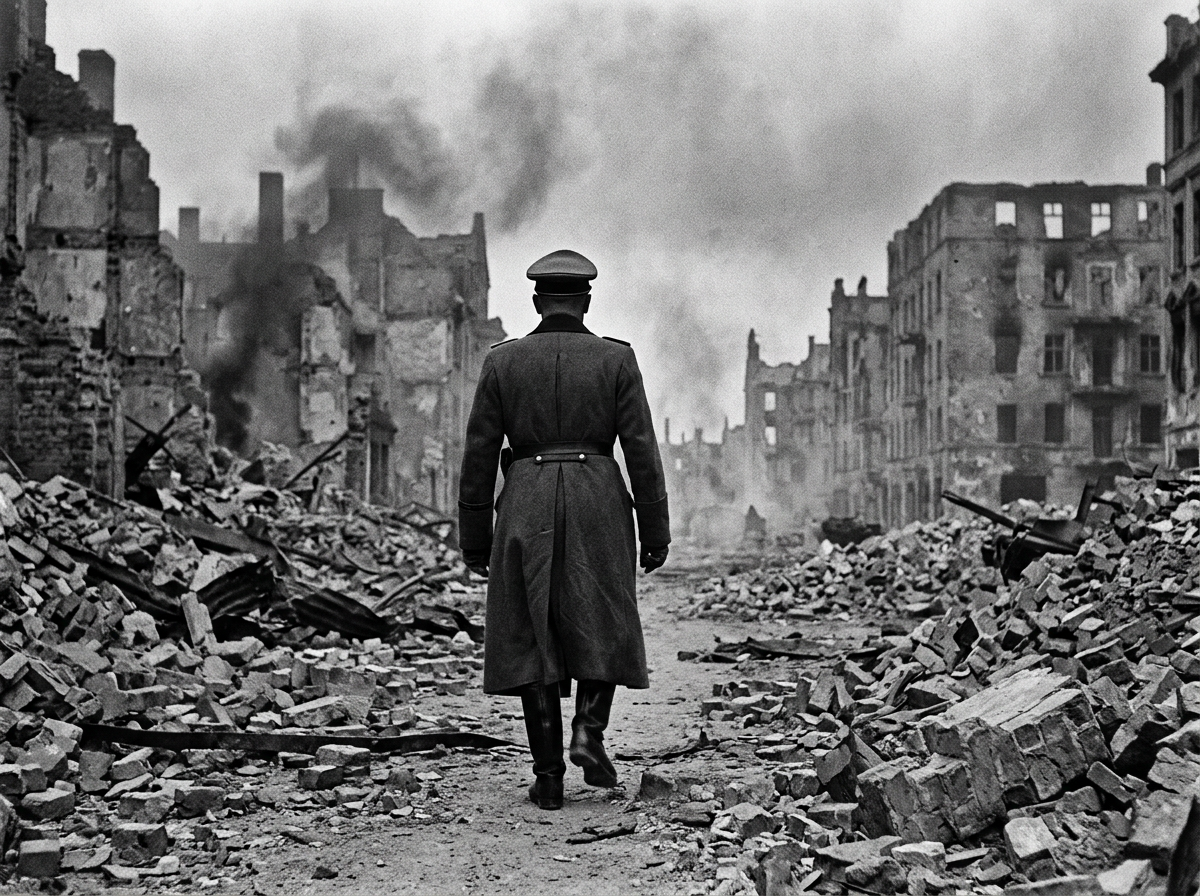

During World War II, Oskar Dirlewanger led an exceptional brigade – an SS unit made up of convicted criminals, released from prisons to fight on the front. His extreme brutality has aroused even among the SS officers, who considered him a lawless monster. He died in prison, killed by the Polish soldiers he had tortured.
(Staff: Germany & Poland / History & War)
In the Black Gallery of the Criminals of the Third Reich, his name Oskar Dirlewanger occupies a special place. He was not just a war criminal, but he was such an abject character that he was despised even by the other Nazis. While many SS officers were feared, Dirlewanger was also ugly—for his extreme sadism, for the gratuitous cruelty, and for the brutality with which he led his unit of convicted criminals.
Who was Oskar Dirlewanger?
Born in 1895, Dirlewanger was a German officer who fought in World War I, where he was decorated for courage. After the war, he was involved in Freikorps, and later convicted of murder and theft during the crisis years of the Weimar Republic. In 1937, he was arrested for rape and for allegedly having sex with a minor. He was convicted, but escaped from prison through high-level intervention and enlisted in the Condor Legion in Spain during the Spanish Civil War.
Due to his relations within the SS, especially with Gottlob Berger, Dirlewanger was reinstated in 1940. He received command of a special unit, originally made up of poachers, intended for combating the partisans behind the front.
Dirlewanger Brigade – A Unit of Criminals
The unit was known by several names: “SS-Sonderkommando Dirlewanger”, and later “SS-Sturmbrigade Dirlewanger”. His soldiers were mostly Condemned criminals – criminals released from prisons in exchange for military service. They were promised amnesty for the crimes committed before the war, if they fought mercilessly on the front and behind the lines.
The unit was joined by people considered politically undesirable, prisoners of war and even psychopathic criminals. This composition made the discipline impossible to maintain, and abuses of all kinds – rapes, robberies, murders – were the order of the day.
Mass murder in Belarus and Poland
Dirlewanger led his unit into bloody actions in Belarus, where they participated in the burning of villages, mass murder of civilians and systematically eliminate any opposition. In 1942, he took part in Operation “Fieseler”, during which hundreds of villages were destroyed and thousands of people were killed.
The most notorious action took place in 1944, during the Warsaw Insurrection. The Dirlewanger Brigade was sent to crush the revolt, and its methods were so brutal that they sparked protest even among other SS officers. Dirlewanger’s soldiers raped, tortured and killed civilians, with no distinction between combatants and non-combatants. It is estimated that, together with other Nazi units, it killed between 150,000 and 200,000 civilians Poles during the insurrection.
despised even by the Nazis
Even though atrocities were the norm in the Nazi War, Dirlewanger managed to stand out. High-ranking SS officials, including Heinrich Himmler, received reports of its excesses. Some of his officers demanded that he be withdrawn from the front. However, Himmler protected Dirlewanger, considering him a useful tool in the fight against the partisans.
Dirlewanger was known for his extreme alcoholism, sexual abuse and sadistic cruelty. It is said that he encouraged his soldiers to torture the prisoners in ways that even the SS considered unacceptable.
The End: Killed by Polish Soldiers
At the end of the war, Dirlewanger was captured by French forces. He was transferred to a prison camp in Altdorf, where there were also Polish soldiers. On the night of June 4, 1945, Dirlewanger was beaten to death by his Polish guards, most likely as revenge for the atrocities committed by his unit in Poland.
Conclusion
Oskar Dirlewanger is an extreme example of how Nazi war and ideology produced monsters. What makes it unique is that it was a product of the system, but also an anomaly – a criminal so brutal that he was rejected by his own comrades. His story remains a grim warning of how free cruelty and lack of any moral boundaries can turn a man into a beast, even a beast regime.




Leave a Reply