
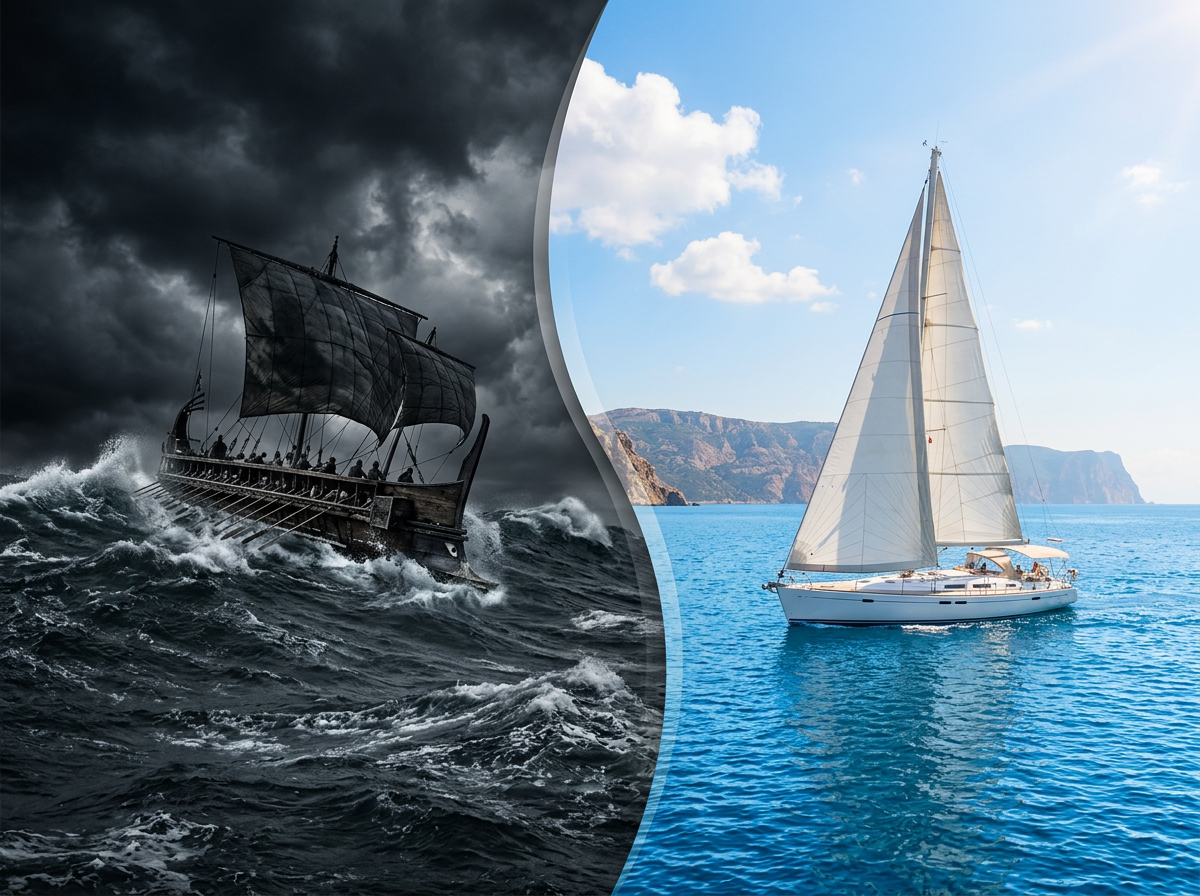

In antiquity, the Greeks called it “Pontos Axenos” – the Inhospitable Sea – due to the terrible storms and the savage tribes on its shores. Later, after colonization, it became “Pontos Euxeinos” – the Hospitable Sea. The current name, “Black Sea”, comes from the Turks, who associated the north with darkness, as opposed to the bright south of the Mediterranean Sea.
(Staff: Romania & Turkey / History & Culture)
The Black Sea today bears a name that seems to hold a dark story. However, over the millennia, this body of water has had several names, each reflecting the perception and relationship the surrounding peoples had with it. From the Greeks to the Romans, from the Byzantines to the Turks, each civilization left its mark on this name. And its story is a fascinating one.
The Cimmerians and the Scythians – the first to name it
The first known inhabitants of these lands, the Cimmerians (16th–11th centuries BC), called it “Axania”, which meant “dark blue”. They were followed by the Scythians, migratory tribes of shepherds and warriors who, in the 8th century BC, occupied the north of the Black Sea.
The Greeks: from “Inhospitable” to “Hospitable”
In the 8th century BC, Greek colonists arrived on the shores of the Black Sea. Their first impressions were grim: terrible storms, harsh winters, dangerous waters, and hostile tribes. They named it “Pontos Axenos” – the Inhospitable Sea. Another linguistic theory suggests that the name was a phonetic calque from an Indo-Iranian language, where the word for “black” referred to the northern cardinal direction. In the ancient representation of the world, the north was associated with darkness, as opposed to the bright south. As Greek colonies multiplied along the coasts and navigation became safer, the perception changed. Through antiphrasis or euphemism, the Greeks transformed the name into “Pontos Euxeinos” – the Hospitable Sea. This remained the main name of the sea in antiquity, and the Romans Latinized it to Pontus Euxinus.
The Byzantines and the Genoese: “The Great Sea”
During the Eastern Roman Empire (4th–16th centuries), the Black Sea was called “Megali Thalassa” by the Greeks and “Mare Maggiore” by the Genoese. The name reflected its impressive dimensions and its extreme position, being considered the largest of the seas. In the chancellery of the Romanian lords, the name “the great sea” was adopted and figured as the extreme limit of possessions.
The Turks: “Kara Deniz” – The Black Sea
The current name was given by the Ottoman Turks. They associated the cardinal points with colours: the North with darkness (black), and the South with light (white). Since the Black Sea was located north of the centre of their empire, they named it “Kara Deniz” – the Black Sea. In contrast, the Mediterranean Sea, located to the south, received the name “Ak Deniz” – the White Sea. The earliest written attestations of the name “Black Sea” appear in a Hungarian chronicle and in Nordic sources. On medieval maps, the name appears in the triple form PONTUS EUXINUS, CARA DENGHIS, MARE NIGRUM (Latin, Turkish, Italian).
Conclusion
From “Axania” to the “Black Sea”, each name of this sea tells a story about the peoples who inhabited it, their fears and hopes. What was once a space of danger became a vital trade route, and its current name, given by the Turks, has remained and spread to all the languages of the six riparian countries: Romanian, Russian, Ukrainian, Bulgarian, Georgian, and Turkish. It is a name that summarises, in a single word, the history of an entire region.



Leave a Reply