

Campulung Muscel, 1986–2026. Four decades of rock, generations of musicians, and a story that continues
At the end of August, Câmpulung Muscel will once again become one of the important points on the European rock map. From August 28 to 30, 2026, Posada Rock Festival celebrates 40 years of existence with an anniversary edition bringing major names from international rock and metal to the stage in Câmpulung.
Dark Funeral, Moonspell, Soen, Tiamat, Carach Angren, Massacre and Evil Invaders are among the bands announced for this edition, alongside the bands taking part in the traditional competition dedicated to the underground scene.
But beyond today’s names and the international stature the festival has acquired, there is a moment from which this story must begin.
1986.
The first edition.
And the name of the band that won it: ROGVAIV from Ploiești.

A festival born in Romania in the 1980s
Posada Rock emerged at a time when Romanian rock music was developing under difficult circumstances. The first edition took place from September 24 to 26, 1986, as a three-day festival and competition, bringing together underground bands and important names from Romanian rock for the recital programme.
Nine bands took part in the inaugural edition.
The Grand Prix and the “Posada” Trophy went to ROGVAIV – Ploiești.
First prize went to Fair Play from Miercurea Ciuc, second prize to Modul from Oradea, while third prize was shared by Replica from Pitești and Propuls from Câmpulung. The jury’s special prize went to Demos from Buzău, and the Popularity Award to Getic from Câmpulung. The Bucharest band Sens performed in the recital programme.
In an article published in the Romanian press a few weeks after the event, the result was recorded simply: the first edition of the new “Posada” festival had been won by the Ploiești group ROGVAIV.
Forty years later, that name is part of the festival’s history.
ROGVAIV did not appear by chance

For the band’s founder and leader, Cristin Tomeci, the victory at Posada was not an isolated moment.
ROGVAIV had been founded during his student years at the Faculty of Petroleum and Gas in Ploiești, and the band was already on the rise within Romania’s rock and pop festival circuit.
But the band had older roots.
Cristin Tomeci is originally from Câmpulung Muscel. In the 1970s, before the ROGVAIV period, he and friends from his hometown founded the band ATM, which he considers the city’s first rock band.
For Tomeci, therefore, the Posada story is not merely the story of a competition won in 1986. It is connected to his own musical formation and to the time when Câmpulung was the place where he first discovered rock.
“Even though I was a student in Ploiești, I always remained a man of Câmpulung for that city,” Cristin Tomeci said in an interview about ROGVAIV and Posada Rock.
Who were the musicians who won the first Posada?
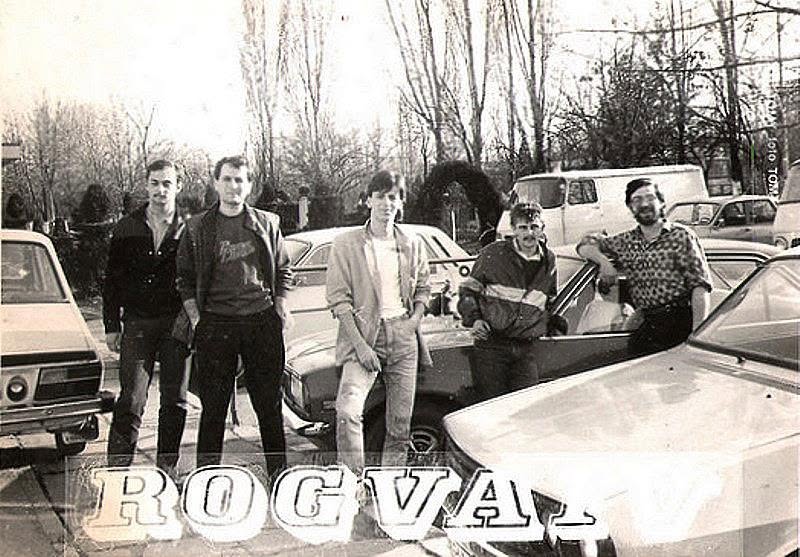
The 1986 ROGVAIV line-up included:
Geo Dobrescu – vocals
Costel Râșniță “Rama” / “Man-Man” – guitar
Felix Barcsy – keyboards
Călin Vișoianu – drums
Cristin Tomeci – bass, vocals and band leader
Photographs and period documents preserve the image of a young band that was nevertheless experienced enough to win a national competition.
The name ROGVAIV was also chosen deliberately: it is the Romanian acronym for the colours of the visible spectrum – red, orange, yellow, green, blue, indigo and violet. In an interview, Tomeci explained that the band’s members came from different parts of the country and had different educational backgrounds, but sought to unite through music, like colours which, together, form white light.
From the Romanian scene to an international career
Cristin Tomeci’s story did not end with the ROGVAIV years.
After spending years in Romania, life took him to Belgium, to Flanders, where he continued working in music and developing international projects.
He became involved in the European music industry and eventually took on an international leadership role at Global Battle of the Bands – GBOB, one of the international competitions dedicated to emerging bands.
In an interview some years ago, Tomeci explained that his interest in the music industry grew stronger after studying “Muziekondernemerschap” in Tilburg, the Netherlands, and that he later went on to organise and develop GBOB projects in Belgium, the Netherlands and Romania. Since 2010, he has been involved in the international leadership of the competition.
His connection with Posada continued after he left Romania. In 2008, in an article about ROGVAIV, the band was again presented in the context of the Romanian rock scene, while Tomeci was mentioned both as the group’s leader and as GBOB’s international director.
Eight albums and a new musical chapter
Alongside his work in the music industry, Cristin Tomeci continued his own artistic career.
Over the four decades since the first Posada edition, his music has gone beyond Romania’s borders. He has released eight albums internationally, available on CD, vinyl and digital formats, recorded in three languages.
His latest album carries a title that perhaps says more than any biography: “Întoarcerea acasă” (“Returning Home”).

The album is in Romanian and represents an artistic return to the language and cultural space from which he came.
Although in recent years Cristin Tomeci’s music has reached an increasingly international audience, including listeners in English-speaking markets, his connection with his birthplace has never disappeared.
From Flanders, Belgium, after more than three decades of life outside Romania, the artist continues to speak about Câmpulung Muscel, Muscel and the Carpathians as places that remain part of his artistic identity.
Those who wish to discover his musical work can find him at cristintomeci.com, as well as by searching for “Cristin Tomeci” on the main streaming platforms and social networks.

Forty years later
Today, Posada Rock is presented by its organisers as the oldest open-air rock festival in Romania. Over the years, the festival has become an international event, and the stage in Câmpulung has hosted numerous Romanian and international bands.
In 2026, four decades after its debut, the festival returns with an anniversary edition at the Municipal Stadium in Câmpulung Muscel.
For younger generations, the name ROGVAIV may be just a page in the history of Romanian rock.
For those who were there in the 1980s, however, the story carries a different weight.
It was a time when a student band from Ploiești could take the stage at a new festival, in a city at the foot of the Carpathians, and return home with the Grand Prix.
It was 1986.
ROGVAIV.
The first Posada.
And the beginning of a history that continues to this day.
A greeting from Flanders to Muscel
Forty years after that victory, Cristin Tomeci will not be present at the 2026 anniversary edition.

According to his statement, neither he nor his former bandmates who live in Romania were officially invited to the event. For the members of the band, such an invitation would have represented a natural recognition of the fact that their names stand at the beginning of the festival’s history.
His message, however, is not one of breaking with Posada.
Quite the opposite.
It is a message of respect for those who have continued to keep the festival alive and for the generations of musicians who have taken part in the Câmpulung competition.
“Congratulations to those who keep the festival’s flame burning” is, in essence, the message conveyed by the artist.
And from Flanders, after more than 30 years of life in Belgium, his greeting returns to the city at the foot of the Carpathians where it all began.
Câmpulung Muscel.
His hometown.
The city where, almost half a century ago, a group of young people began playing rock.
The city where, in 1986, ROGVAIV won the first Posada.
And the city that, 40 years later, continues to play rock.
Happy 40th anniversary, Posada Rock!
Congratulations on 40 years of history!
And for those who want to discover what Cristin Tomeci is doing today, the story continues through music.
This time, through an “Întoarcerea acasă” – a “Returning Home”.




Leave a Reply