
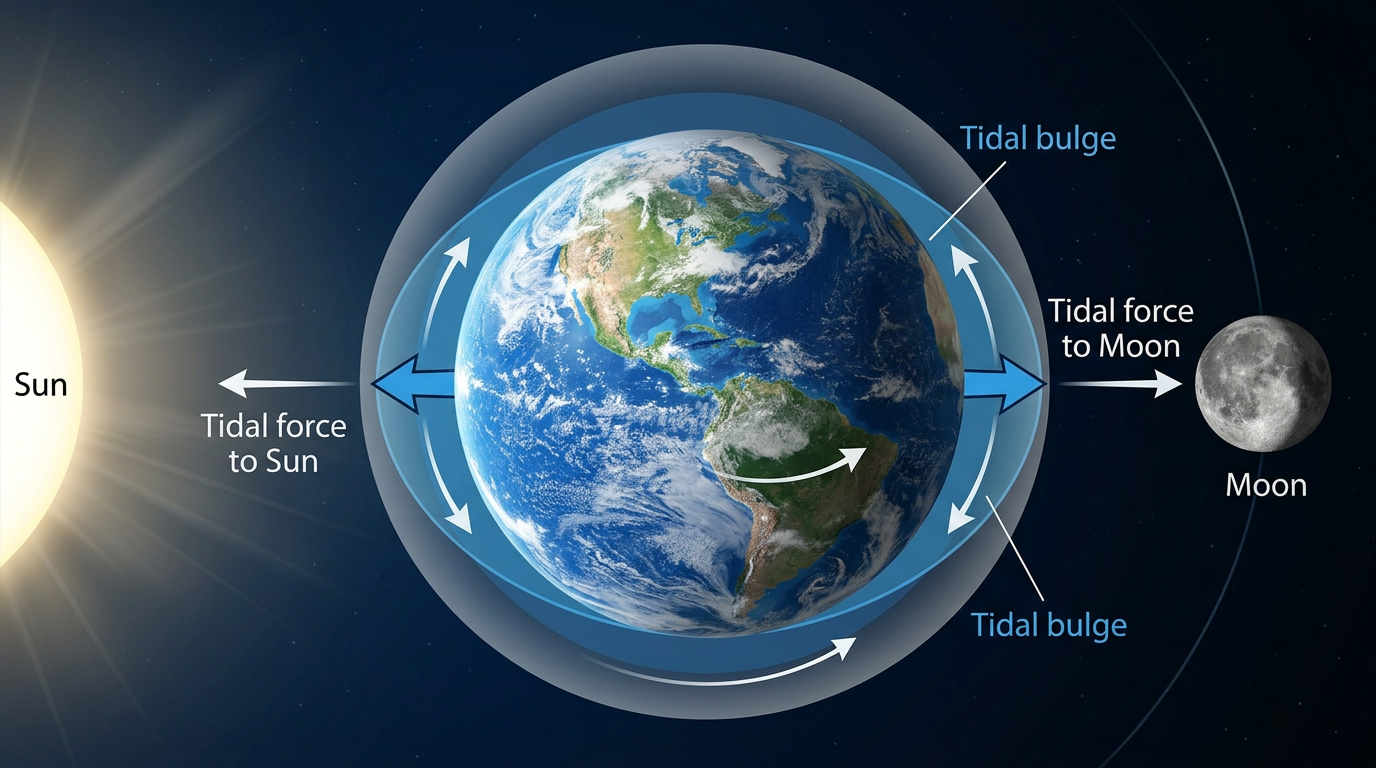

On a social network, a specialist explained the physical mechanism of braking the planet. The tidal forces and gravitational interactions cause a slow slowdown, but the effects will not be visible until billions of years from now.
(Staff: Netherlands & Belgium / Science & Education)
A seemingly simple question – “Why doesn’t the earth stop from spinning? Does the space provide any form of friction resistance?” – generated a detailed and captivating response from an electronics/computer engineer, Fonne Deleeuw. He explained that although there is no friction in space in the classic sense of the word, the earth is gradually slowing down, but the process is so slow that the effects are not noticeable on a human scale.
How has the rotation speed of the Earth evolved?
According to Deleeuw, at the time of the formation of the Earth, about 4.5 billion years ago, a day lasted only 5 hours. The tidal forces – generated mainly by the gravitational attraction of the Moon, but also by the Sun and Jupiter – acted as a brake in time. This phenomenon gradually reduced the speed of rotation:
- Now 600 million years, when the first complex life forms appeared, a day already lasted 19 hours. .
- During the Dinosaurs, now about 68 million years, the day was approaching 23 hours. .
- Today, a day lasts 24 hours, and the slowing process continues, but at an extremely slow pace: approximately 1.8 milliseconds per century. .
Tidal forces – main brake
Deleeuw explains that tidal forces are the main cause of this slowdown. The moon attracts the Earth and creates the oceanic tides, which, by rubbing with the bottom of the oceans, consume kinetic energy from the planet’s rotation. This effect is similar to braking a tip that rotates on a surface, but on a colossal scale.
Another user, François Wouters, added that the Earth will not stop completely before the sun has gone out or the solar system is no longer there. The braking process is so slow that it would be necessary Tens of billions of years For the Earth to have a rotation synchronized with its orbit around the Moon-like Sun, which always shows the same face.
Controversial theories and scientific argumentation
The discussion also sparked reactions from people who questioned the very heliocentric model, suggesting that the Earth is flat and stationary. These interventions were contradicted by most participants, who pointed out that scientific explanations are based on solid observations, calculations, and experimental evidence, not on speculation or literal interpretations of some religious texts.
Conclusion
Although the Earth will not stop spinning soon – and humanity will not witness this end – its slowness is a well-documented scientific fact, caused by gravitational interactions with the Moon, the Sun and the planets. Understanding this process shows us how fragile and delicate is the balance that governs heavenly movements. And for those who believe that the earth is flat and still, the scientific community’s response is, above all, one based on evidence and reason.




Leave a Reply