
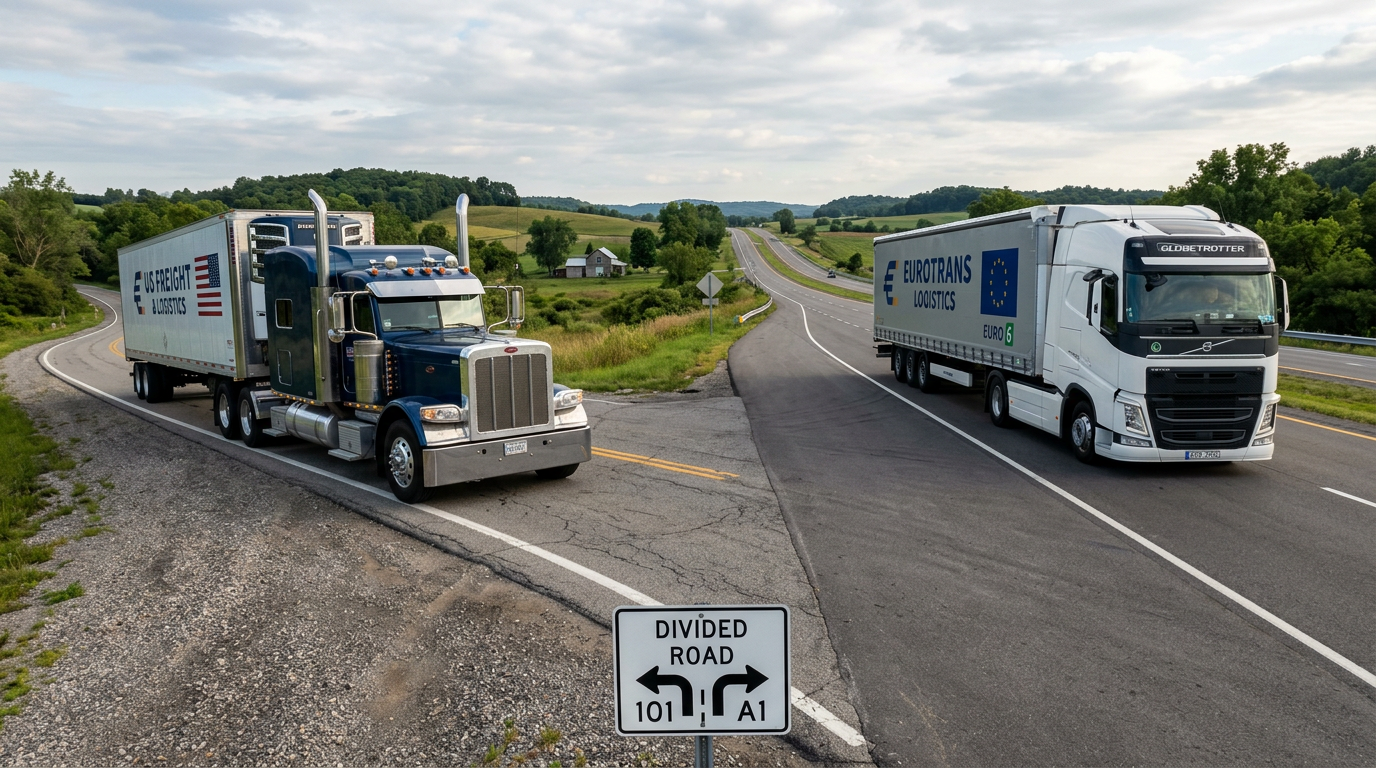

Laws, bridges, dimensions, roads, and an entire trucking culture – this is what transformed the American and European trucks into two radically different vehicles. A viral video explains, in simple terms, why one continent chose the long hood, and the other the compact cab.
(Staff: United States of America & Europe / Transport & Technology)
At first glance, the difference between an American and a European truck seems to be just a matter of design. On one side, the American mastodons, with long hoods, shiny chrome, huge engines, and spacious cabs, seem to have stepped right out of movies about the great American highways. On the other side, European trucks, built in most cases with the cab positioned over the engine, have a compact, much more vertical shape. But this difference is not just a matter of taste. Behind the shape of a truck lie decades of legislation, weight and length regulations, road characteristics, road infrastructure, transport economics, and even how each continent viewed the profession of professional driver. A video that went viral on social media presents, in a visual and accessible way, the evolution of the American truck and explains why, after the legislative changes in the United States in the 1980s, the long-nose truck began to become the emblematic form of American road transport.
Before 1982, truck length was a major issue
To understand why the American truck looks the way it does today, we need to go back in time. In the past, U.S. legislation on the length of road trains could limit the total length of the tractor-trailer combination. In such a situation, every inch occupied by the tractor cab could mean inches lost from the length available for cargo. This is where the advantage of the cab-over-engine (COE) truck comes in. If the engine is located under the cab, the tractor can be shorter, and the space available for the semi-trailer can be used more efficiently. For this reason, in certain periods, cab-over trucks were also found in the United States. It was not unusual for American or European manufacturers to offer such configurations. But the situation was about to change radically.
1982: the year that changed the American truck
One of the key moments presented in the video is the year 1982, when the United States adopted the Surface Transportation Assistance Act, known by the acronym STAA. The law had important consequences for American road transport. Among other things, the STAA required states to allow certain combinations of trucks that met the new federal standards to operate on the so-called National Network. For tractor-semi-trailer combinations, the legislation set a minimum length of 48 feet for the semi-trailer, and for double-trailer combinations, requirements were established regarding their length. A very important aspect was that, on these roads, a general limit on the total length of the tractor-semi-trailer combination could no longer be imposed, under the conditions provided by law. In other words, the tractor no longer had to be as short as possible at all costs for the operator to benefit from a sufficiently long semi-trailer. This gave rise to the freedom to build a longer tractor. And American manufacturers began to exploit this freedom.
Why choose a long-nose truck?
If total length was no longer the same problem, the engine could be moved to the front of the cab. This brought back in force the classic American configuration: the engine in front, the cab behind it, and a long hood between the driver and the front of the truck. The image of the modern American truck was gradually built around this architecture. Kenworth, Peterbilt, Freightliner, International, and other manufacturers transformed the hooded tractor into a symbol of American transport. It was no longer just about space efficiency. The truck could be bigger, more comfortable, more imposing, and could benefit from a cab built behind the engine, with generous space for the driver. Over time, this configuration became part of American trucking culture.
80,000 pounds and the bridge problem
The video also draws attention to another essential component: weight. In the American system, the federal gross weight limit for certain trucks on the Interstate Highway System is 80,000 pounds, which is approximately 36.3 tons. But the issue is not just how much the truck weighs. It also matters how the weight is distributed across the axles. This is where what is known in the United States as the Bridge Formula comes into play. The principle is relatively simple: the more the weight is distributed over a greater distance and over more axles, the more the load exerted on certain infrastructure components can be managed differently. That is why the distance between axles is extremely important. A long truck does not automatically mean it can carry any weight. But the length and positioning of the axles can influence how the weight is distributed on the infrastructure. This is why, in the world of American trucks, chassis dimensions, axle position, and wheelbase are not just design elements. They have major technical and legal importance.
Why a long truck can be advantageous on a bridge?
The video uses a very suggestive comparison: two trucks carrying the same weight, but with different configurations. A shorter truck concentrates more weight in a smaller area. A longer truck can distribute the mass over a greater distance. This idea explains why the dimensions of the American truck should not be viewed solely through the lens of exterior appearance. Behind the long hood, the massive chassis, and the distance between axles lies a whole engineering logic. The American truck weight regulation system takes into account precisely these relationships between mass, number of axles, and the distance between them.
So why did Europe go in the opposite direction?
If in the United States the hooded truck became increasingly popular, Europe followed a different path. The main reason is that European infrastructure is, in many regions, much denser and more constrained. Europe has historic cities, narrow streets, roundabouts, small intersections, villages crossed by national roads, and a road network developed at a time when no one imagined the appearance of road trains weighing tens of tons. Under these conditions, the total length of the vehicle becomes extremely important. In the European Union, common rules on weights and dimensions of heavy vehicles are mainly established by Directive 96/53/EC and subsequent acts. For a common articulated assembly with a single articulation point, the general limit is 16.5 meters. In such a system, every centimeter occupied by the tractor must be used with great care. And here, the cab-over truck has a clear advantage.
Cab-over: maximum cargo in a limited space
On a European truck, the driver practically sits on top of the engine. The cab can be tilted for access to the engine compartment, and the front of the truck is much shorter. This architecture allows for more efficient use of the total length available for the road train. On European motorways, the advantage is obvious. But the real difference is seen when the truck has to enter a city. A European truck can be easier to maneuver in tight spaces, can have a better utilized length, and offers the driver a very good visibility position over the immediate vicinity of the vehicle. In contrast, the American long-nose truck needs more space in front for maneuvering and has a larger frontal area that does not carry cargo.
It’s not just about legislation
However, it would be wrong to say that legislation is the only reason why American trucks have become so different from European ones. There are also fundamental differences in how drivers work. In the United States, long-distance road transport takes place in completely different geographical conditions. A truck can travel thousands of miles on wide motorways, crossing entire states, with far fewer situations where it needs to enter historic centers with narrow streets. In Europe, a truck leaving Belgium can reach France, Germany, Luxembourg, the Netherlands, or other countries on the same day or in the same week, each with its own infrastructure particularities. European transport is much more connected to dense networks of cities and towns.
The roads dictate the shape of the truck
Perhaps this is one of the most interesting conclusions. It was not the truck that decided what the road should look like. To a large extent, the road decided what the truck should look like. America has vast spaces, very long highways, and transport corridors built for large freight flows. Europe has a much more fragmented infrastructure, with cities and towns close to each other and a much older road history. Consequently, two continents that transport the same types of goods have come to build radically different vehicles.
Driver comfort has also become important
There is also another aspect that should not be ignored: comfort. The American hooded truck offers the manufacturer the possibility to develop a very spacious cab. For drivers who spend days or even weeks on the road, the cab is not just a place from which to drive the truck. It is an office, a bedroom, a rest area, and sometimes almost a small mobile home. The photographs and images of spectacular American trucks presented in the video illustrate this culture very well: large cabs, elaborate finishes, chrome, lighting, comfortable seats, and generous rest areas. In Europe, the pressure for the most efficient use of total length and for maneuverability has favored a different philosophy.
And there is a cultural reason
For Americans, the truck is not always just a transport tool. In American popular culture, the long-haul truck has become a symbol. Movies, TV series, country music, trade magazines, and truck shows have all contributed to building an almost mythical image of the American trucker. A Peterbilt or a Kenworth with a long hood, impeccable chrome, and numerous lights is not perceived just as a commercial vehicle. It is also an expression of the owner’s or driver’s personality. In Europe, there is of course a strong truck culture, but the aesthetic is different. Here we more often encounter Volvo FH, Scania, Mercedes-Benz Actros, MAN, DAF, or Renault Trucks in cab-over configurations. The image of the European truck is closer to the idea of efficiency, technology, and space optimization.
An American truck is not necessarily “better”
The comparison between the two systems can easily lead to the conclusion that one is superior to the other. In reality, it is not that simple. An American long-nose truck is excellently adapted to the environment for which it was designed. A European cab-over truck is equally well adapted to the European environment. If we took a long American tractor and introduced it onto the narrow streets of some European towns, its advantages would quickly turn into disadvantages. Similarly, if we took a European cab-over truck and sent it across the United States in long-distance road transport, it might work very well technically, but it would not necessarily reflect all the preferences and traditions of the American industry.
A difference that says a lot about the two continents
Ultimately, the story of the American and European trucks is a story about two different ways of building infrastructure and transport economics. In the United States, the legislative changes of 1982 decisively contributed to creating the conditions in which the tractor could become longer without this directly reducing the legal length of the semi-trailer on the National Network. In Europe, the rules on the dimensions of assemblies and the characteristics of the infrastructure continued to favour the compact solution, with the cab over the engine. This results in two silhouettes that have become recognisable around the world. One with a long hood, the engine in front and a recessed cab, associated with the great American highways. The other with a vertical cab, positioned over the engine, optimised for the limited space of European networks.
From economy to symbol
Perhaps the most interesting thing is that an apparently technical legislative decision, taken more than four decades ago, contributed to transforming a vehicle into a true cultural symbol. Today, when we see an American long-nose truck crossing a road in Texas, California or Montana, its shape seems natural. But this shape did not appear by chance. It is the result of the meeting between legislation, engineering, infrastructure, economics and transport culture. Likewise, when we see a European MAN, Mercedes-Benz, Volvo, Scania, DAF or Renault truck with the cab over the engine, its compact shape tells, without words, the story of the continent on which it was designed to work. Ultimately, the truck is more than just a vehicle. It is a mirror of the roads on which it travels.





Leave a Reply