
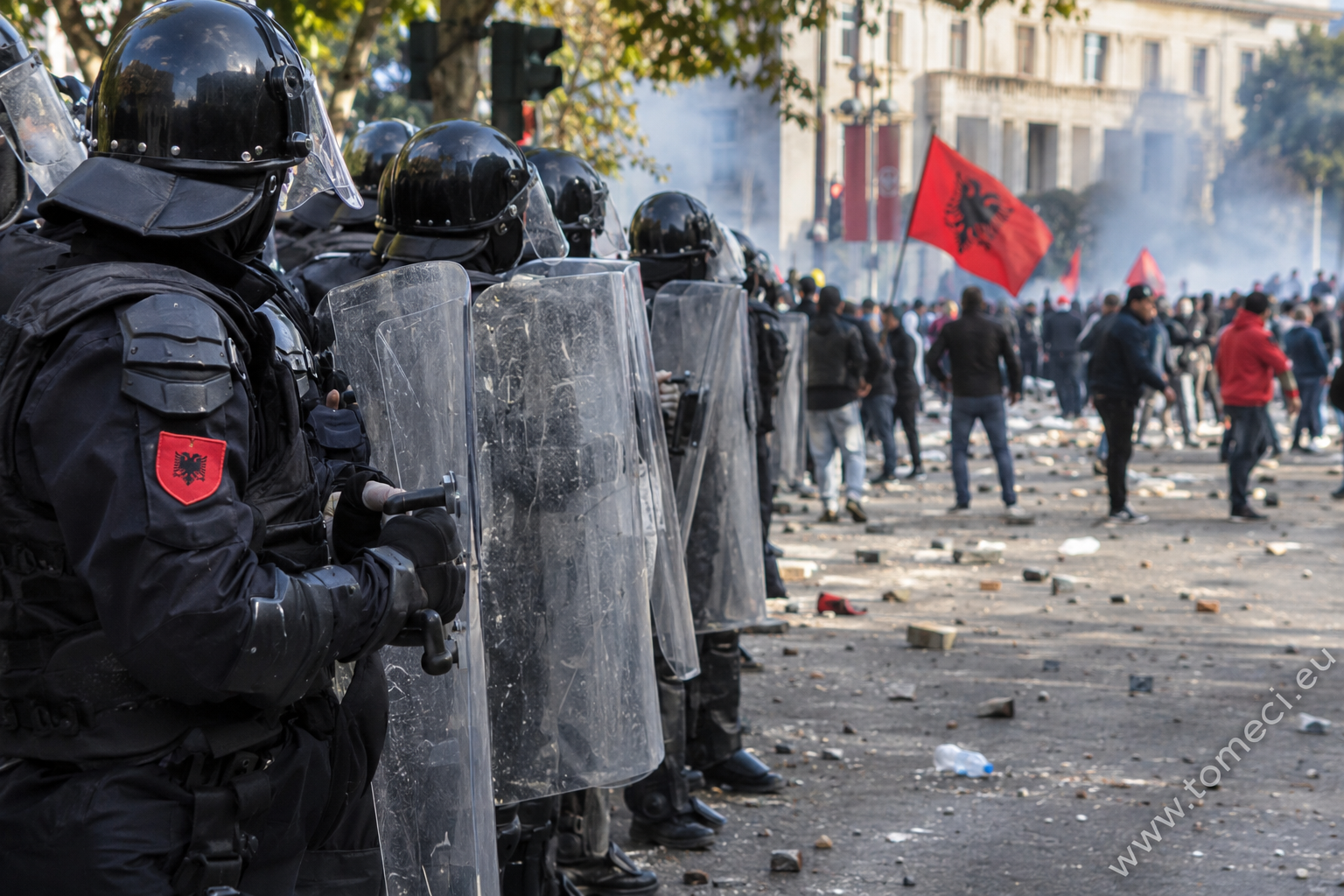
“We are not in Palestine or in a war zone. We are in Tirana, the capital of a country that says it wants European integration.” The message published by TVA News accompanies images of law-enforcement officers equipped for crowd-control operations and violent clashes in the streets of the Albanian capital.

Footage distributed by TVA News shows a tense scene in Tirana: police officers in riot gear, shields, stones and other objects scattered across the road. In one sequence, an officer is bent over beside another policeman while their colleagues remain in formation.
The commentary accompanying the footage is forceful and highlights the contrast between Albania’s European aspirations and the violence in the streets of its capital.
Protests that escalated into violence
In October 2026, Tirana was the scene of large-scale protests involving students, young people and opposition supporters. The demonstrations raised several demands: improving conditions in education, tackling corruption, creating opportunities for young people and calling for the resignation of Prime Minister Edi Rama.
On 24 October, the clashes intensified. According to reports from international news agencies and the Albanian press, some protesters threw stones, fireworks and Molotov cocktails at police officers and public buildings. Law-enforcement forces intervened with tear gas and water cannons.
Arson, damage to public and private property, arrests and numerous injuries were reported. The authorities announced that more than 300 protesters and police officers had been injured in the clashes that day.
An uncomfortable question for an EU candidate country
Albania has been seeking membership of the European Union for years. Accession negotiations have advanced, and European integration remains an officially stated strategic objective of the government.
However, the process is about more than diplomatic negotiations and legislative reforms. Respect for fundamental rights, freedom of expression, the right to peaceful protest and the proportionality of police interventions are also essential criteria for a European democracy.
At the same time, the right to protest does not justify attacks on police officers, setting buildings on fire or destroying property. The state is obliged to protect both public order and the rights of people demonstrating peacefully.
Between the European image and the reality on the streets
The footage from TVA News draws attention once again to a broader problem: the gap that can exist between declared political objectives and institutional reality.
A single video sequence cannot explain the entire situation, nor can it establish responsibility for every act of violence. But viewed in the context of the clashes documented in October, the images show how tense the situation in Albania’s capital has become.
The road to the European Union is not measured solely by political statements. It is also measured by the ability of institutions to manage conflicts without abuses, uphold the law and protect citizens’ rights.
Albania wants to become part of Europe. The question is how quickly its institutions will manage to turn that aspiration into a democratic reality.


Leave a Reply