
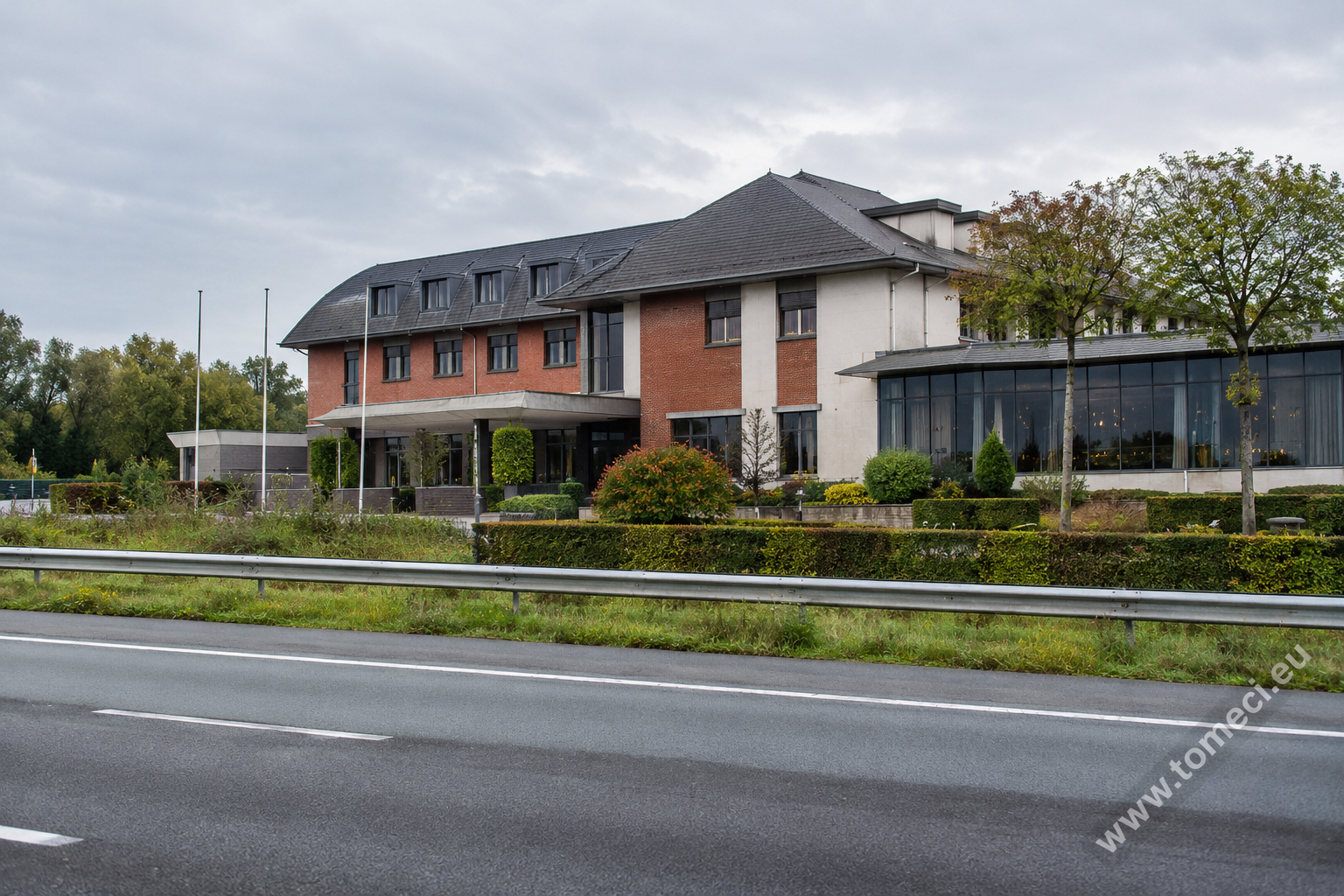
Vlaams Belang argues that the project beside the E17 motorway breaches several legal provisions and is calling for its opening to be stopped. At the same time, residents are demanding transparency about costs, permits and security measures. The dispute has now reached the courts.

A project by the Belgian federal government is causing tensions in Nazareth-De Pinte, in the province of East Flanders. The former Van der Valk hotel, located alongside the E17 motorway, is due to be converted into a European return centre for people who arrived in Belgium after entering the European Union through another Member State.
The project, announced in July 2026 by Minister for Asylum and Migration Anneleen Van Bossuyt (N-VA), is designed to accommodate up to 300 people. According to the authorities, the centre will temporarily house people whose international protection procedures must be handled by another European state, under the European rules that determine which country is responsible for examining an asylum application.
However, the choice of building, the funding arrangements and the legality of converting the former hotel have become matters of controversy.
Four legal objections raised by Vlaams Belang
On 19 November, Vlaams Belang representatives and MPs Francesca Van Belleghem and Ortwin Depoortere announced that they had identified four legal grounds on which the centre should not open in its current form.
According to the legal analysis presented by the party, the issues are as follows:
- The terms of the concession: The land belongs to the Flemish authorities and was granted to Van der Valk under a concession to provide services to users of the E17 motorway. Vlaams Belang argues that converting it into a reception centre conflicts with the purpose of that concession.
- Rules governing motorway service areas: The party argues that these sites are intended to provide services for drivers and that the function of a return centre is incompatible with that purpose.
- The zoning designation: According to Vlaams Belang’s interpretation, the land is classified as a private-services zone, and using it for a public reception function would not be consistent with that designation.
- Lack of authorisation for the change of use: The party says that environmental and planning permits would be required to change the building’s use and challenges the possibility of applying an exemption intended for emergency situations.
These are Vlaams Belang’s legal arguments, not a court ruling. The legality of the project still has to be determined through the competent procedures.
A dispute over the concession and public money
Another sensitive issue concerns the project’s financial arrangements.
The land belongs to the Flemish Region and is managed by the Agency for Roads and Traffic (Agentschap Wegen en Verkeer – AWV). The company Van der Valk holds the concession, and the hotel facilities are due to be leased to the federal authorities for the operation of the centre.
The project therefore involves two levels of government: the Flemish authorities, which manage the land and concession, and the federal state, through the services responsible for migration and return.
Vlaams Belang is calling for the value of the concession and the rent paid for the use of the building to be made public. Party representatives argue that citizens should be able to check the difference between the amount the company pays for the concession and the amount it subsequently receives under its contract with the state.
According to the MPs, requests for access to information were refused, and those refusals are now being challenged.
Until the financial documents are clarified, the total cost of the project to taxpayers cannot be established accurately on the basis of the publicly available information.
Court proceedings in Ghent and questions about permits
The dispute has also reached the courts. According to a statement by Vlaams Belang, the Flemish Region, the Belgian state, Fedasil and Van der Valk Immo Nazareth have been summoned before the Court of First Instance in Ghent in proceedings seeking to stop the centre from operating.
It is important to clarify that the legal action does not amount to a decision to cancel the project. The court must examine the arguments and rule on the applications submitted.
There is also a technical issue documented in parliamentary debates: the current permit for the wastewater treatment plant is based on the capacity of the former hotel – 84 double rooms, equivalent to a maximum of 168 people.
To accommodate 300 people, a more capable wastewater treatment facility and a new environmental permit would be required.
The local administration has also explained that, under certain conditions, the project could operate temporarily under an exemption from the requirement to obtain a planning permit, for a maximum period of three years. Whether that exemption applies and whether all legal conditions are met remain important questions in the case.
Residents demand transparency and security guarantees
Discontent is not limited to political parties. On 11 November, a local action committee handed the Nazareth-De Pinte administration a petition with more than 2,100 signatures opposing the location of the centre in the former hotel.
Residents cited a lack of consultation and transparency, and requested access to the studies carried out, the alternatives considered and the lease agreement.
Mayor Thomas Van Ongeval said the local administration shared some of the community’s concerns and that discussions were taking place with the police, fire services and provincial authorities about security and possible operational issues.
The neighbouring municipality of Sint-Martens-Latem, located about 800 metres from the site, also asked to be involved in organising communications and security measures. Its municipal council called for a cooperation protocol, a point of contact for urgent situations and prompt notification in the event of incidents.
These requests show that the project’s impact is being viewed as a regional issue, not merely a matter for the municipality where the building is located.
A project that must be clarified before it becomes operational
The centre in Nazareth-De Pinte sits at the intersection of several sensitive issues: European migration policy, Member States’ responsibility for asylum applications, the use of public property, contract transparency and the safety of local communities.
On the one hand, the federal authorities justify the project by the need to apply European rules and organise transfers to the countries responsible for examining protection applications.
On the other hand, critics insist that this policy must be implemented lawfully, with the appropriate permits, transparent contracts and clear measures for the neighbouring community.
Political claims about alleged crime risks cannot replace concrete security assessments and verifiable data. Residents are entitled to precise information about how the centre will be organised, the response procedures and the responsibilities of the institutions involved.
Before any opening, clear answers must be provided on legality, technical capacity, costs and safety. A public project of this scale cannot operate solely according to a political timetable: it must comply with the law and provide the community with guarantees that can be verified.

THE WEEKEND MAGAZINE


Leave a Reply