
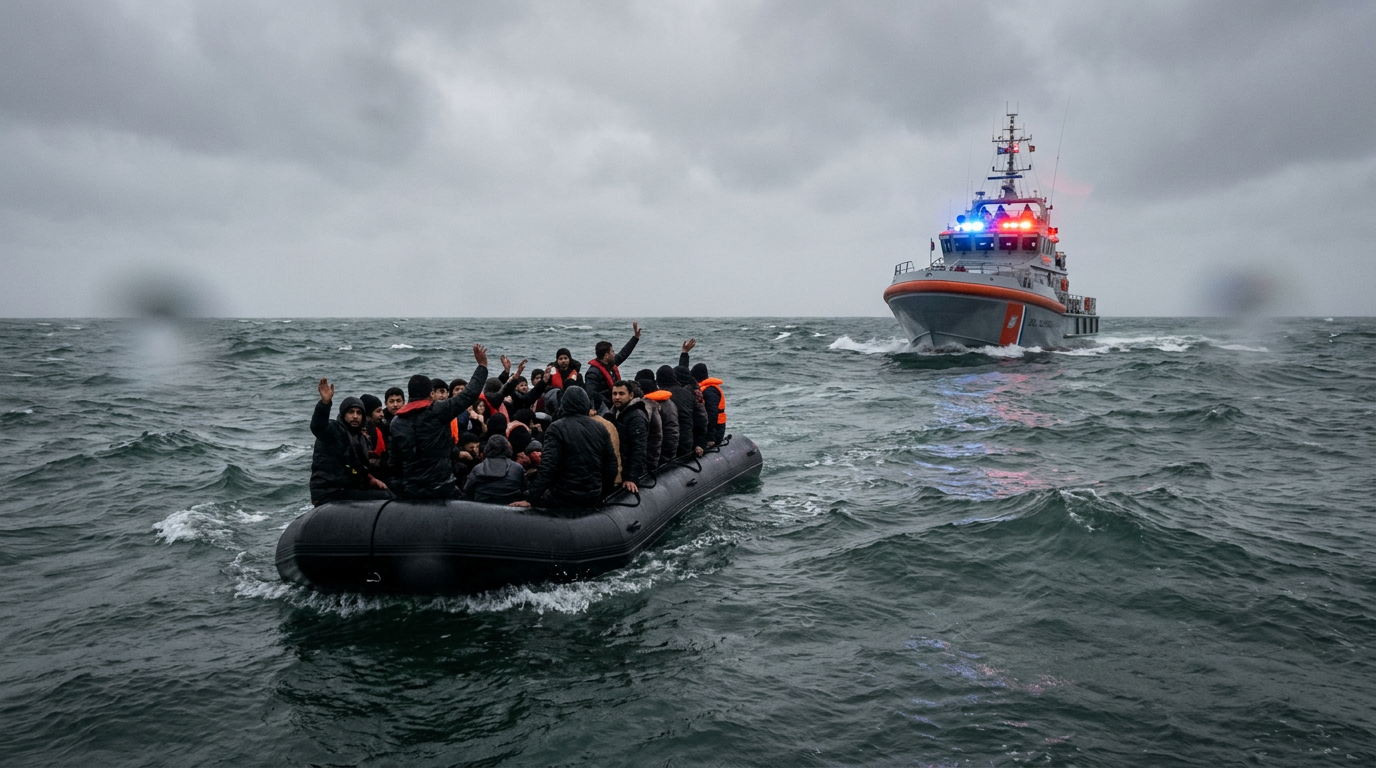

A tense Sunday on the North Sea. An overloaded boat with about 30 people attempting to cross the Channel was spotted off the coast of Belgium near the Nieuwpoort. Unlike the regular scenarios, the people on board put up an active resistance to the rescue teams, forcing the French authorities to take over a complex operation of tracking on the water.
(Staff: Belgium, France & United Kingdom / Migration & Maritime Security)
On Sunday morning, the territorial waters of Belgium were the scene of an incident that illustrates an increasingly harsh reality of the migration crisis in Western Europe. Emergency services were alerted to a small inflatable boat that was heading dangerously close to the shore, near the town of Nieuwpoort. On board there were about 30 people, considered to be people attempting to cross the Channel trying to cross the English Channel to the United Kingdom.
“They are putting up active resistance”
What appeared to be a standard rescue operation quickly turned into a confrontation at sea. The Belgian Federal Police intervened with crews on the spot to bring the craft to the shore and prevent a tragedy, given the precarious sailing state of the boat. But, according to the authorities, the migrants categorically refused the aid.
“We tried to bring them ashore, but they won’t,” An Berger, spokesman for the Belgian Federal Police, told the local press. “They offer a truly active resistance. They continue to navigate,” she added, emphasizing the unusual character of the situation. Most of the time, migrants at sea are grateful for the intervention of rescuers, but here, the fear of being returned to European land and losing their chance to reach the UK seems to have been stronger than the fear of drowning.
The takeover by the French authorities
As the craft refused to stop and continued to advance southwest, leaving the area of Belgium’s competence, the operation was transferred to the French counterparts. The authorities in Paris took over the coordination, following the craft into French territorial waters. This demonstrates the fluidity and, at the same time, the difficulty faced by the border police over networks of traffickers constantly changing routes.
This area of the North Sea has become, in recent years, an unofficial highway for illegal migration. Smuggling networks take advantage of the fact that maritime borders are difficult to guard and the relatively short distance between the continental coast (Belgium, France, the Netherlands) and the United Kingdom.
A growing phenomenon
The Nieuwpoort incident is not unique. Since the beginning of the year, the Belgian authorities have intercepted dozens of such boats. The traffickers’ methods have diversified, from rowboats to pneumatics bought from the supermarket, where dozens of people are crammed, often without life jackets.
The fact that migrants refuse to be saved and taken over by the authorities on the continent is a change of tactics. They know that if they are taken back to the shore, they risk being detained, fingerprinted and will be denied asylum, losing their huge financial investment made to traffickers. Thus, they prefer to risk everything at sea, trying to reach British waters, where the legislation and return procedures are perceived (often erroneously) as more favorable.
Conclusion
Sunday’s operation at Nieuwpoort is a snapshot of the desperation and determination of people fleeing from poverty or war. However, it also raises serious question marks about safety at sea. The refusal of the rescuers is an extreme act, which endangers both the lives of migrants and those of emergency crews. It remains to be seen how the pursuit in French waters will end and whether all 30 people will arrive safely. It is certain that the North Sea continues to be a deadly border, hardly guarded by the authorities and mercilessly exploited by criminal networks.




Leave a Reply