
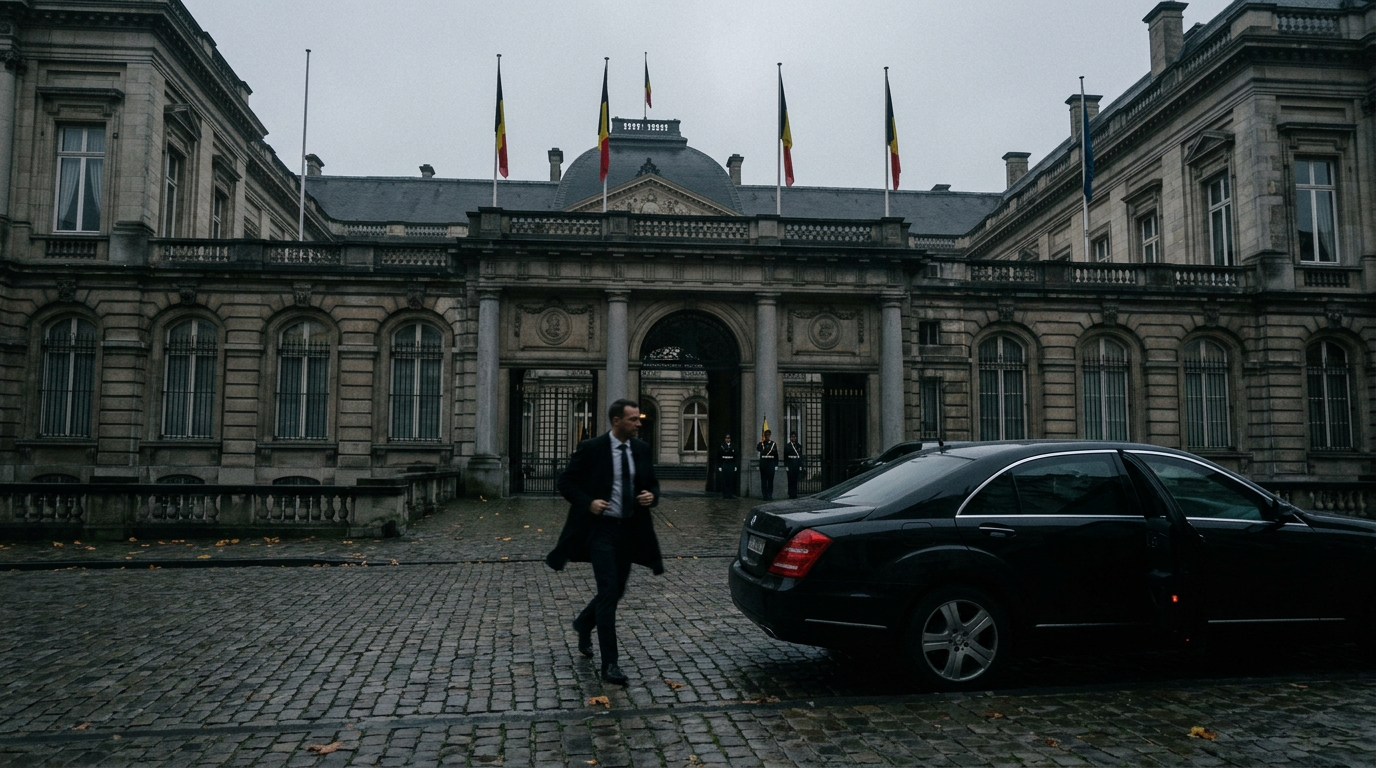

After a night of deadlocked negotiations, Belgium’s prime minister headed to the Royal Palace to tender his resignation. The stakes are enormous: finding €10 billion to avert a financial crisis. Behind closed doors, socialists and liberals blame each other for the deadlock, while Belgium faces the prospect of early elections.
(Staff: Belgium / Politics & Economics)
It is one of those mornings that can change a country’s course. At 9:30 a.m., as Brussels woke beneath a grey sky, Prime Minister Bart De Wever arrived at the Royal Palace to submit his resignation to King Philippe. The dramatic move followed a marathon night of failed federal budget negotiations. If the King accepts the resignation, the government will fall and Belgium could be plunged into a snap election campaign.
The night at number 16
It began on Sunday evening, at around 9 p.m., when De Wever summoned his deputy prime ministers to the government offices at 16 Rue de la Loi (Wetstraat 16) for one final attempt to save the budget. For months, the five-party coalition had been searching for a way to fill a huge financial gap.
Expectations were pessimistic from the outset. The Prime Minister wanted an agreement by Tuesday to avoid provisional budget arrangements in 2027, a scenario that could freeze investment and send a panic signal to financial markets. But at around 1:30 a.m., it became clear that no compromise was possible.
As he left the building, Deputy Prime Minister David Clarinval (MR, the French-speaking liberals) pointed the finger directly at Vooruit’s socialists, saying bluntly: “I said there were too many taxes.” Sources close to the talks indicated that tensions went beyond the liberal-socialist divide: the allocation of the budgetary burden had become a battleground in its own right.
The impossible equation: €10 billion
Why is this budget so difficult? Belgium is facing a serious financial challenge. Public debt is high and interest rates are rising. The National Bank and the Federal Debt Agency have already warned of a possible snowball effect in interest payments, which could weigh heavily on the economy from 2028 or 2029.
De Wever put forward a tough plan: around €4 billion in spending cuts and reforms, supplemented by €1.5 billion in new taxes, €1 billion in technical adjustments and €2 billion in recovery measures. Some coalition partners reportedly wanted to scale the plan back to €8 billion, a proposal the Prime Minister rejected outright.
De Wever also sought to introduce a “debt brake”, involving a drastic freeze on public spending, and even proposed cutting ministers’ salaries as a gesture of solidarity. Neither proposal gained support. Vooruit’s socialists refused cuts affecting healthcare and pensions, arguing that the wealthiest should contribute more. The MR liberals categorically rejected any increase in taxes.
The King’s decision and the prospect of elections
The decision now rests with King Philippe. Given the country’s difficult financial position, the monarch may not accept the Prime Minister’s resignation immediately. There is also no clear political alternative capable of forming a new majority. If the King declines the resignation, De Wever could be given a renewed mandate to break the deadlock, as happened last year.
If the resignation is accepted, Belgium would enter a major political crisis. The government would fall and elections would have to be held within 40 days. The latest polls point to a political landscape that could reshape the country: in Flanders, the far-right Vlaams Belang is polling in first place, while in Wallonia the PS socialists are well ahead. Such a result would make forming a new government extremely difficult.
Conclusion
Belgium once again shows how fragile governing can be in a country divided along linguistic and political lines. Bart De Wever, known for his determination, appears to have reached the end of his patience. Whatever the King decides, the underlying problem remains: without a budget agreement, Belgium risks entering a debt spiral that will be difficult to escape. If politicians cannot agree on a way to safeguard the country’s finances, they will have to answer to citizens far sooner than expected.

Leave a Reply