
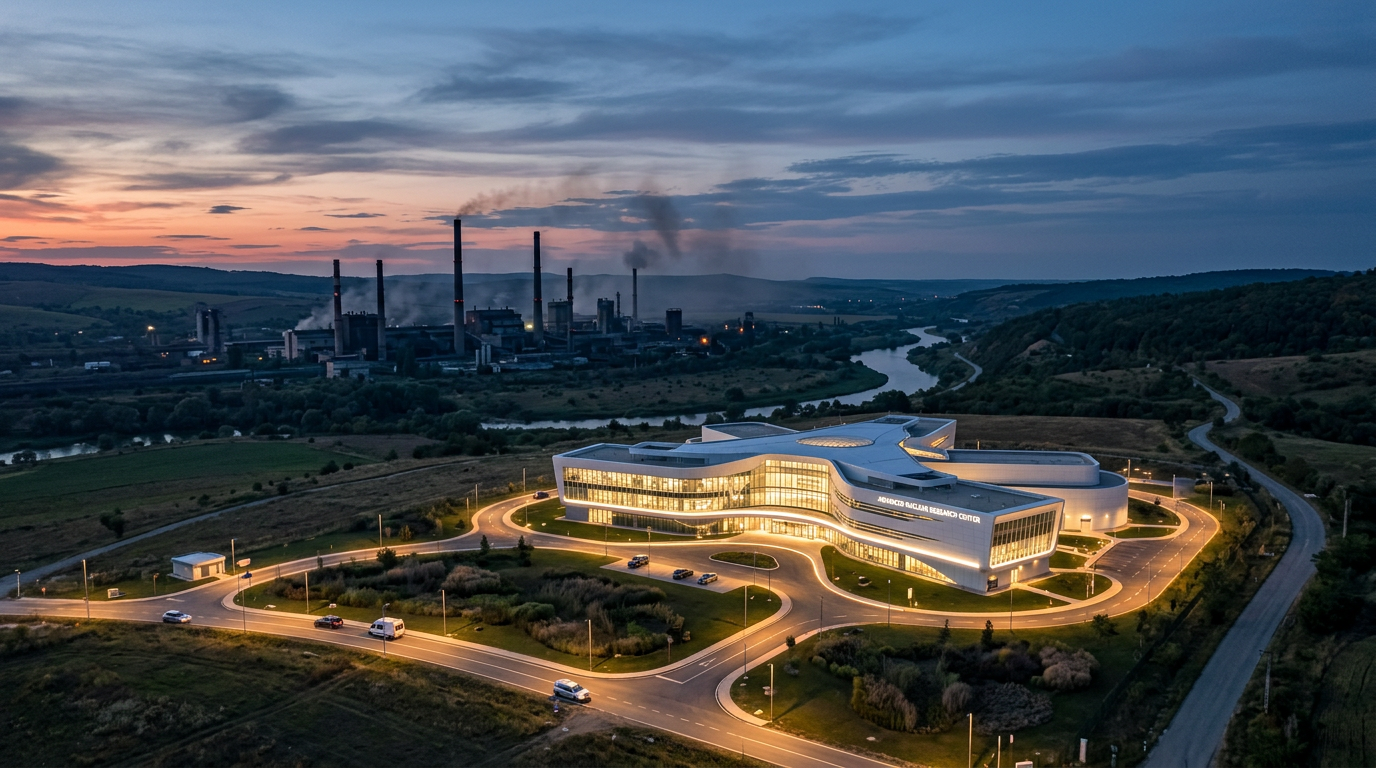

While the car factory faces cost-cutting measures and an order slowdown, just a few kilometres away Romania and Europe are developing one of the most advanced nuclear reactor projects in the world. It is called ALFRED. It uses molten lead rather than water as its primary coolant, and its design aims for a high level of safety. The people working on the project include Romanian researchers.
(Staff: Romania & Europe / Energy & Technology)
When people hear the name Mioveni, they usually think first of the Dacia factory, the thousands of people who earn their living on its assembly lines and the models that have motorised Romania for decades. In recent weeks, the news from Mioveni has been gloomy: falling sales, voluntary departures and a strong demand from the Renault Group to reduce costs by as much as 30%.
Yet only a few kilometres from the furnaces where the Duster is made, a project is taking shape that could help redefine Europe’s energy future. It does not run on petrol; it relies on advanced nuclear science.
What is ALFRED and why is it different?
ALFRED stands for Advanced Lead Fast Reactor European Demonstrator. It is a Generation IV nuclear reactor demonstrator intended to help prove the technical and economic viability of fast-reactor technology cooled by lead. Its distinguishing feature is the use of molten lead as the primary coolant.
Unlike conventional reactors that use pressurised water to cool the core, ALFRED is designed to use molten lead. Lead does not burn in air and does not react with water in the same way as some other coolants. The primary system is designed to operate at low pressure. These characteristics can help reduce certain risks, while the reactor’s safety case still has to be demonstrated through research, testing, assessment and licensing.
The promise of this technology is a nuclear energy system that could operate at large scale while meeting demanding standards for safety and sustainability. ALFRED is a demonstrator project, not an operating power station.
A project moving forward in stages
The project is not simply a scientific ambition. It has received support from Romanian authorities and European research and industrial partners. The message behind the initiative is clear: Romania needs the confidence and determination to undertake major technological projects.
The work is progressing in stages. Experimental facilities are being developed on the Mioveni nuclear platform, with European funding, to test materials, components and systems in liquid lead. This infrastructure is an essential step towards validating the technology; it should not be confused with the construction of a completed ALFRED reactor.
The people behind the research
Beyond the concrete, liquid metal and control equipment, the most important element is the people. Romanian physicists, engineers and researchers are contributing to a European research effort that brings together expertise from several countries.
In a country whose skilled people have often sought opportunities abroad, this project highlights the capacity of Romanian research teams to take part in advanced international technology programmes. If the technology is successfully validated and licensed, the knowledge developed could contribute to future projects beyond Romania.
Conclusion
Mioveni is a city of contrasts. On one side is an automotive industry facing global competition and the transition to electric mobility. On the other is a research programme exploring a possible next generation of nuclear technology.
The challenges facing Dacia are real and affect thousands of families. But Romania’s industrial and scientific potential is not limited to car assembly. Some of the most important advances may emerge in research facilities just a few kilometres from the factory. Looking beyond the immediate crisis means investing in people and in the knowledge that can shape the future.


Leave a Reply