
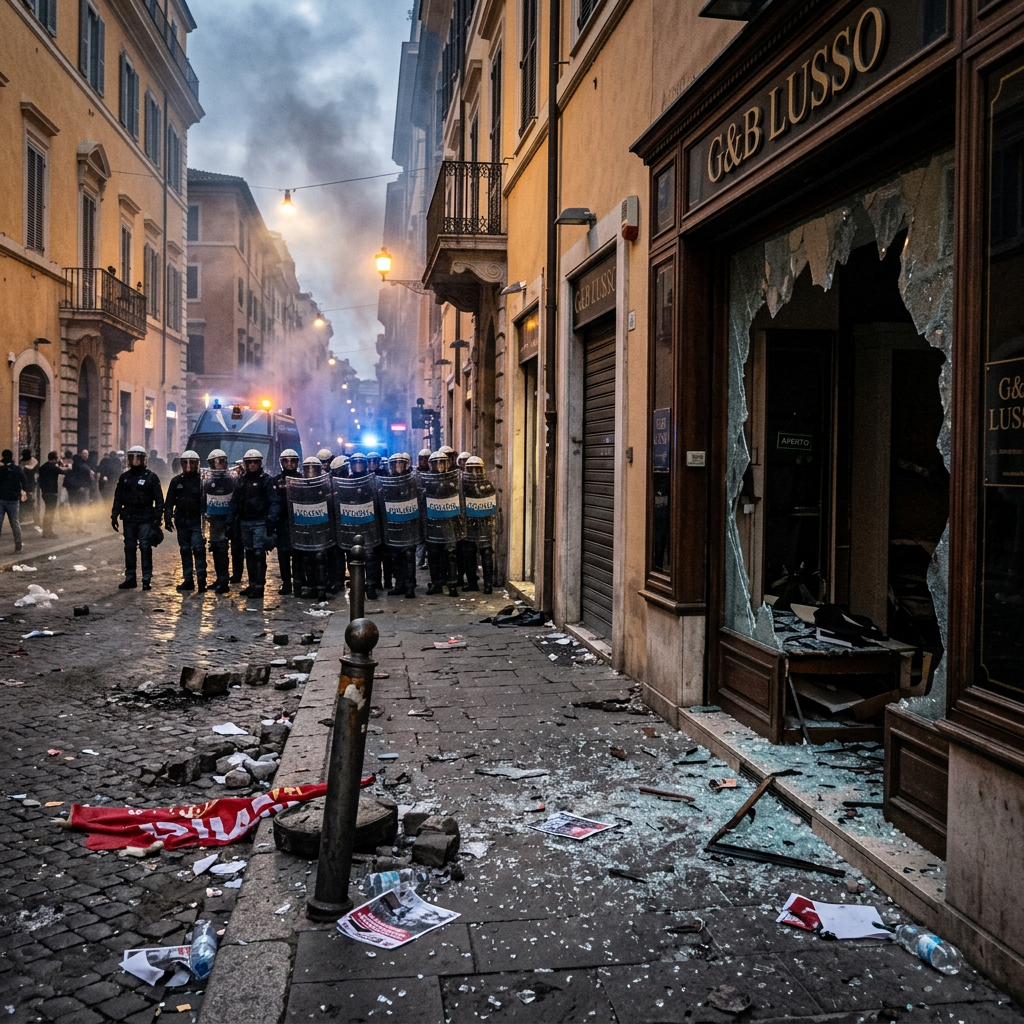

After the nights when the shops were robbed and law enforcement was attacked in the street, the Rome executive approved an unprecedented package of measures. From stinging fines for vandalism, to urban bans for violent demonstrators, the new decree promises to restore order, but already evokes heated criticism from human rights defenders.
(Staff: Italy / Politics & Society)
Italy has been shaken in the last few days by waves of protests that quickly degenerated into large-scale violence that Rome had not seen for years. What started as a manifestation of popular rage turned into a nightmare for merchants and law enforcement. The toll is grim: hundreds of shops robbed and destroyed, broken windows, burned cars and, worst of all, about 200 police officers injured in direct confrontations with groups of radicalized demonstrators.
In the face of this situation, the Italian government decided to act firmly. The executive approved a new decree designed to put a brake on street violence and provide a much more solid legal shield to law enforcement. It is a legislative response that sends a clear message: the right to protest remains guaranteed, but vandalism and assaulting the authorities will no longer be tolerated.
What does the new decree provide
Although the exact text is to be published in the Official Gazette, sources from the government coalition have revealed the main directions of action. The new legislative package introduces much harsher sanctions for those caught in the act during the destruction.
One of the toughest measures concerns Payment of damages. Those who are identified as having looted shops or destroyed public goods will be forced to fully cover the costs of repairs. The government also wants to extend the application of “Daspo” – an urban ban used so far mainly in the world of sports for hooligans – on those who cause violence during protests. They will no longer be allowed to approach certain areas of cities for long periods.
Another key provision aims at Identity concealment. The police will have the right to ask the demonstrators to take off their masks, hoods or helmets that cover their face, in situations where there are suspicions of violent behavior. The refusal will attract immediate sanctions. At the same time, red-handed arrests for acts of vandalism will become procedurally simpler to eliminate the bureaucracy that allowed many aggressors to be released shortly after the detention.
Why was this decree needed?
The authorities in Rome explained that the measures are a direct reaction to the way in which the criminal groups acted infiltration among the peaceful protesters. According to the Ministry of the Interior, a significant part of those arrested had nothing to do with the original claims, being individuals known for common law crimes, including drug trafficking and thefts.
In a press conference held after the government meeting, the prime minister said the state has the duty to protect its citizens and those who earn their living through honest work. “We cannot allow freedom of expression to be turned into a shield for thieves and aggressors. Our law enforcement has been attacked with stones, incendiary bottles and firecrackers. This will stop here,” the official said.
Heated criticism and debate
If for a large part of the public and traders’ associations the decree is a welcome breath of oxygen, human rights organizations have immediately expressed concern. They warn that expanding police powers and sanctioning their refusal to remove the mask could deter legitimate protests.
“We must be very careful about how these rules will be applied. A person who covers his face to protect his health or privacy must not be treated as an offender,” said a representative of a civic organization. Critics also say the government is focusing on symptoms, instead of solving the root causes that led to the outbreak of protests.
However, the Italian executive seems determined to move forward. The decree is to be put to a vote in Parliament in the coming weeks, where the governing coalition has the necessary majority to turn it into law.
Conclusion
Italy demonstrates once again that the balance between freedom of expression and public safety is one of the most fragile in modern democracies. The new decree is not only a reaction to a momentary crisis, but a paradigm shift in the way the Italian state chooses to respond to street violence. It remains to be seen whether the measures will succeed in stopping the robberies and protecting the police, without turning the fundamental right to protest into a simple memory.



Leave a Reply