
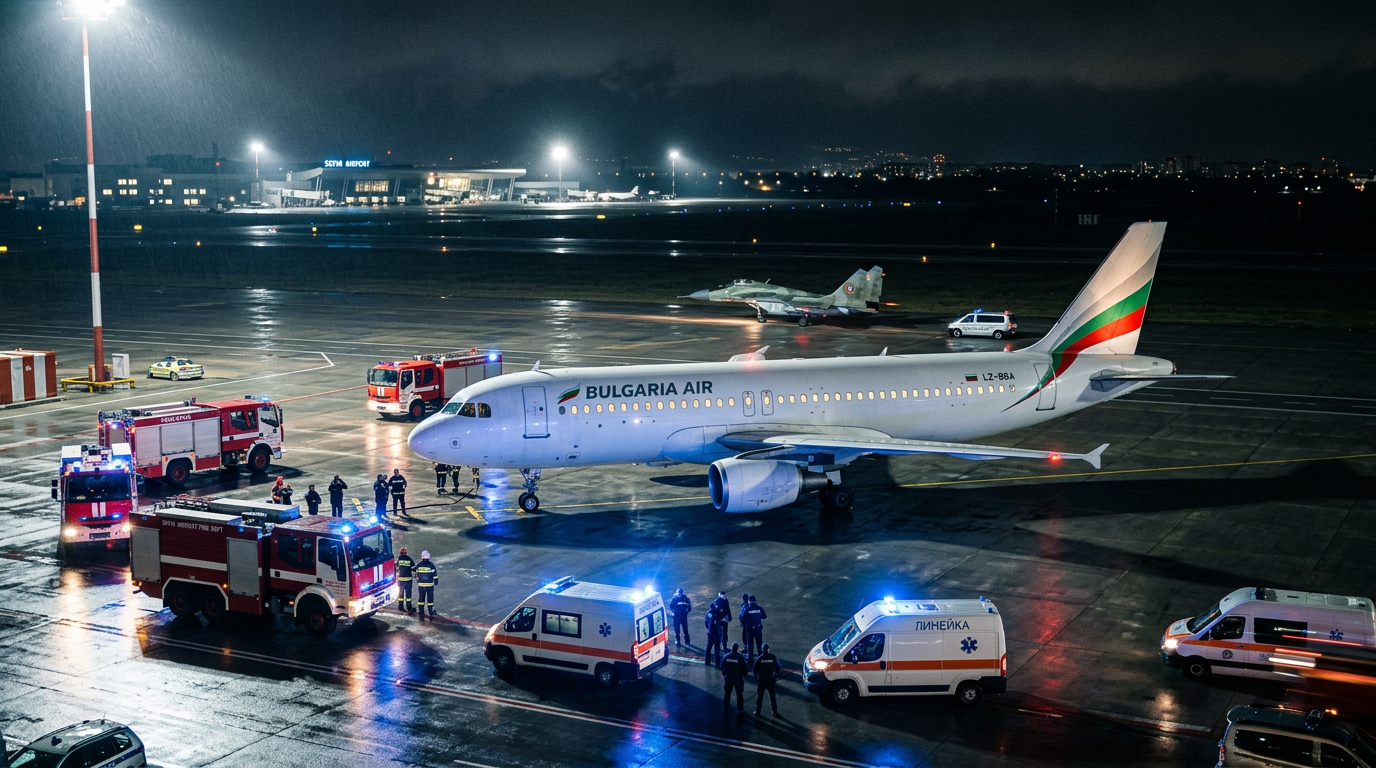

Austrian Airlines flight OS82 entered Romanian airspace on Sunday evening, around 21:10, with 51 passengers on board. Shortly after, the crew reported a bomb threat, turned abruptly south and made an emergency landing in Sofia. The Bulgarian Air Force picked up a MiG-29 for the escort, and checks confirmed that the alarm was false.
(Staff: Israel, Austria, Bulgaria & Romania / Aviation & Security)
On Sunday evening, October 18, 2026, the sky over Eastern Europe was the scene of an incident that instantly brought back to attention the vulnerability of commercial aviation to security threats. An Austrian Airlines Airbus A320, which was making flight OS82 on the Tel Aviv – Vienna route, had to suddenly change its trajectory after the crew received a bomb threat. The plane was near the border with Romania, and the decision not to continue the flight to Vienna was made in a few seconds.
Timeline of a tense evening
According to the flight tracking data cited by the international press, the OE-LZE registered aircraft entered the Romanian airspace around 21:10 Romanian time. At that time, the airplane transponder issued the code 7700, the standard signal for a general emergency. The crew immediately reported a bomb threat, and air traffic controllers authorized a route change.
The plane turned south, far from its normal corridor to Austria, and headed for the Bulgarian capital. At 21:42, the aircraft landed safely at the Vasil Levski Airport in Sofia. There were 51 passengers and six crew members on board, according to official confirmations of the company and the Bulgarian Ministry of Transport.
Military Escort and NATO Coordination
The landing was not an ordinary one. The Bulgarian Air Force lifted a MiG-29 fighter jet from the ground, which escorted the civilian aircraft to the ground. The Ministry of Defense at Sofia stated that the intervention was part of the NATO Air Police Mission and was coordinated with the Combined Air Operations Center in Torrejón, Spain.
Once on the ground, the plane was evacuated, and the intervention teams immediately started security checks. Passengers were taken to a safe area of the airport, and the Bulgarian authorities announced the establishment of a crisis cell and the opening of an investigation.
Who made the threat?
According to the Israeli publication Ynet, quoted by international agencies, the alert was allegedly triggered by an Austrian citizen who called to announce that a bomb was on board the aircraft. That person was not on the plane. The information was also picked up by the Bulgarian press, who reported that the threat was made through a phone call from Vienna.
Among the passengers was a delegation of young people who were to give a speech at the United Nations, according to the Israeli media. Their presence increased the visibility of the incident, although there is no indication that they were specifically targeted.
The alarm, confirmed as false
After about an hour of checks, Austrian Airlines issued a statement confirming that “during the inspection of the targeted plane, passengers and crew, no danger was identified.” In other words, the alarm was false. The aircraft was declared safe and passengers were rescheduled on other flights to Vienna.
However, the incident was not unique. Just a few days before, another bomb threat had targeted a Delta Air Lines flight from New York to Tel Aviv, which landed at Ben Gurion and underwent similar checks. And then, the alarm turned out to be false. These repeated events raise questions about the nature of these threats and the huge resources that the authorities are forced to mobilize for each alert.
Regional context and the stake of air security
The incident in Romanian airspace cannot be viewed in isolation. It takes place in a tense regional context, marked by conflicts and threats to civil aviation security. Last month, a co-pilot of the FlyDubai company tried to hijack a plane destined for Tel Aviv, being stopped by the crew and passengers. Last week, an accidentally triggered hijacking alert mobilized fighter jets from Croatia and Germany.
For Romania, the incident is relevant not only through the prism of the airspace crossed, but also as a signal of how a threat that is not directly related to our country can affect air traffic and trigger emergency procedures. The aircraft entered the Romanian airspace, issued the Emergency Code and was monitored by the Romanian authorities until the moment it left the national territory again, heading for Bulgaria.
Conclusion
An anonymous phone call was enough to turn a regular Sunday night race into a large-scale security operation, with fighter jets lifted from the ground and dozens of evacuated passengers. The alarm turned out to be false, and the plane continued its journey to Vienna a few hours later. But the incident remains a clear reminder: in modern aviation, a threat, be it fake, has real costs — in money, in time, and especially in the security resources mobilized to check it. And for the passengers on board the OS82 flight, Sunday evenings will never be as quiet again.




Leave a Reply