

Editorial by Cristin Tomeci
The Weekend Magazine – A Tomeci Press Publication
There are people who build a career and people who, throughout their lives, build projects that help others to move forward. Liviu Hopârtean belongs to the second category. An engineer, teacher, journalist and man involved in cultural life, he linked his path to education, the promotion of Romanian culture and the construction of sustainable ties between people and communities.
I have known him for over 30 years and I have followed the evolution of a man for whom initiative and involvement did not remain simple intentions. That’s why his story deserves to be seen beyond functions and titles, through the projects he initiated, through the communities he got involved in and through the values he chose to defend.
Courage to change education
At the beginning of the 90s, when Romania was in a period of profound transformations after the fall of communism, Liviu Hopârtean got involved in the development of private education. Together with Carmen Drăghici Hopârtean, he contributed to the establishment, in Slatina, of the first private school in the post-revolutionary period, according to published reports about their activity.
In a society that was trying to redefine its institutions and perspectives, such an initiative involved more than a good idea. It took courage, the ability to organize things in a new context and the belief that education can benefit from different alternatives and patterns.
For Liviu, education would remain a constant. Later established in Belgium, he continued his work as a teacher in the Belgian public system. The experience in two countries and in two educational contexts gave him the comparative perspective of a man who knew the systems from within. Not only the differences between them matter, but also the fundamental question: what kind of people do we form and how do we help them discover their vocation?
His involvement did not stop at the professional activity. In Belgium, he also created a school intended for Romanian children, in a multicultural environment where education also means preserving the language, understanding the origins and developing the feeling of belonging. For children raised far from their parents’ country, the connection with the Romanian language and culture can become a bridge between generations, not an obstacle to integration into the society in which they live.
Arthis – more than a cultural institution
In Belgium, the name of Liviu Hopârtean is closely related to Arthis – Belgo-Romanian House of Culture, an organization in which he holds the position of president and through which numerous cultural, educational and community initiatives have been developed.
Arthis has become a meeting space between languages, traditions and experiences. His activity is not limited to the organization of Romanian events for the Romanian public. It creates dialogue contexts with the Belgian society, provides visibility to artists and cultural initiatives and contributes to maintaining vivid ties between the Romanians in Belgium and the country they come from.
Through the Radio-TV Arthis projects, this mission has also acquired a media dimension. Culture can thus circulate beyond the event halls and geographical borders, reaching people who cannot physically find themselves in the same place. In a Europe where mobility has changed the way we live and build our communities, such initiatives have a special value.
We also knew this dimension through our collaboration: in 2014, at Liviu’s suggestion, I joined Radio-TV Arthis Brussels and created the show Music of Europe, which reached the public from different corners of the world. But the merit of such a collective construction must be understood in the broader context of Arthis’ activity and the people who give it continuity.
“Home, with us, in Greblești” – Return to the roots
One of the projects that best expresses the human and cultural dimension of this path is “Home – artistic journey in the open houses of Greblești”, initiative developed by Liviu and Carmen Hopârtean together with numerous partners and people of the community.
Greblești, a village in Câineni commune, Vâlcea county, is not just the setting of a festival. It is the place where the family’s memory, the rural heritage and the desire to keep in touch with Romania have turned into a cultural project with its own identity.
Everything started from the desire to bring back to attention the Romanian village and its values. An old family house, restored and preserved in its authentic form, became one of the starting points of an approach that gradually expanded. Traditional houses and households began to open their doors, turning into exhibition and meeting spaces. Contemporary art, literature, music and built heritage thus became in the middle of the village life, not in a space isolated from the community.
At the 2026 edition, the event reached its fourth edition, bringing together visual artists, writers and musicians. Households, community spaces and village buildings have become places where the past and the present met naturally. The program included exhibitions, literary meetings and concerts, and an important moment was the unveiling of the bust of the painter Cecilia Cuțescu-Storck, a prominent personality of Romanian art, originally from Câineni commune.
The importance of the project, however, goes beyond the program of a festival. At a time when many Romanian villages face the depopulation, degradation of old houses and the loss of traditions, Greblești proves that heritage can become an active part of contemporary life again. An old house is not only a building that needs to be preserved, but also a storehouse of memories. A street, household or family story can become starting points for a project that attracts artists, visitors and public attention to a community.
Through “home”, Liviu Hopârtean and his partners show that the connection with Romania is not preserved only by evoking the past. It is preserved through concrete actions, through the restoration of the heritage, through the involvement of the locals and through the creation of reasons for people to return, discover and value the places they come from.

It is, in fact, another form of education: one that takes place in the middle of the community and teaches people to recognize the value of their own heritage.
From the experience of a life to the TEDx scene in Brussels
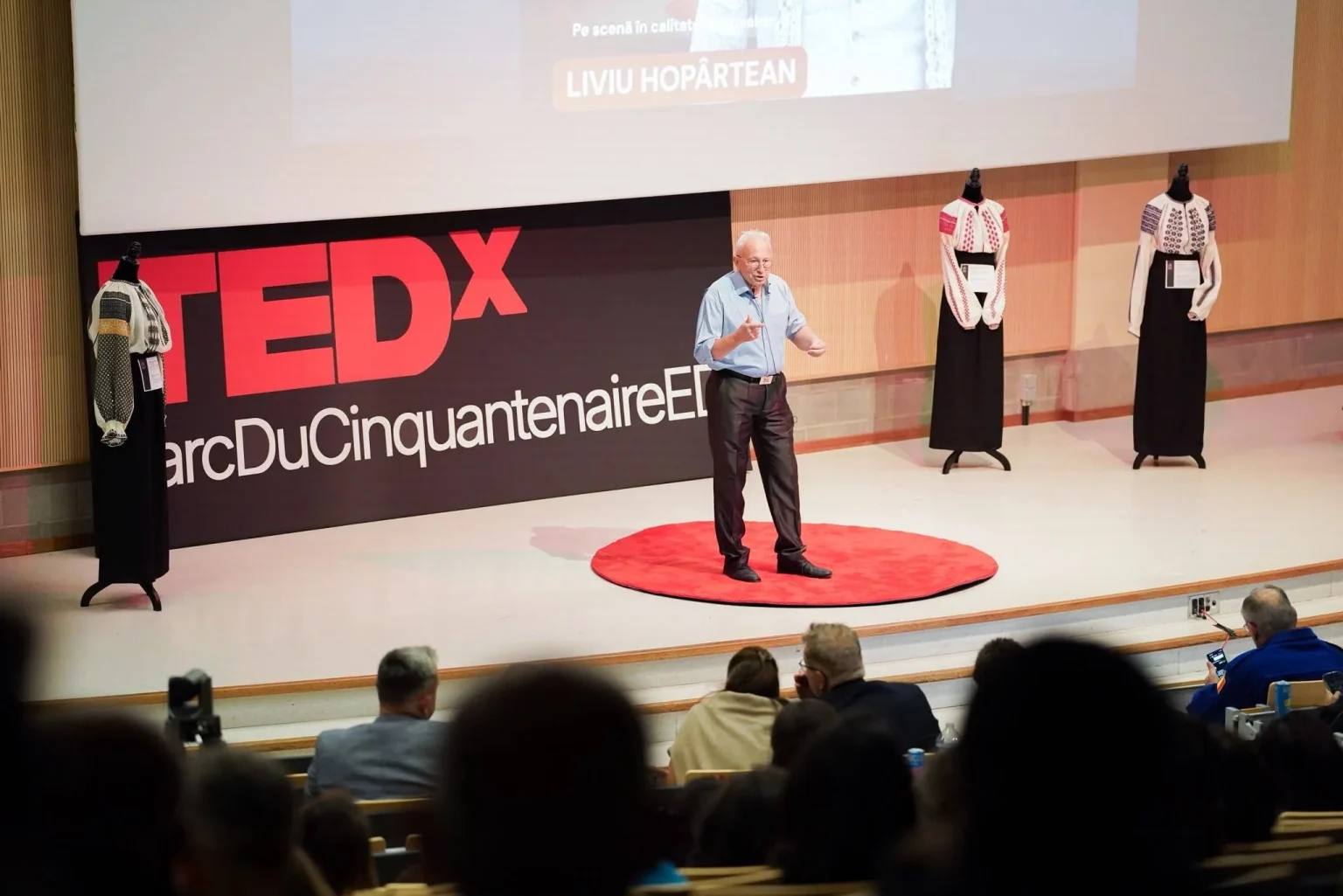
Recently, Liviu Hopârtean presented his perspective on education within TEDxparc du cinquantenaire edin Brussels, under theme “Education begins with the vocation, not the system”. .
The title focuses an idea that crosses its entire course: education cannot be reduced to institutions, programs and procedures. At its center is the man – the inspiring teacher, the student whose skills must be discovered and the community that has the responsibility to create conditions for development.
His experience is relevant precisely because it does not come from a single perspective. He experienced the changes in education in post-communist Romania, worked in the Belgian system and got involved in the education of Romanian children in the diaspora. These experiences allow him to look at education not only as a professional field, but as a social and human responsibility.
Its presence on the TEDx scene provides visibility to an experience built over time, through work and engagement. It is also an opportunity to bring an essential question to the public debate: how can we transform education into a process that not only transmits knowledge, but helps people discover their vocation and find their place in society?
A path built through consistency
Behind the Arthis projects is the contribution of Carmen Drăghici Hopârtean, Liviu’s partner in life and in numerous cultural initiatives. Together they demonstrated that sustainable projects are built through collaboration, perseverance and respect for the communities they address.
Looking at the entire course of Liviu Hopârtean, several directions can be distinguished that complement each other: education, through concern for the formation of people; culture, by promoting the dialogue between Romania and Belgium; And the heritage, through projects such as the one from Greblești, which bring the Romanian village back to the public’s attention.
These areas may seem different, but they have a common element: the belief that the identity and development of a community depends on what we choose to pass on. A school offers knowledge and chances. A cultural institution creates meetings and maintains connections. A project dedicated to the village saves the memory of places and restores people’s sense of belonging.
For me, after more than three decades since we have known each other, Liviu’s story is that of a man who did not limit himself to talking about the things he believes in, but sought to transform them into concrete projects.
Education, culture and respect for roots are not three separate chapters of Liviu Hopârtean’s life. They are expressions of the same vocation: that of building bridges between people, generations and countries. And the value of such work is seen not only in organized events or in developed institutions, but also in communities that continue to grow because of it.
Sources consulted for the verification of information: Liviu Hopârtean’s official profile for TEDxparc du Cinquantenaire ED, Agerpres reports about the “Home” project and Radio Romania International materials about the 2026 edition.




Leave a Reply