
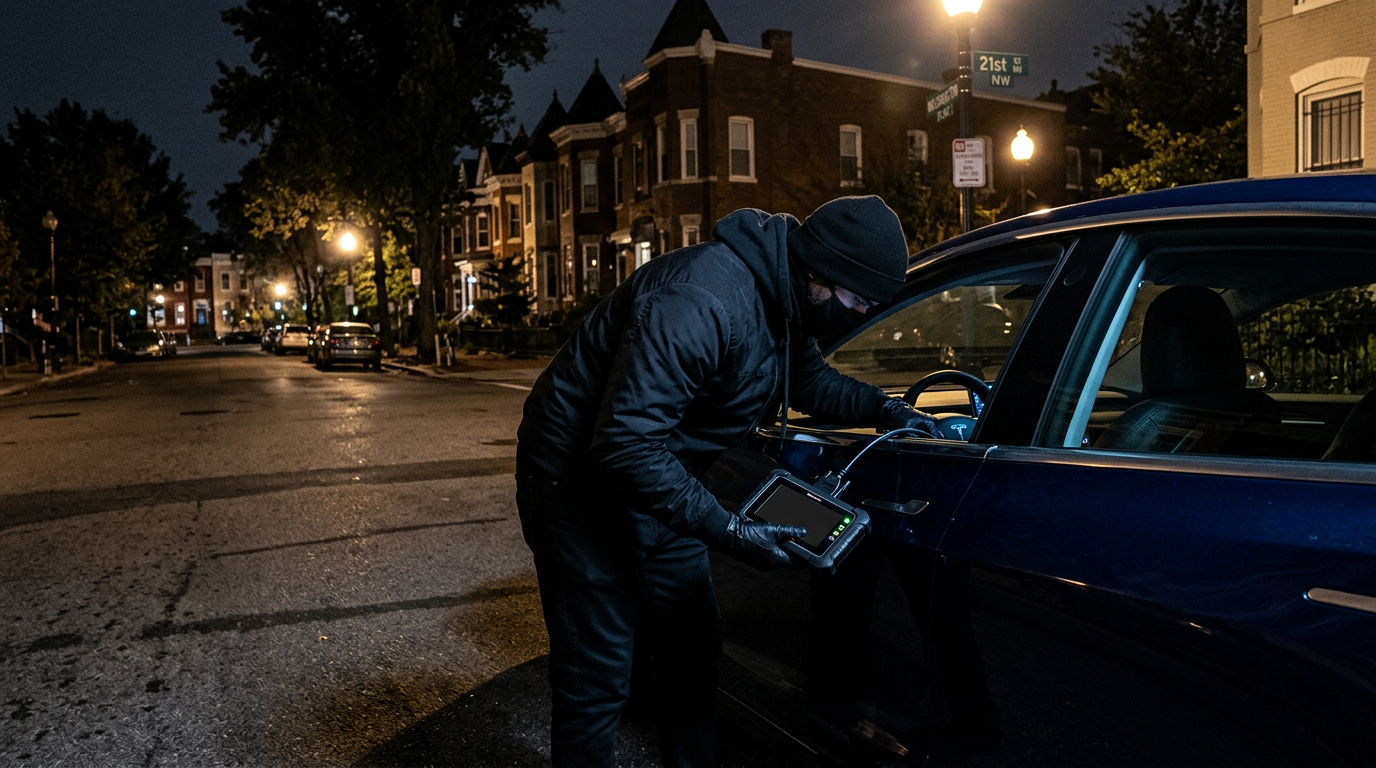

Six men have been indicted in connection with more than 100 car thefts in the Washington, D.C., metropolitan area. Investigators say they used a $500 device to reprogram keys in under a minute. Stolen cars were hidden in Navy Yard parking lots, loaded into containers labelled as furniture and shipped to Africa. The FBI and prosecutors led by Jeanine Pirro announced the dismantling of the alleged international operation.
United States / Justice & Technology
For car owners in Washington, D.C., car theft has taken on a new dimension. It is no longer just about smashed windows, forced ignitions or alarms. The theft can be quiet and precise, without waking the neighbours. The suspects did not need the original keys; they allegedly used an electronic device about the size of a smartphone.
On Wednesday, 22 April 2026, federal and local officials announced a major operation against an alleged international car-theft network. The press conference included U.S. Attorney Jeanine Pirro, Mayor Muriel Bowser, interim Metropolitan Police chief Jeffery Carroll and FBI representatives. Their message was clear: organised crime has adapted to technology, and the so-called Autel method represents a new form of car theft.
How the Autel network worked
According to the federal indictment, the suspects included Jacob Hernandez, 29, of Los Angeles; Dustin Wetzel, 23, of Virginia; James Young, 23, and Khobe David, 24, of Maryland; Chance Clark, 25, of Maryland; and a sixth suspect who remained at large. They allegedly stole at least 20 vehicles in Washington, D.C., Maryland and Pennsylvania. Investigators link the group to more than 100 thefts in the District of Columbia and 30 more in Prince George’s County.
The suspects allegedly operated at night, mainly on quiet streets in the north-west of the city. After forcing a door lock, they connected an Autel MaxiIM KM100X key programmer, sold online for about $500, to the vehicle’s on-board diagnostics (OBD) port. This allowed them to reset the security system and program a new key to start the engine.
“They don’t need keys or improvised wiring. No smashed windows, no drama—just an electronic device called Autel. In less than a minute, the car’s computer is reprogrammed. The car disappears in 60 seconds,” Jeanine Pirro said. Investigators said the group targeted luxury sports cars such as Corvettes and Camaros as well as everyday vehicles such as Honda Civics.
From Navy Yard to African ports
The cars were allegedly taken to temporary holding locations, including parking lots in Washington’s Navy Yard neighbourhood and a Marriott hotel car park in Maryland. There, licence plates were changed and vehicle identification numbers (VINs) altered or removed.
The vehicles were then transported to the ports of Baltimore, Maryland, and Savannah, Georgia. They were loaded into shipping containers labelled as furniture rather than vehicles, allegedly to avoid close customs scrutiny. Many were destined for Africa, where demand for American cars can be high.
Pirro said the cars were shipped to Africa in sealed containers, where demand and potential profits were substantial. Investigators identified more than 20 vehicles directly linked to the indictment, worth nearly $1 million, but believe the network was responsible for many more thefts.
A regulatory issue
Officials highlighted how easily such devices can be purchased. The Autel MaxiIM KM100X is sold online without a special licence or identity check, according to the authorities. Pirro called for a registry or regulations governing purchases of key-programming devices, arguing that they can be dangerous in the wrong hands.
While the investigation continues, interim D.C. police chief Jeffery Carroll advised motorists to keep keys in Faraday pouches that block wireless signals and to use a mechanical steering-wheel lock. These precautions may deter thieves who rely on electronic tools.
Conclusion
The alleged Autel operation illustrates how organised crime adapts to new technology. A tool designed for automotive professionals was allegedly used to turn stolen cars into export cargo. The investigation disrupted the group, but key-programming devices remain available online.
For Washington residents, the operation is an important step against the alleged network. The broader challenge is to prevent similar schemes from emerging and to determine how these devices should be sold and monitored.





Leave a Reply