
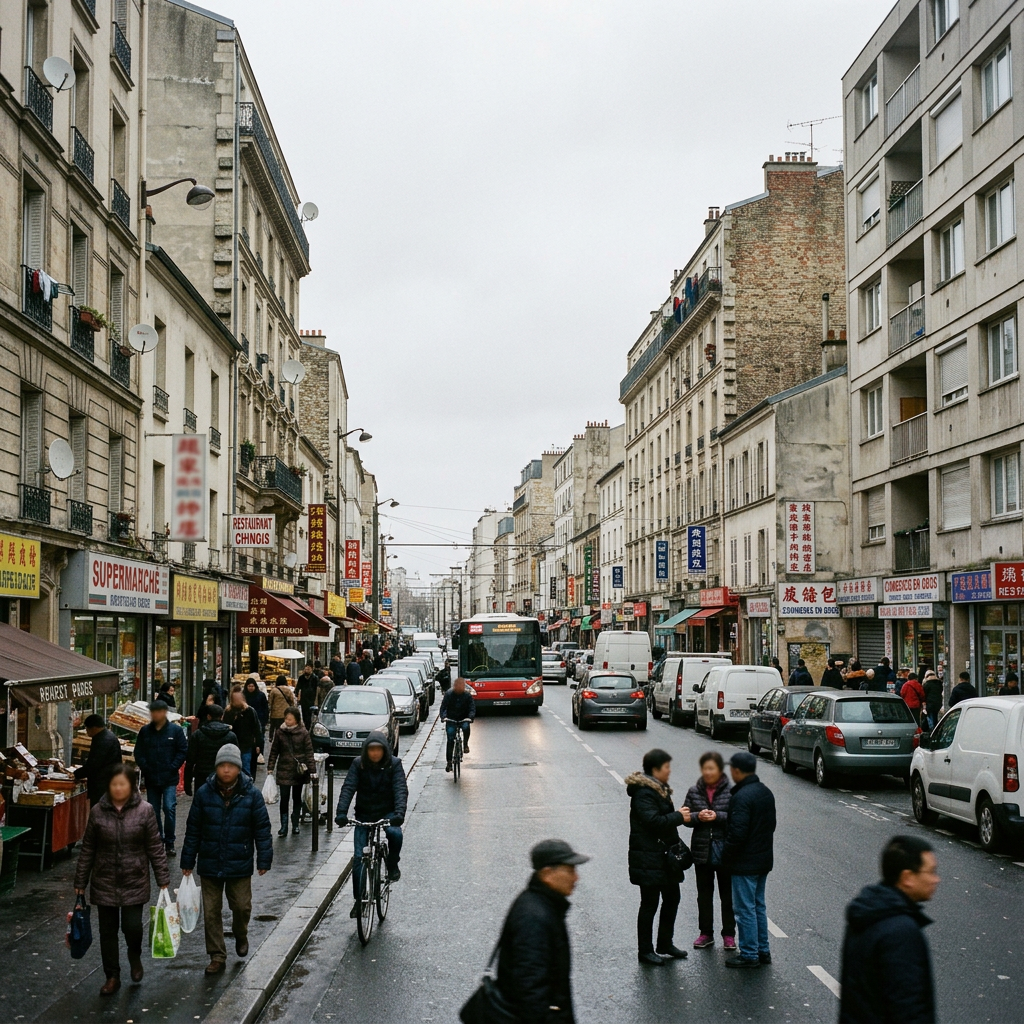

In Aubervilliers, north of Paris, the Chinese community has built an economic hub through work and discretion, while some members of the North African community face difficulties with economic integration. A DW documentary explored the often-unseen tensions between those who have built businesses and those who feel left behind.
(Staff: France / Society & Economy)
Just ten kilometres from central Paris, in the suburb of Aubervilliers, there is a commercial world with its own rhythms. Near the Saint-Denis Canal, more than 700 Chinese merchants have established a major wholesale clothing centre covering 55,000 square metres. The working day begins before sunrise and ends after sunset; goods are handled by hand, and earnings are often reinvested in the businesses.
In the same streets and among the same concrete buildings lives another community: people with North African backgrounds whose experiences of economic integration are varied and, for some, difficult. A documentary by German broadcaster DW placed these realities side by side, examining tensions that have been present for years.
An economic hub built through work
The Chinese community in Aubervilliers did not emerge overnight. Its roots go back to the 1990s, when early merchants, many from Wenzhou, began opening small workshops and warehouses. They worked long hours, opened shops, transported goods and learned how the French administrative system operated.
Today, the results of those efforts are visible. Thousands of families of Chinese origin have bought homes, expanded their businesses and helped transform a run-down industrial area into an important commercial centre. Many operate with discretion, focus on their businesses, invest in their community and build their futures away from the public spotlight.
A second community, a different reality
In the same area, people of North African background face their own challenges. Economic integration can be slower, and some experience a strong sense of marginalisation. According to observations discussed in the documentary, some people struggling with these difficulties may perceive the success of Chinese neighbours not as an example to learn from, but as a threat. This is a reported perception, not a description of either community as a whole.
This outlook can be shaped by a simplistic idea of the economy: wealth is imagined as a fixed pie, a limited resource that must be divided. If a Chinese neighbour earns more, someone else is assumed to lose. What can go unnoticed are the daily effort, long working hours, risks and repeated reinvestment behind a business. From the outside, people may see only the outcome: busy shops, renovated buildings and newer cars.
When tension turns into violence
The tensions described in accounts of the area have not been limited to resentment. Over the years, members of the Chinese community in Aubervilliers have been victims of crime, including robberies and street attacks targeting traders and their families. In 2016, the killing of Zhang Chaolin, a Chinese tailor attacked in the street, prompted large protests and renewed calls for better security.
The author of the post on which this article was based points to a troubling interpretation: a preference for tolerance and avoiding confrontation, attributed to some Chinese immigrants, may be mistaken by offenders for weakness. Whatever the motives in individual cases, people who simply want to go about their lives deserve to be safe.
An uncomfortable mirror for French society
The issue is not simply that two communities fail to get along. It also raises questions about whether France’s integration model has provided everyone with equal opportunities. The article attributes part of the Chinese community’s business success to close mutual-support networks and a strong emphasis on work and saving, despite language barriers and limited connections. Other residents may not have had access to comparable networks, while public policy has not always filled the gap.
The result can become a vicious circle: frustration feeds resentment, resentment can contribute to violence, and violence deepens isolation and fear. In the middle are people who have spent years building a home and a livelihood but end up afraid to walk their own streets.
Conclusion
Aubervilliers is presented here as a wider reflection of a Europe still struggling to manage diversity and inequality. One community’s economic success should not be a threat to another. When work and discipline are met with envy rather than respect, the question is no longer simply who built what, but what kind of society people want to live in. In a neighbourhood where different worlds share the same pavements, the real challenge is not only access to resources, but also dignity and safety for everyone.

Leave a Reply