
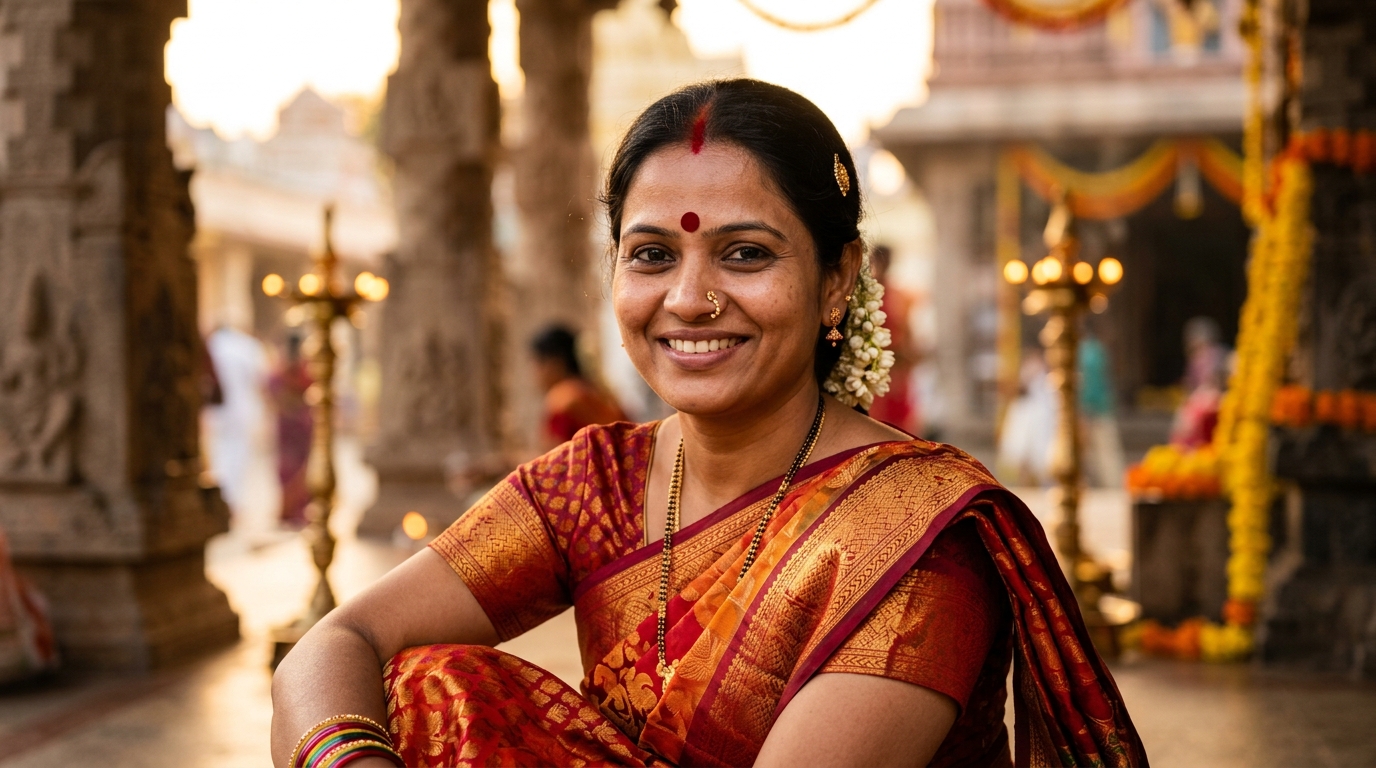

A discussion on social media has highlighted the many interpretations of the bindi: a religious sign, a symbol of marriage, spiritual protection or simply makeup. Although it is now strongly associated with Hindu spirituality, some online commenters suggest its origins may also be cultural, connected with drawing attention to the face. Here is what religious traditions, local customs and contemporary comments say.
(Staff: India / Culture & Religion)
The coloured mark worn on the forehead by many Hindu women is known as a bindi. Related forehead marks may also be called tilak or kumkum, depending on the context. It is one of India’s most recognisable symbols. In Western perceptions, it is often linked automatically to Hinduism and the idea of a third eye. A recent social-media discussion, however, showed how varied its meanings can be—and how difficult it is to reduce its history to a single explanation.
Cultural origins: a practical form of adornment
One participant, whose wife comes from a traditional Hindu family, said the bindi may not originally have been a religious sign but a cultural marker worn to draw attention to a woman’s face rather than other parts of her body. In societies where a neckline or other areas were considered intimate, the mark on the forehead could provide an accepted and attractive visual focal point.
Other commenters compared this interpretation with lipstick or blush, used in many cultures to highlight facial features. One user suggested that before acquiring religious meanings, the mark was worn by women and children as protection against the “evil eye” or simply as decoration. These are interpretations shared in the discussion, rather than a settled account of the bindi’s historical origins.
Religious meaning: the third eye and energy centres
In Hindu traditions, the bindi is associated with the third eye, or ajna chakra, a spiritual centre linked to intuition and wisdom. Some believe that marking this area supports concentration, meditation and energetic balance. A few commenters also suggested that the mark might protect the pineal gland, which certain traditions associate with higher consciousness; this is a spiritual belief, not an established medical effect.
During puja, or worship, priests may apply a sacred mark to a devotee’s forehead using sandalwood paste, kumkum, ash from a sacrificial fire or rice grains. The mark is offered as a blessing. Its form varies by tradition and community; marks worn by men may be vertical lines or other designs, and are especially visible among some Brahmins, gurus and devout practitioners.
A symbol of marital status
In many Hindu communities, the bindi can also be connected with marital status. Married women may wear a red—or differently coloured—bindi in the centre of the forehead, alongside sindoor or kumkum applied along the hair parting during the wedding ceremony. In some traditions, these signs express auspiciousness, marital commitment and wishes for the family’s well-being.
One participant in the online discussion said that, in some traditional settings, not wearing these signs in public may be interpreted as a sign of vulnerability. For that reason, some women are encouraged to wear a bindi or kumkum daily, including at home, as a way of invoking positive influences and warding off negative ones. Customs vary widely, and the bindi does not indicate marital status in every community.
The bindi today: between tradition and fashion
In contemporary India, the bindi extends well beyond religious practice. Women of different ages and social backgrounds wear it as an accessory, and fashion designers have incorporated it into their collections. Bindis come in many materials, colours and shapes, from simple paper or plastic designs to versions decorated with stones. Some women wear them every day; others reserve them for special occasions.
The bindi has also become a marker of cultural identity for parts of the Indian diaspora. In countries such as the United Kingdom, the United States and Canada, some Hindu women wear it to honour tradition or express a sense of belonging.
Misunderstandings and controversy
The discussion also exposed misconceptions. Some users wrongly described the bindi as a sign exclusive to the Brahmin caste; its use is not limited to that caste. Others confused it with Muslim practices, although the bindi is not an Islamic religious symbol. Sarcastic and insulting remarks showed how quickly discussions of cultural traditions can slide into stereotypes.
Conclusion
The bindi has several layers of meaning: it may carry spiritual significance, be associated with marital customs, serve as cultural expression or simply be a fashion accessory. Its history cannot be reduced to one explanation, and practices differ across regions and communities. Whatever its meaning for the person wearing it, the bindi is best approached with respect and curiosity rather than prejudice. Online debates are a reminder that there is still much to learn about other people’s traditions.




Leave a Reply