
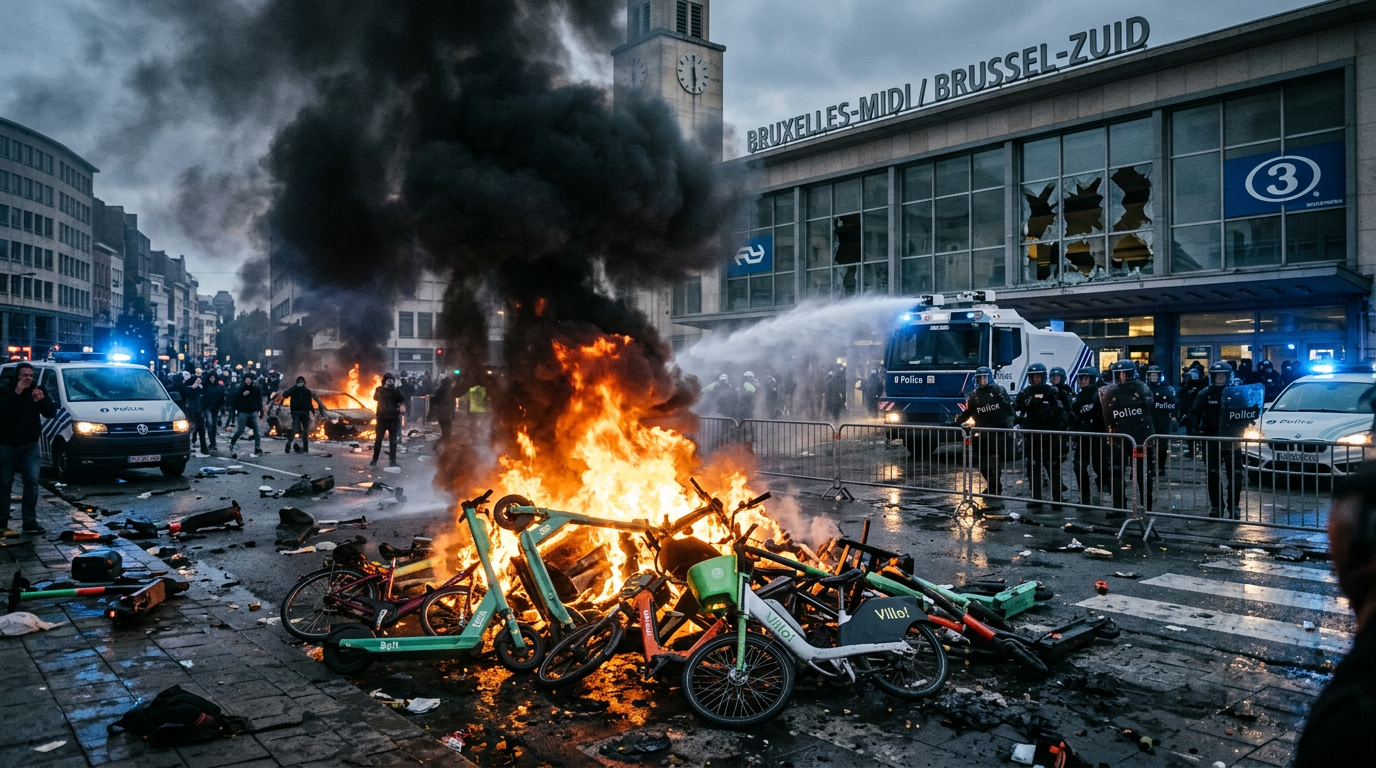

A public-sector strike called by ACOD disrupted Brussels and other Belgian cities on Monday. Near Brussels-South station, groups of young people set fire to scooters, bicycles and a vehicle, prompting police to use tear gas and water cannon. Ten people were arrested, including nine minors. Public transport, waste collection, postal services and Flemish public broadcasting were also affected. Unions are urging the federal government to abandon its planned budget cuts.
(Staff: Belgium / Society & Public Administration)
The national day of action in public services, organised by the socialist union ACOD, began at 10 p.m. on Sunday and continued throughout Monday, 12 October 2026. The action targets federal government savings measures that affect the public sector. Unions argue that the cuts threaten service quality and put additional pressure on workers.
Clashes and arrests at Brussels-South station
The most serious incidents took place near Brussels-South station (Brussel-Zuid), where hundreds of young people gathered following calls on social media. Brussels police reported several acts of vandalism, including the burning of electric scooters, bicycles and a vehicle. Images shared online showed a large fire involving scooters, bicycles and rubbish, which spread to a parked van. Smoke could be seen from a distance.
Police used tear gas and water cannon to disperse the crowd. Officers were reportedly targeted with projectiles and fireworks thrown by masked individuals. Ten people were arrested, nine of them minors; several others were held administratively. Police also seized fireworks, bottles containing flammable liquid, sprays, masks and gloves, which they described as posing a risk to public safety.
Public transport severely disrupted
The strike caused major disruption across the public transport network. Brussels operator STIB-MIVB reported substantial service reductions and interruptions on routes serving the city centre and South Station. Buses 29, 37, 38, 46, 48, 49, 50, 63, 65, 66, 71, 73, 78, 89, 95 and 96 were affected. Trams 4, 10, 82 and 92 also experienced disruption. Metro services continued at reduced frequency, while Clemenceau station was temporarily closed.
On the national rail network, three in ten InterCity trains were cancelled, along with a significant number of peak-hour P trains. Fewer S and L trains were running. Access to South Station was temporarily restricted, with entrances from Fonsnylaan and Hortaplein remaining available. De Lijn and TEC services were also affected.
Waste collection hit hard
The regional waste agency Net Brussel said the strike seriously disrupted rubbish collection. Many collection rounds could not be completed, leaving substantial backlogs in several municipalities. The worst-affected areas included Anderlecht, Sint-Gillis, the Bockstael area of Laeken—where around 70% of bags reportedly remained uncollected—as well as Forest and Ixelles, at around 60%. Residents were asked to keep blue and yellow bags until the next collection day. The backlog adds to disruption from Friday and could take several days to clear.
VRT programming scaled back
The Flemish public broadcaster VRT was also affected. Radio output was largely replaced by music, while VRT 1 and VRT Canvas relied on archive programmes, shortened news bulletins and the evening programme Terzake. Popular shows including Thuis, Dagelijkse Kost and Blokken were not scheduled, and De Ideale Wereld was cancelled. The VRT tower displayed television test colours as part of the strike action.
VRT unions are protesting against €11.2 million in new savings announced by the Flemish government, on top of €16.6 million in cuts already under way. Union representatives estimate that around 150 jobs could disappear through redundancies or outsourcing. Carlos Van Hoeymissen of ACV-VRT described the latest round of savings as impossible to absorb. The unions want to meet Flemish Media Minister Cieltje Van Achter of N-VA to renegotiate the measures.
Bpost and hospitals affected
At Bpost, the main disruption was at sorting centres, meaning postal workers set out with fewer letters and parcels. The company said around 85% of delivery routes could still operate, while warning customers of possible delays.
At Sint-Pieters Hospital in the Marolles, around a hundred people gathered to protest budget cuts and deteriorating working conditions. Maternity staff continued working but voiced their opposition to the measures. Midwife Clémence Bertouille, who has six years of experience, said patients were already vulnerable because of austerity and stressed that continuing to work did not mean accepting the situation.
Student action and political backdrop
At the ULB campus, students organised a picket at the entrance to protest reforms affecting French-speaking higher education. They argued that university studies are becoming more expensive and that young people are bearing the brunt of austerity. Activities included workshops, a photo exhibition, a collective mural, a general assembly, screen-printing and banner-making sessions, a solidarity meal, a decolonial guided tour and a concert.
Conclusion
Belgium’s national day of action brought workers and supporters into the streets and disrupted public services. While unions said their action was peaceful, separate groups of young people were involved in violent incidents near South Station, resulting in arrests and property damage. Unions are calling on the federal government to reconsider austerity measures as social tensions remain high. It remains to be seen whether negotiations will ease the conflict.


Leave a Reply