
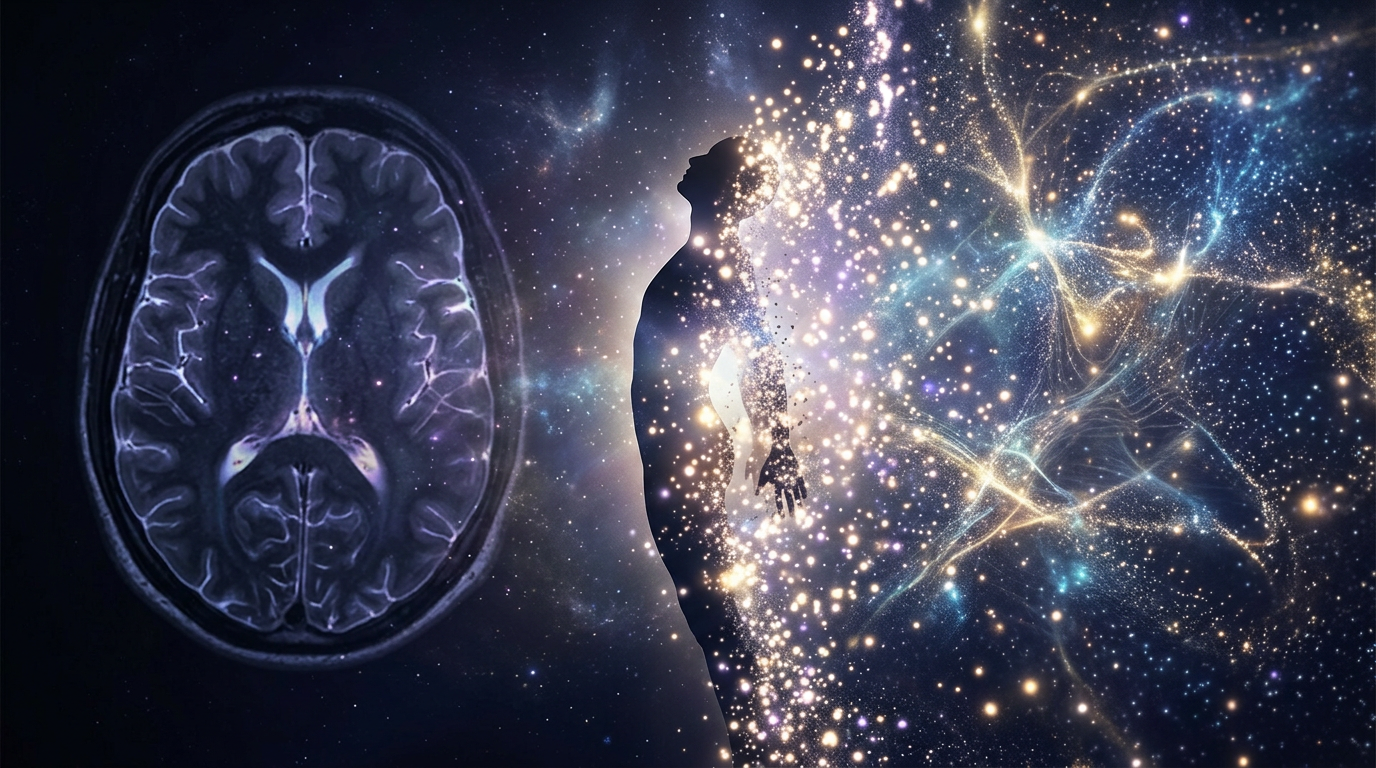

An age-old question has sparked a heated discussion on a social network. Some argue that brain functions stop gradually and consciousness fades like in deep sleep. Others speak of a “quantum consciousness field” from which the soul would be released. Critics point out that such claims cannot be scientifically verified and remain speculation.
The question “What does a person feel at the moment of death?” has always been one of the most disturbing. This time, it returned to the spotlight through a discussion on a social network, where users tried to answer from the perspectives of neuroscience, religion and personal experience.
What happens to the brain in the final moments?
Most scientifically oriented commenters emphasized one essential point: death is not an instantaneous event, but a process. Brain functions do not all stop at the same time; they cease gradually, over seconds or minutes. One user explained that “death is defined as the cessation of brain activity”, but that this cessation is not instantaneous. In the final moments, the dominant sensation would reportedly be extreme fatigue, similar to falling asleep.
Another participant described a shocking personal experience: he had suffered peritonitis, sepsis, intestinal obstruction and intestinal necrosis and had been close to death. “I did not feel panic, and my life did not flash before my eyes. I was simply extremely tired. As if I had been drinking, but much worse. If I had died, I would not have known anything. It is like entering a deep sleep, without the feeling of extreme fatigue.”
The “quantum consciousness” theory: does the soul become free?
In contrast to the neurobiological explanations, one participant presented a spiritualist view. According to him, at the moment of death, the “soul” or “quantum consciousness” detaches from the physical body and enters a “quantum consciousness field”. He referred to physicist Roger Penrose and theories concerning microtubules as an interface between the brain and this field, linking them to out-of-body experiences (OBE), near-death experiences (NDE), precognitive dreams and remote viewing. In his view, consciousness does not depend on the body and continues to exist after death.
Criticism: “Pseudowissenschaftliches Gerede”
The theory was met with skepticism by other users. One commenter responded sharply: “Quantum consciousness…? What is it, and what evidence do you have?” He argued that the idea is unverifiable and therefore cannot be considered science, but at most speculation.
Another user added: “Anyone who takes the term ‘quantum consciousness’ seriously should ask why. Using language that sounds scientific is not the same as verifiable science.”
Another simply said: “Zielen zijn een uitvinding van religie en vast verbonden aan een levende toestand… geen leven betekent ook geen ziel.” (“Souls are an invention of religion and are tied to the living state… without life there is no soul.”)
Community conclusion: no one knows for certain
Despite the divergent opinions, a consensus emerged: no one can know for certain what a person feels at the moment of death. Science can describe physiological processes, but it cannot answer whether there is a subjective experience after the brain stops functioning. Claims about “quantum consciousness” remain, for now, outside the scientifically verifiable domain.
One user summarized it perfectly: “Dit kan niet bewezen worden… misschien gaat ons bewustzijn wel over in een goudvis, of in een mier… of in helemaal niets! Niemand weet hier iets over!” (“This cannot be proven… perhaps our consciousness moves into a goldfish, an ant… or into nothing at all! Nobody knows anything about it!”)
Conclusion
The debate over what a dying person feels remains one of the deepest and most difficult questions to resolve. Science tells us that brain functions cease gradually, while accounts from people who have been close to death suggest a feeling of extreme fatigue rather than panic or pain. Beyond these observations, however, any claim about “quantum consciousness” or the soul remains a matter of belief, not established science. Until someone can tell us what lies beyond, the mystery remains.
(Staff: Global / Science & Philosophy)




Leave a Reply