
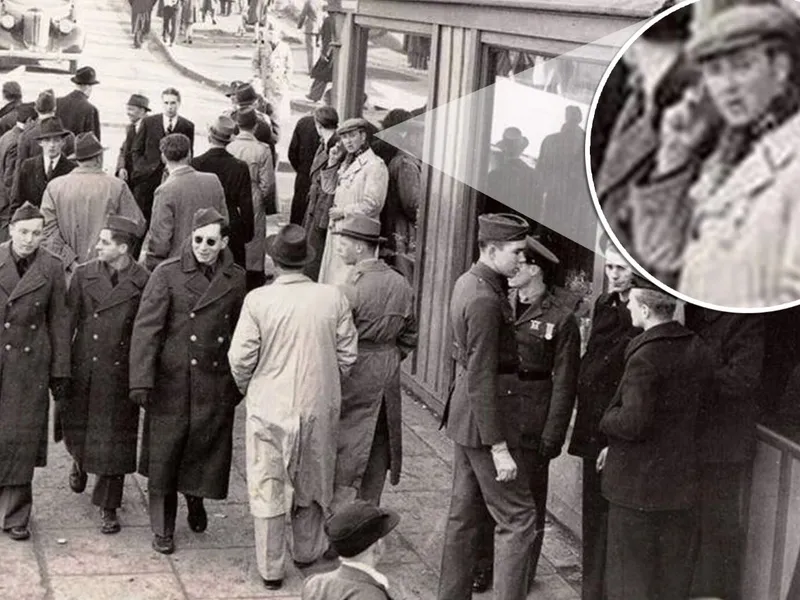

An eight-decade-old image seems to capture a person holding an object to their ear, as if they were talking on a mobile phone. Netizens immediately came up with theories about time travel, but simple explanations are much more plausible. From optical illusions to hearing aids or simple gestures, photography remains a classic example of how a detail can change the way we look at the past.
An old photograph from 1943, taken in the middle of World War II, went viral again on social media after an apparently trivial detail attracted the attention of netizens. In the picture, a person at the window of a building seems to hold an object to his ear, in a position that is strikingly reminiscent of how we use mobile phones today. The problem? The mobile phone had not been invented, and the first transistor would only appear in 1948.
Why does he seem to be talking on a mobile phone?
At a quick glance, the figure in the photo suggests that the person might be holding a phone to their ear. The shape of the hand, a small, dark object, the positioning at the level of the head – they all seem to indicate a telephone conversation. But, as the specialists in the analysis of historical images draw attention, there are several plausible explanations, none of them involving time travel.
The simplest explanation: he is scratching his ear
One of the most circulated comments is that the man in question simply scratches his ear or adjusts something. The gesture is extremely common, and in a low-resolution photo it can easily be confused with holding a phone. „Krabt aan zijn oor waarschijnlijk…” („probably scratching his ear”) is one of the first reactions of Internet users.
Hearing aids and pocket radios
Another theory suggests that the person might use a hearing aid (an acoustic tube or a primitive sound amplification device), which was available since the 19th century. Also, some have speculated that it could be a pocket radio, but this variant is unlikely, because portable radios based on transistors did not appear until after 1948. There were also tube radios, but they were far too large to be held to the ear.
Perspective and image quality – enemies of clarity
The most important explanation lies in perspective and the technical limitations of 1940s photography. A black-white, large-grained photo can create optical illusions. An object in the background, a shadow or a reflection may seem to be part of the main figure. In addition, when the image is scanned, enlarged and distributed online, digital artifacts may appear that amplify the feeling of anomaly.
A commentator even noticed that The image is not an original photograph but a modified reproduction, because „spiegelbeeld klopt niet” (mirror image does not correspond). This could mean that the photo was edited or it comes from a source that has reversed the image, which can create further confusion.
Why do we like mysteries so much?
The 1943 photo is neither the first nor the last to arouse conspiracy theories. The Internet is full of old images where people think they see UFOs, ghosts or impossible technologies. Psychologists explain this phenomenon by pareidolia – the tendency of the human brain to recognize familiar forms in vague stimuli. When we look at a blurry picture, the brain automatically fills in the missing information, and the result can be a compelling illusion.
Conclusion
The 1943 photograph is a fascinating example of how a simple image can become a subject of debate for decades. Although it seems to show a person talking on a mobile phone, rational explanations – a trivial gesture, a hearing aid, perspective and poor image quality – are far more plausible than any science fiction scenario. It is also a reminder that the past is not always what it seems, and a seemingly trivial detail can change the way we look at an entire era.
(Staff: Belgium / History & Technology)




Leave a Reply