
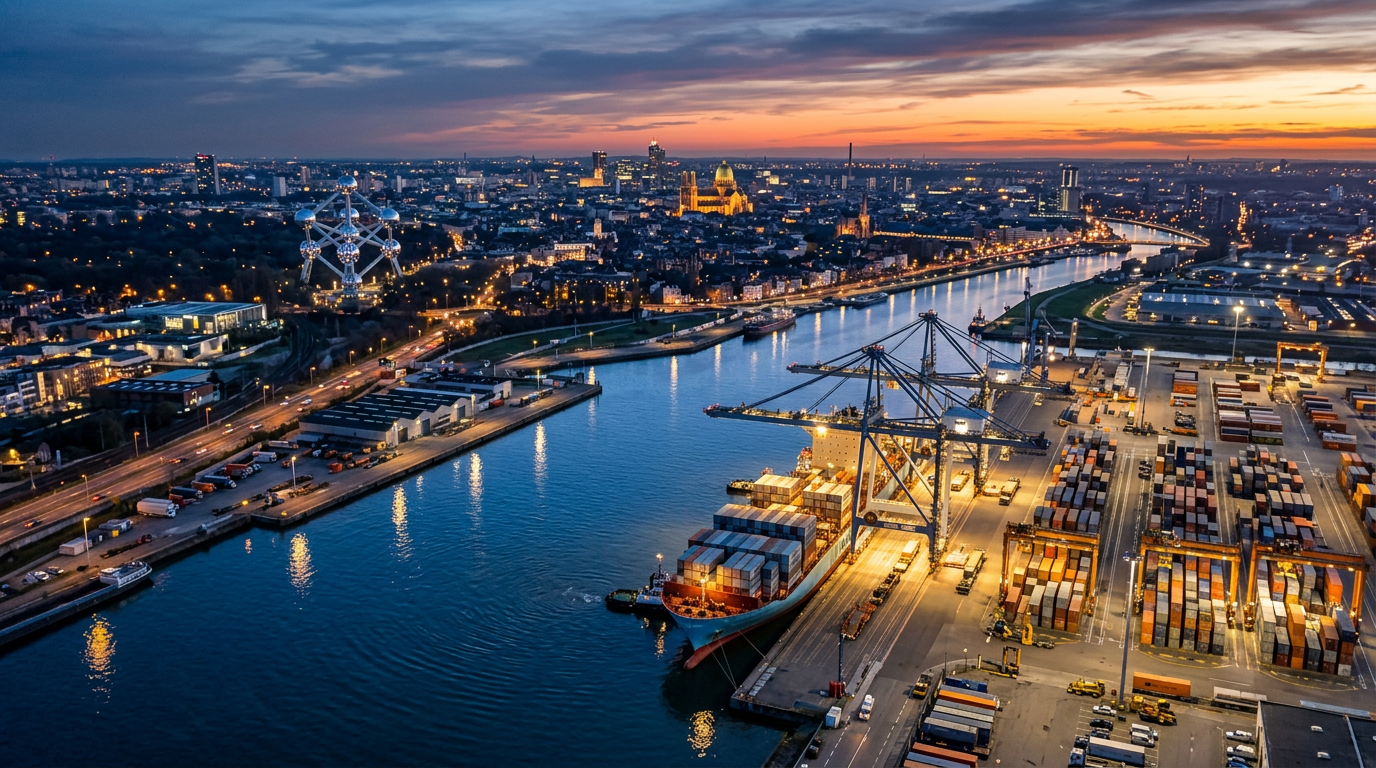

Although located in the heart of the continent, Brussels has a maritime port thanks to a navigable canal built in the 16th century. The Willebroek Canal, inaugurated in 1561, connects the city to the Scheldt (Escaut), which flows into the North Sea. Today, the Port of Brussels hosts 300 companies, provides 13,000 jobs and aims to double container traffic.
Brussels is known as the administrative centre of the European Union and as a cosmopolitan city, but few people know that it also has a functional seaport, approximately 120 kilometres from the North Sea. This particularity is due to a navigable canal built more than four and a half centuries ago, which turned the Belgian capital into an important commercial hub.
Origin: a canal to bypass the tolls in Mechelen
The idea of a canal connecting Brussels to the sea emerged around 1550. At that time, the city relied on the Senne for transporting goods, but its waters were too shallow for larger vessels, and trade was hampered by the taxes imposed by the city of Mechelen (Malines). The inhabitants of Brussels decided to dig a canal to bypass Mechelen and provide a direct waterway to the Rupel, a tributary of the Scheldt.
The project faced strong opposition from Mechelen, which saw its tax revenues threatened. After years of disputes, on 31 May 1550, Regent Mary of Hungary decided in favour of Brussels. Work began, and the Willebroek Canal was inaugurated in 1561, with a length of approximately 20 kilometres.
Route: from Brussels to the North Sea
Thanks to this canal, a vessel leaving the Port of Brussels follows a clear route:
- Brussels–Scheldt Maritime Canal (formerly the Willebroek Canal) – starts at Brussels’ inner port and heads north towards Willebroek.
- Rupel River – at Willebroek, the canal flows into the Rupel.
- Scheldt (Escaut) River – the Rupel in turn flows into the Scheldt, a navigable river that crosses France, Belgium and the Netherlands.
- North Sea – the Scheldt flows into the North Sea, giving Brussels direct access to international maritime routes.
This route is possible thanks to a series of locks and hydraulic works that maintain a constant water level and allow safe navigation. Over time, the canal has been modernised and expanded, and today it allows access to maritime vessels such as coasters and river-sea vessels.
Evolution of the port: from medieval basins to the modern terminal
Brussels’ port did not remain a simple river dock. In the Middle Ages and the early modern period, the inner port was located around the Sainte-Catherine Basin and was a vital centre for the distribution of goods. Today, this area has been transformed, while street names such as Quai au Foin (Hay Quay) and Quai à la Houille (Coal Quay) recall its commercial past.
In the 20th century, the port moved outside the medieval centre. In 1922, a modernised canal was opened, allowing larger vessels to enter. Major works in the 1970s and 1990s created a direct connection with the Scheldt, eliminating dependence on the Rupel and increasing the port’s capacity.
Today’s port: 64 hectares, 300 companies, 13,000 jobs
The Port of Brussels is located in the Avant-port and covers an area of 64 hectares. It hosts approximately 300 companies that provide around 13,000 jobs. Although it is a river port, it is considered a seaport because it can receive maritime vessels through the Brussels–Scheldt Maritime Canal.
A key element of its development is the container terminal, operated by Van Moer Logistics. Its objective is to increase traffic from 500,000 tonnes per year to one million tonnes. The expansion of the terminal and the development of container traffic are part of an ambitious economic and ecological transition plan that also includes decarbonising port activities.
Conclusion
Brussels is not only the capital of Belgium and the European Union, but also a seaport with a fascinating history. Thanks to a canal built more than 450 years ago, the city has maintained access to the sea and become an important commercial hub. Today, its port is an economic engine for the region and an example of adaptation to the new requirements of global trade.
Cristin Tomeci – (Staff: Belgium / History & Infrastructure)



Leave a Reply