
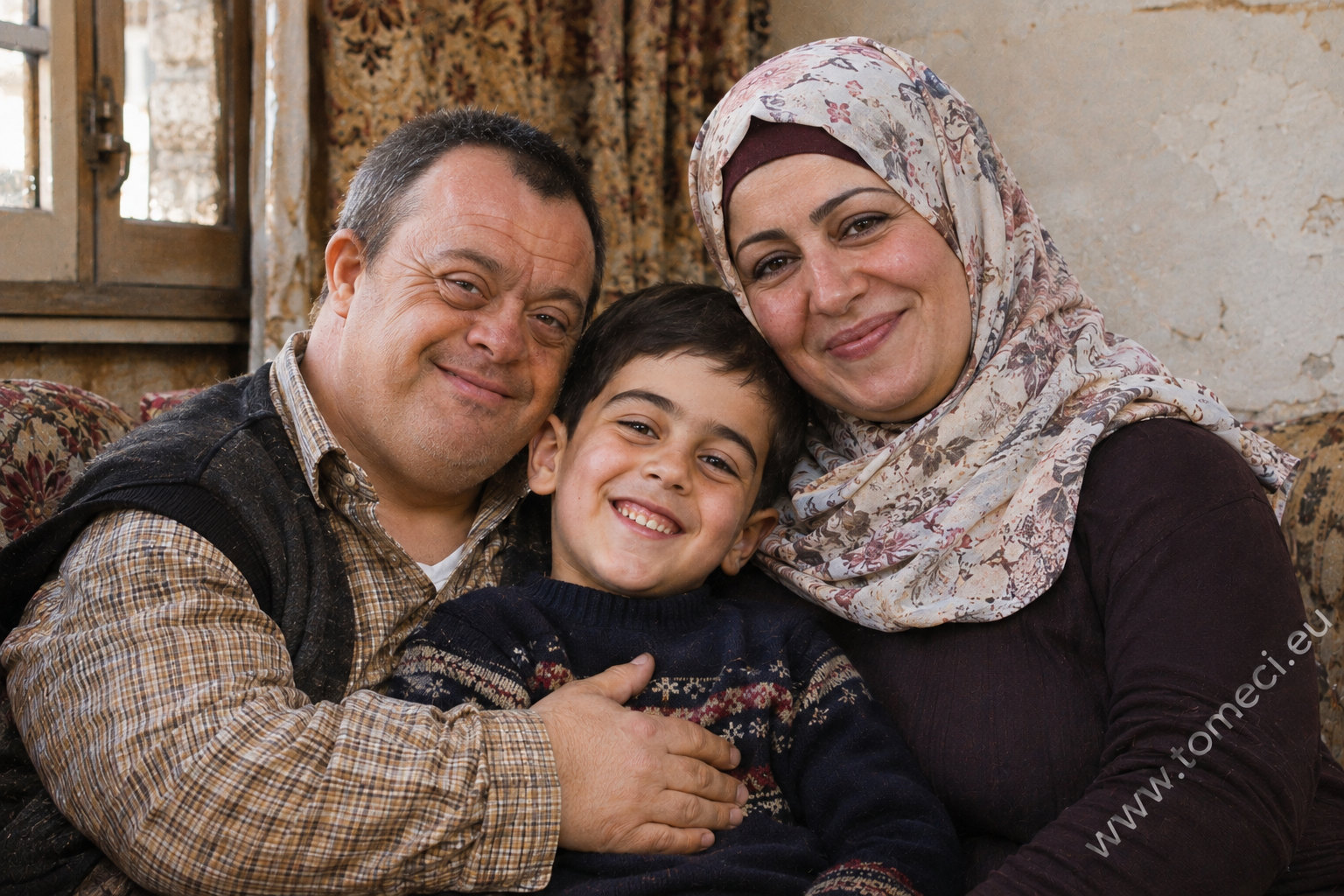

The story of a man from Syria, his wife and their son shows that a medical diagnosis alone cannot define a person’s ability to love, work and build a family.
(Editorial team: The Weekend Magazine)
Can a father with Down syndrome support his child? Can he marry, work and have a family life? The story of Jad Issa, a man from Syria, gave the world a concrete answer to these questions.
In 2019, his family’s story became known internationally after his son, Sader Issa, spoke publicly about growing up with a father who gave him affection, stability and support.
Jad did not become known for sporting achievements or a spectacular career. He attracted attention for something that may seem simple but challenges society’s prejudices: he was a husband, a father and a source of support for his family.
A father who worked for about 25 years
Jad Issa lived with his family in northwestern Syria. He worked for about 25 years in a wheat-processing plant, helping to provide for his family.
His wife, Samira, does not have Down syndrome. Together they had a son, Sader.
In accounts published in 2019, Sader said that his father had done everything he could to give him a childhood as close as possible to that of other children.
Jad was not simply a parent who appeared in family photographs. He worked, contributed financially to raising his child and provided emotional support throughout his son’s school years and education.
Sader spoke proudly of his father and of the way he had encouraged him to study and find his own path.
A son who never hid his pride
The story went viral largely because of Sader’s account.
When he spoke publicly about his family, Sader was studying dentistry. He explained that his father had been an important source of support, both materially and emotionally.
Sader said that one of the moments that moved him most was when Jad proudly introduced him to others, saying that his son would become a doctor.
To Sader, his father was not defined by a medical diagnosis, but by everything he had done for his family.
In his accounts, he described a childhood in which he never felt deprived of love or support. On the contrary, he believed his father’s affection and perseverance had helped shape his character.
This perspective resonated with people in many countries because it offered a direct picture of a family relationship beyond the stereotypes associated with disability.
Can men with Down syndrome become fathers?
Jad Issa’s story also has a particular medical dimension.
Down syndrome is a genetic condition associated, in most cases, with the presence of an extra copy of chromosome 21. This chromosomal difference can affect physical, cognitive and reproductive development, but its effects vary from one person to another.
When it comes to fertility, there is an important difference between women and men.
Women with Down syndrome can become pregnant and have children, although their fertility is generally reduced. Pregnancy requires medical assessment and monitoring, including genetic counselling.
In men, fertility is much less common. Medical literature describes reduced sperm production and other reproductive difficulties.
However, infertility is not an absolute rule.
A medical paper published in 2006 described the case of a 26-year-old man with confirmed trisomy 21 whose biological paternity was demonstrated through DNA analysis. His child did not have Down syndrome.
Another study, published in 2020 in the scientific journal Andrologia, documented a man with Down syndrome who became the father of two boys who did not have the genetic condition. Genetic tests confirmed paternity.
These cases are rare and should not be confused with the usual medical situation. They nevertheless show that the possibility of becoming a father is not ruled out in every case.
What do we know about passing Down syndrome on to children?
Genetic risk is another important aspect.
A person with Down syndrome can pass an extra copy of chromosome 21 on to a child, but the outcome of a pregnancy cannot be determined solely on the basis of the parent’s diagnosis.
Medical literature has documented pregnancies in women with Down syndrome in which children were born both with and without the condition.
For women with trisomy 21, some medical guidance points to a significant risk of transmission, estimated by certain sources at around 50% for each pregnancy. Individual risk must nevertheless be assessed according to the specific genetic situation.
Genetic counselling and medical assessment are therefore important for any couple in which one partner has a chromosomal abnormality.
Beyond the medical diagnosis: the right to love and family life
Perhaps the most important lesson from the Issa family’s story is not about genetics, but about how society views people with disabilities.
People are too often judged solely by their diagnosis. Down syndrome can involve learning difficulties, health problems and differing support needs, but it does not erase personality, feelings, the desire for closeness or the ability to build relationships.
People with Down syndrome can have friends and romantic relationships, take part in professional activities and lead active social lives. Some can live independently, while others need ongoing or occasional support.
Every person has their own abilities and needs. There is no single model of life that can be applied to everyone.
At the same time, the right to relationships and privacy must be accompanied by appropriate sexual education, protection from abuse and access to healthcare services.
True respect does not mean idealising people with disabilities or reducing them to the limitations of a diagnosis. It means recognising their dignity, individuality and right to participate in community life.
A story worth knowing
Jad Issa and his son, Sader, became known for showing the public a family relationship that challenged numerous prejudices.
A man with Down syndrome worked, married and raised his child. His son spoke of him with respect and gratitude, showing that a parent’s role cannot be measured by a diagnosis alone.
Their story does not prove that all people with Down syndrome can have the same experience. It does show, however, that we should not decide in advance what a person can or cannot achieve.
Sometimes the most powerful lessons about family do not come from theories or statistics, but from the lives of people who had the courage to live their story despite prejudice.
The Weekend Magazine – A Tomeci Press Publication





Leave a Reply