
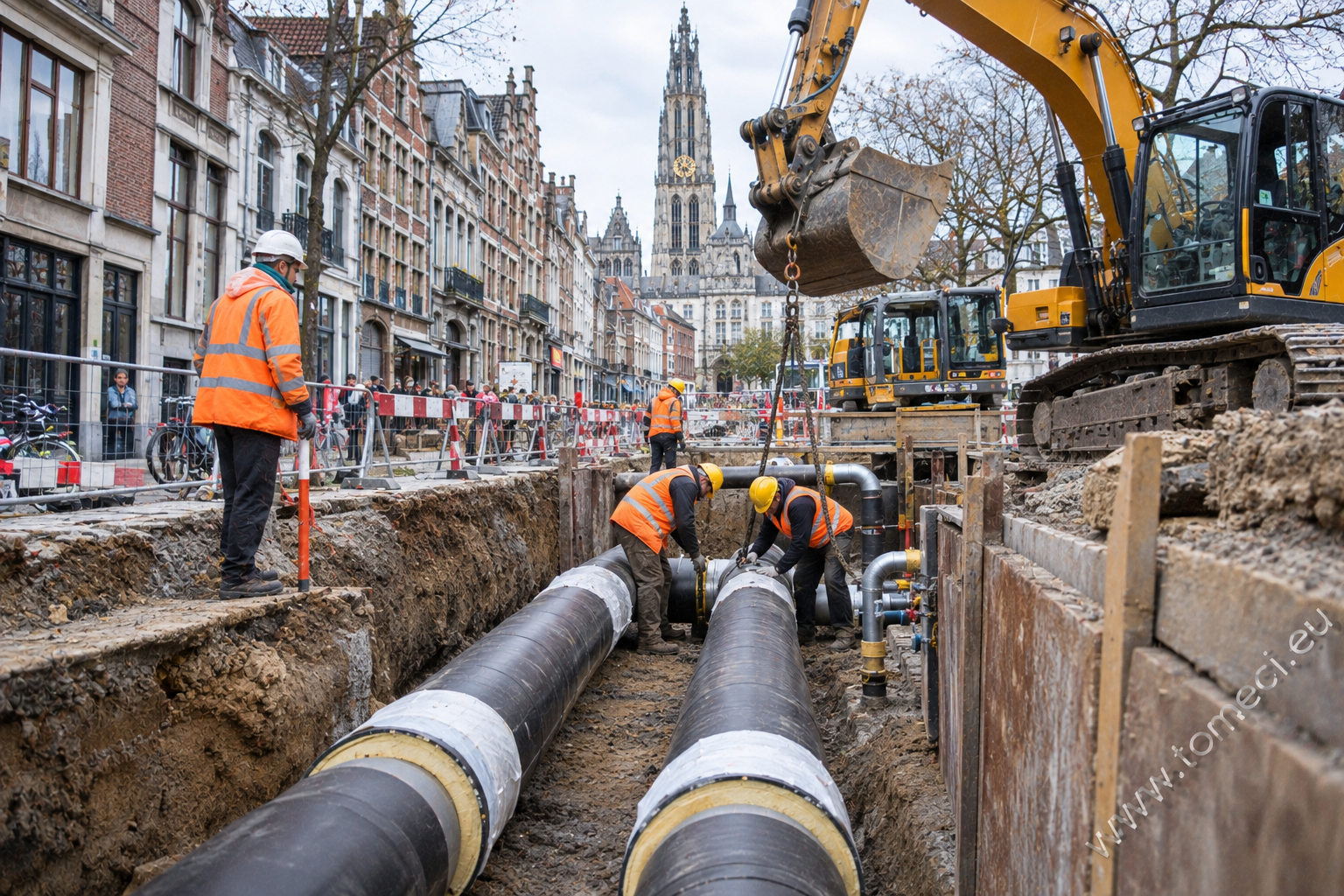
A project presented as a solution for the energy transition is facing financial and technical difficulties. The city is looking for new partners, while public authorities and the network operator shift responsibility between them.

(Editorial team: The Weekend Magazine)
Plans to expand Antwerp’s district-heating networks have entered a period of uncertainty after the Flemish operator Fluvius decided to take on no new commitments for the development of high-temperature heat networks. The financial impact is significant: the investment budget for these projects is expected to fall from €32.9 million in 2026 to just €3.3 million in 2027.
The reduction of around 90% puts the timetable for several planned projects in the city in doubt. Antwerp’s city administration says, however, that it does not intend to abandon its goals and is looking for other partners to take over some of the work.
When waste heat becomes a cost issue
District-heating networks deliver heat through underground pipes from a central source to homes, public institutions and businesses. The energy can come from waste heat generated by industrial facilities, power plants or other local sources.
The idea is attractive: instead of allowing heat produced by industrial activity to go to waste, it can be used to heat buildings. Under certain conditions, the system can reduce fossil-fuel consumption and carbon-dioxide emissions.
But the necessary infrastructure is expensive. Pipes sometimes have to be installed over considerable distances, heat sources must be sufficiently close and reliable, and the number of connected consumers must justify the investment.
Fluvius points to the economic and technical difficulties of high-temperature networks, rising costs, the length of construction works and public financial support that it considers insufficient compared with what is available in some neighbouring countries.
Which Antwerp projects are affected?
According to information provided by the city administration and reported by Flemish media, projects already under way in the north, near Rozemaai, and in the eastern part of the city — including the areas around Slachthuissite, Stuivenberg, Wilgenstraat and the Veldstraat swimming pool — are expected to continue according to the current schedule.
The situation is less certain for projects that have not yet begun, particularly those in the city centre and on Linkeroever. For these schemes, Antwerp is looking for new operators or partners to take on the role that Fluvius no longer wishes to perform.
The city also wants to preserve the planned connection between Hof ter Beken and Nieuw Zuid and has said it is prepared to finance the unprofitable part of the project.
Local authorities have asked Fluvius to provide a written response by 30 November to clarify the future of the projects and whether responsibilities can be transferred to other partners.
Why can’t the infrastructure be financed through everyone’s energy bills?
One of the central issues is the way Fluvius’s activities are regulated.
Electricity and natural-gas distribution is a regulated activity in which the operator manages network infrastructure under conditions of a natural monopoly. District-heating networks, however, are a separate activity.
The costs of a separate commercial activity cannot simply be passed on to all electricity and gas consumers through regulated tariffs. Doing so would amount to cross-subsidising projects through the bills of customers who do not benefit from them.
District-heating networks must therefore have their own financial rationale, attract appropriate funding and be able to cover installation, operation and maintenance costs.
This does not mean that all district-heating networks are unprofitable. Their viability depends on the distance from the heat source, the density of consumers, the amount of energy available and the cost of the infrastructure.
Energy minister challenges Fluvius’s explanation
The dispute is not limited to the city administration and the network operator.
Flemish Minister for Energy and Housing Melissa Depraetere (Vooruit) rejected the explanation that a lack of public financial support was the main reason for the projects’ difficulties. In comments reported by VRT NWS, she placed responsibility on Fluvius and its shareholders.
The minister argued that the operator had not applied for certain subsidies available through Flemish programmes supporting green heat. According to a source familiar with the case, quoted by VRT, Fluvius had missed two opportunities to apply for funding over the past two years. A budget of €19 million was reportedly available through the programme for 2026.
Industry representatives also challenge the idea that district-heating networks cannot be profitable in Flanders. Tom Prinzie, vice-chair of Warmtenetwerk Vlaanderen, told VRT that high population density can support such projects, provided there are enough consumers in relation to the investment. He also pointed to networks considered profitable in places such as Oostende and Kortrijk.
The debate is therefore not just about costs. It also concerns how projects are prepared, how subsidies are used and where responsibility lies between operators and public authorities.
An important issue for climate targets
For Antwerp, the issue goes beyond a financial dispute. District-heating networks play an important role in the city’s climate plan for 2030. Documents and statements cited in the local debate point to an estimated reduction of 71 kilotonnes of CO₂ associated with the development of these networks.
The Groen party warns that delays could jeopardise some climate targets and affect coordination with other infrastructure projects. If district-heating pipes are not installed at the same time as streets and other networks are upgraded, some areas may need additional works in the future, at a higher cost.
The city administration maintains, however, that its ambitions remain unchanged and that the projects can continue with the help of other partners.
An energy transition that must also be financially sustainable
The Antwerp case illustrates one of the major challenges of the energy transition: a solution may be attractive environmentally without automatically being economically viable.
Recovering waste heat and distributing it to homes can bring real benefits, especially where industrial sources are nearby and enough consumers can be connected. Larger projects involving substantial investment and long payback periods, however, require careful planning and a robust financial model.
Over the coming weeks, Fluvius’s response and negotiations with potential partners will be decisive for the future of Antwerp’s district-heating networks. It remains to be seen whether the city can turn its climate ambitions into viable projects or whether the investment cuts will lead to delays and a revision of the plans.

THE WEEKEND MAGAZINE – A Tomeci Press Publication




Leave a Reply