
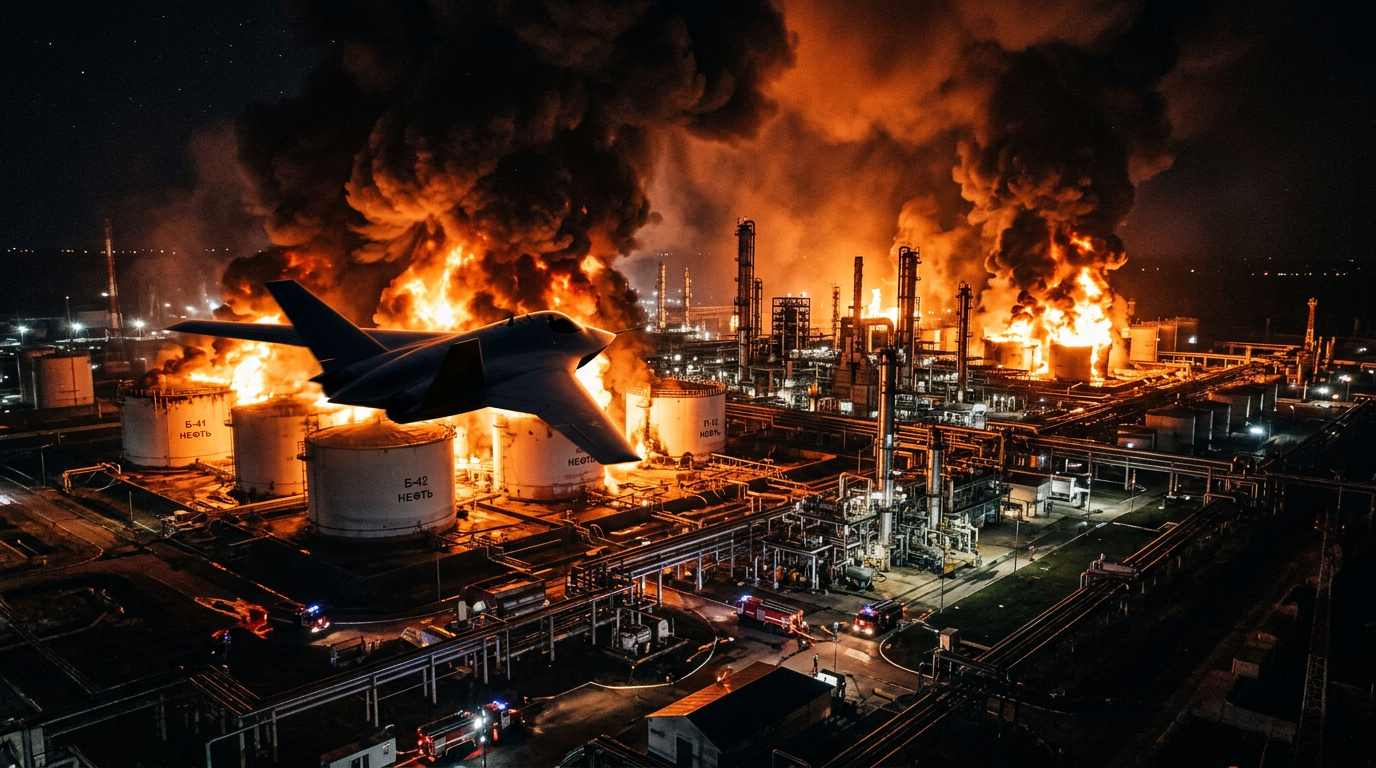

For the first time since the beginning of the invasion, the effects of Ukrainian attacks on Russian energy infrastructure have crossed the borders of the Russian Federation. Kazakhstan’s Ministry of Energy in Astana has officially confirmed the suspension of transport through the Atyrau–Samara pipeline. This decision turns what was yesterday merely an OSINT assessment into a logistical crisis with international repercussions.
Editorial team: Ukraine, Russia & Kazakhstan / Geopolitics & Energy
There are moments when hybrid warfare shows its true face: panic no longer remains confined to military analysts’ offices but reaches the screens of commodity markets. Today’s strike on the huge Samara oil hub was not simply another explosion deep inside Russian territory. It triggered the first officially confirmed domino effect: Kazakhstan halted the transport of oil through the pipeline that feeds into Russia’s Transneft system.
From OSINT to operational reality
Until now, discussions about attacks on refineries and oil hubs in Russia had largely been based on satellite images, visible fires and OSINT (Open Source Intelligence) assessments of damaged storage tanks. But after Ukrainian drones struck the Samara hub, the reaction was swift.
The information was confirmed by Kazakhstan’s Ministry of Energy. According to the authorities in Astana, pumping was halted at 06:09 local time. Specialists are now inspecting the infrastructure before deciding whether to resume the flow. This is no ordinary local pipeline but a critical artery: via Atyrau–Samara, Kazakh oil enters the Russian system and is directed towards global export markets. Approximately 7.57 million tonnes of oil passed through it in the first nine months of the year — more than 200,000 barrels a day.
The strategy of cumulative impact
This suspension fundamentally changes how Ukraine’s campaign of strikes against Russian energy infrastructure should be assessed. What initially appeared to be a tactic aimed at spectacular fires now looks much clearer. Ukraine is not targeting only the destruction of individual storage tanks, but the repeated degradation of a vital hub.
The fact that Samara has been hit five times in a single month points to a calculated strategy of attrition. Each attack forces a temporary halt in the flow, emergency repairs to facilities and logistical rerouting, while generating enormous economic losses. However quickly Russia tries to repair the storage tanks, the impact on the entire supply chain is becoming increasingly difficult to manage.
Shock waves across Central Asia
The most interesting aspect of this event is that it undermines Kazakhstan’s geopolitical comfort. For years, Astana has tried to maintain balanced relations with both Moscow and the West. But when its own oil exports — on which the national economy depends — become collateral victims of a war being waged by Russia, the calculations change.
Kazakhstan is now being forced to seek solutions. Will it simply wait for the Russians to repair Samara, or will it accelerate the development of alternative export routes, such as the Trans-Caspian corridor, which bypasses Russian territory altogether? This interruption could be the spark that leads Astana to diversify its logistics partners once and for all.
Conclusion
The attack on the Samara hub is a lesson in military and economic strategy. It shows that in the 21st century, a drone costing just a few thousand dollars and launched hundreds of kilometres away can halt billions’ worth of trade flows, affecting economies that are not even directly involved in the conflict. Ukraine is managing to export economic warfare beyond Russia and, through this ripple effect, across the entire region. It remains to be seen how quickly the Russians can repair the infrastructure, but one thing is certain: the days when Russian pipelines were a safe haven for Central Asian oil may be over for good.




Leave a Reply