
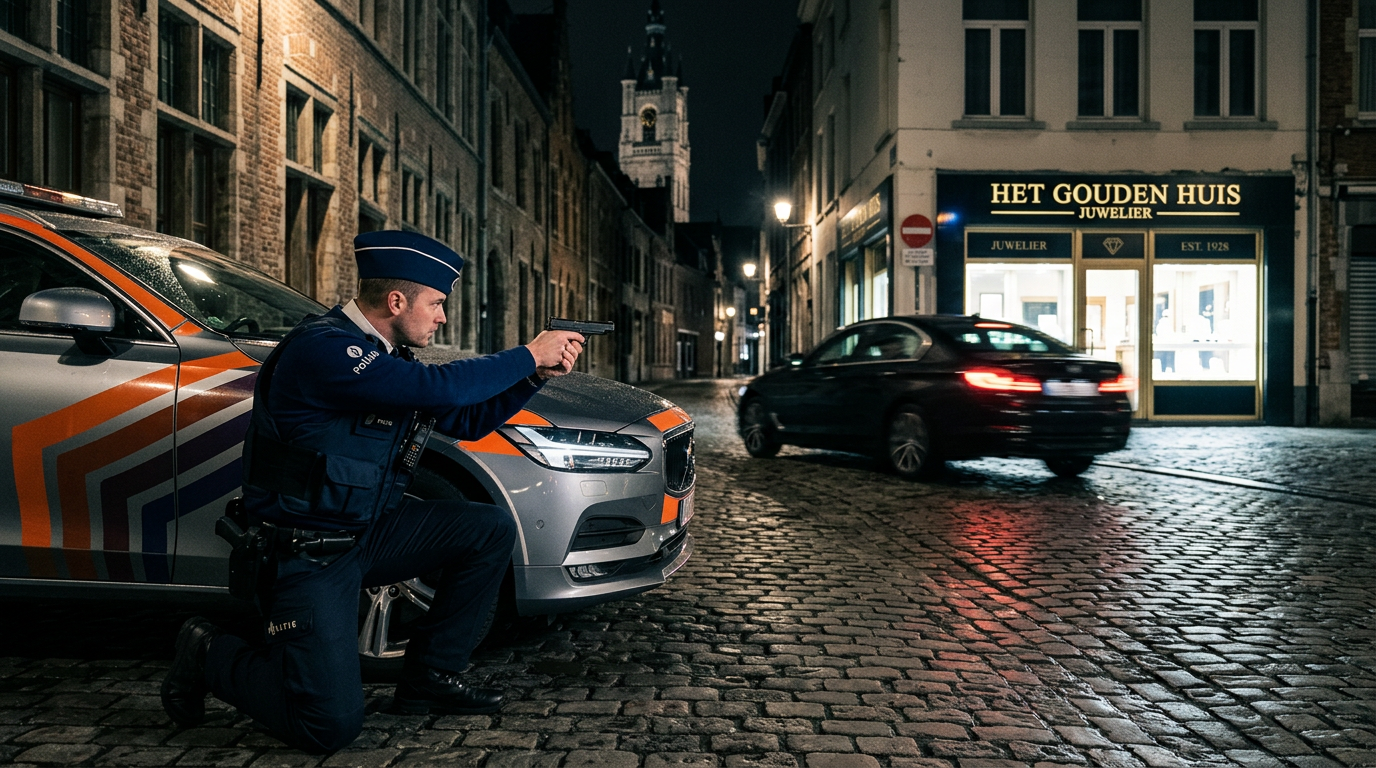

Four men broke into a jewellery shop and stole items reportedly worth close to €1 million. Police arrived and confronted the suspects, but they managed to escape. This was not necessarily a failure to act: Ghent police chief Philippe Rasschaert explained that Belgian law does not allow officers to fire simply to prevent a suspect from fleeing. The use of firearms is subject to strict legal conditions, including an immediate and serious threat to human life.
(Staff: Belgium / Justice & Society)
Action films often portray a familiar scene: police corner suspects, order them to stop and open fire when they try to escape. The reality in many European countries is very different. A recent incident in Ghent has brought the strict limits governing police use of firearms into focus. Even when a serious property crime has taken place, the law protects human life and restricts the circumstances in which officers may use potentially lethal force.
A robbery with losses estimated at €1 million
The incident took place at a jewellery shop in the Belgian city of Ghent. Four individuals reportedly stole goods whose value may approach €1 million. Police officers arrived at the scene and encountered the suspects as they were attempting to leave.
Images from the confrontation show officers kneeling and pointing their firearms towards the suspects’ vehicle. Despite the tense situation, the vehicle drove away and no shots were fired.
The law: Why did the officers not shoot?
For some members of the public, the decision may look like weakness or a serious mistake. Ghent police chief Philippe Rasschaert explained, however, that officers acted within the legal framework. Not firing was not a matter of cowardice; it reflected the limits imposed by law.
Police officers may not use firearms simply to stop suspects or prevent them from escaping. Specific legal conditions must be met, such as an immediate and serious threat to human life, Rasschaert explained.
Under the Belgian legal framework, police force must be necessary and proportionate to the danger. A suspect fleeing with stolen jewellery does not, solely by doing so, automatically pose a lethal threat to officers or bystanders. Firing at someone merely to prevent an escape would therefore not be justified under the circumstances described.
The dilemma of proportionality
The incident highlights a dilemma faced by democratic societies: how can the rights of victims to safety and property be balanced with the right to life of people suspected of crimes?
The jewellery shop’s owners may face a substantial loss, while the police operation did not result in the suspects’ immediate arrest. Some may argue that officers could have aimed at the vehicle’s tyres. But firing at a moving vehicle can create serious risks, including ricochets, injuries to bystanders and fatal road accidents.
Belgian law places strict limits on the use of firearms to reduce the risk of such tragedies. A shot fired towards a moving car in a busy urban area can have unpredictable consequences. The police must assess the danger to everyone present, including officers, suspects and members of the public.
Conclusion
The Ghent robbery is more than a story about a major theft. It raises an important question about the rule of law. The legal limits on police force do not change according to public anger or the value of the stolen property. In Belgium, a suspect’s life cannot be taken simply because that person is trying to escape arrest. The investigation will have to establish whether those responsible can be identified and brought before the courts. The objective must be to secure arrests and accountability within the law, not to risk further lives.




Leave a Reply