
Editorial by Cristin Tomeci | The Weekend Magazine

A reflection from Douglas Kruger’s message: “How to destroy an entity civilization… without firing a single shot”. Sometimes the biggest threats to a society come not from the outside, but from the gradual weakening of values, education, responsibility and trust between people.
Contents
- A message that deserves serious reflection
- A civilization is not just about buildings and technology
- Education: First line of defense
- When the truth becomes negotiable
- Institutions without trust, societies without direction
- Technology can help us, but it cannot replace our consciousness
- Conclusion: A civilization defends itself by what it transmits to next generations
1. A message that deserves serious reflection
I met on Facebook a message attributed to Douglas Kruger, known for his work as an author, speaker and trainer in the field of leadership. The title itself is challenging: “How to destroy an entire civilization… without firing a gun”.
There is no need to hear explosions, see bombed cities or witness military confrontations to ask if a society is heading in a dangerous direction.
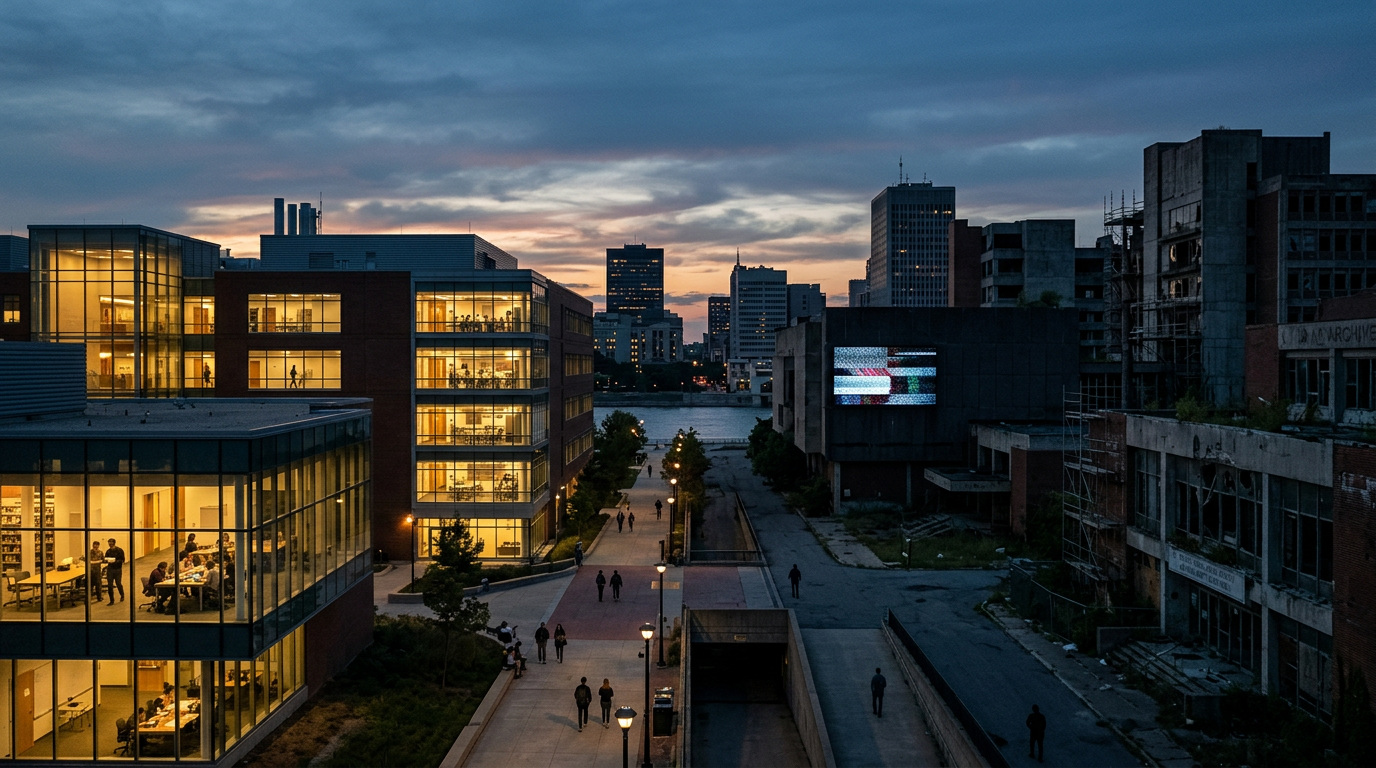
Some forms of destruction are not immediately visible. They leave no ruins in the streets or spectacular images on television. They unfold slowly, through repeated decisions, by giving up principles, by tolerating incompetence, by abandoning education and by losing trust in institutions.
I do not claim that a single video can explain all the mechanisms by which a civilization can degrade. But the question in the title deserves a serious reflection: What happens to a society when it begins to destroy its own values that keep it together?
2. A civilization is not just about buildings and technology
When we talk about civilization, we often think of modern cities, highways, universities, hospitals, computer networks and scientific discoveries.
All these are important. But they represent only the visible part of a much more complex construction.
A civilization also means respecting the law, the transmission of knowledge, the protection of human dignity, the responsibility towards the community and the ability of people to live together even when they have different opinions.
We can build impressive buildings and buy the best performing equipment, but what value do they have if the institutions do not work, if people no longer trust each other and if the truth is sacrificed for momentary interests?
Material progress does not automatically guarantee moral progress.
Moreover, a society can maintain the appearance of prosperity while gradually losing those things that ensure its long-term stability: competence, solidarity, culture of dialogue and respect for public responsibilities.
That’s why the real question is not only how advanced we are, but also What kind of people do we become as we advance?
3. Education: First line of defense
No civilization can survive indefinitely if it does not educate its new generations.
Education is not only about memorizing some information, obtaining a diploma or accumulating qualifications. It means the ability to think critically, to verify a statement, to recognize a mistake and to accept that sometimes we have to change our opinions in the face of evidence.
When the school becomes just a formality, when genuine achievement is replaced by appearances and when the diplomas come to be worth more than the real skills, the whole society pays the price.
It is paid by the patient who needs a well-trained doctor, the citizen who depends on a competent administration, the child who needs a dedicated teacher and the employee who must trust the decisions of his management.
It is not about despising a generation or idealizing the past. Each era has remarkable people and people who do not fulfill their responsibilities.
It is about the standards we set and how we select, prepare and evaluate those to whom we entrust responsibilities.
A society that no longer rewards competence risks losing it.
4. When the truth becomes negotiable
Another threat is the degradation of public space through manipulation, disinformation and the inability to distinguish between facts and opinions.
Today, information is circulating almost instantly. A message can reach millions of people before someone checks its authenticity. A statement repeated often enough may seem true, even if it is not supported by evidence.
But the problem isn’t just technology. The desire to believe the information that confirms our own beliefs has always existed.
The difference is that current tools can amplify the phenomenon on a scale hard to imagine a few decades ago.
When people stop checking sources, when any criticism is interpreted as enmity, and when a convenient lie is accepted more easily than an uncomfortable truth, public dialogue becomes more and more difficult.
In such an atmosphere, society is fragmented. People come to live in different informational worlds, fear each other and reject any explanation that does not correspond to their own beliefs.
A mature civilization is not one where everyone thinks the same. It is one where people can have different opinions without giving up facts, arguments and mutual respect.
5. Institutions without trust, societies without direction
Institutions are not perfect and should not be safe from criticism. On the contrary, they must be able to be controlled, evaluated and reformed.
But when responsibility is replaced by improvisation, personal connections replace competence and opacity replaces transparency, public trust is eroded.
People begin to believe that the rules are not the same for everyone, that the effort is not rewarded and that the results depend more on relationships than on merit.
This perception, when fueled by concrete experiences and lack of effective liability mechanisms, can have serious consequences. Citizens withdraw from the life of the community, professionals look for opportunities in other places, and those who remain are becoming more and more skeptical of the possibility of change.
No country can build its future only through investment and official statements. It needs functioning institutions, predictable rules and people who assume the consequences of their decisions.
Criticism does not destroy a society. A reasoned criticism can contribute to its improvement. The danger arises when problems are denied, when mistakes are not corrected, and when responsibility disappears behind endless explanations.
6. Technology can help us, but it cannot replace our consciousness
We live in an age where artificial intelligence, automation and digital tools change the way we work, communicate and produce knowledge.
These technologies can make services more accessible, support research, simplify administrative activities and provide people with opportunities that until recently seemed impossible.
But technology does not guarantee a better society by itself.
A digital system can be efficient or poorly designed. Artificial intelligence can help identify problems, but it can also produce errors. A platform can facilitate access to information, but it can also be used for manipulation.
The difference is made by the people, the rules and the responsibility with which these tools are used.
We must not fear progress, but neither should we confuse technical progress with wisdom.
We need people capable of understanding technology, knowing its boundaries and using it for the benefit of the community. We need digital education, privacy protection and institutions that are responsible for decisions made with the help of automated systems.
A civilization is not modern just because it uses artificial intelligence. It is modern when it uses knowledge to improve people’s lives, without giving up dignity, freedom and responsibility.
Conclusion: A civilization defends itself by what it transmits to next generations
The message attributed to Douglas Kruger invites us to look beyond the images of war and wonder what makes a society vulnerable from within.
The answer cannot be reduced to a single cause. The degradation of a civilization is a complex process, influenced by economic, political, cultural and social factors. Not every administrative mistake means decline, and not every change of values is a threat.
But there are some things we should not consider negotiable: education, freedom to think, respect for truth, public responsibility, and human dignity.
As a journalist and as a man who has experienced different systems and cultures, I think we must retain the ability to ask questions, criticize and ask for explanations. At the same time, we must avoid collective condemnations and judge people and institutions based on facts, not prejudices.
We can’t build a better world just by accusing others. We also have to ask ourselves what we do every day to keep what is worth passing on.
Do we teach children to think or just repeat? Do we demand responsibility from those who lead us and practice it ourselves? Do we check the information before we distribute it? Do we agree to be contradicted when the evidence shows we were wrong?
These questions have no simple answers, but they can help us understand the direction in which we are going.
A civilization does not defend itself only through weapons, borders or alliances. It defends itself through education, through the truth, through responsible institutions and through people who refuse to give up critical thinking.
And if we want to leave a better world to the next generations, we must start by protecting those values without which even the most advanced technology cannot save us from our own mistakes.
— Cristin Tomeci
The Weekend Magazine | A Tomeci Press Publication


Leave a Reply